
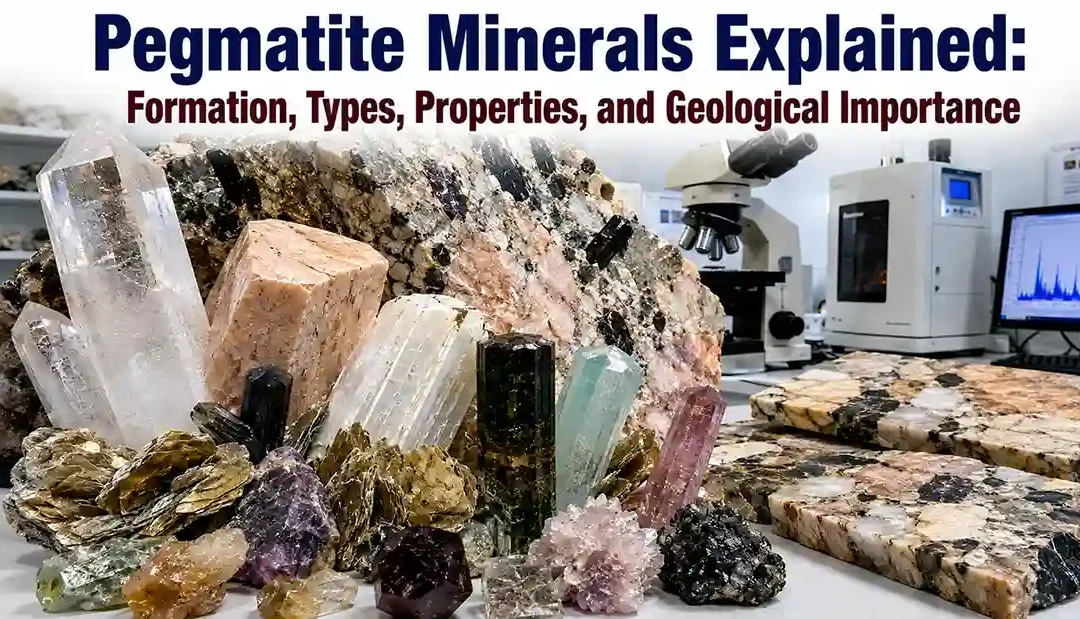
Pegmatite minerals are the exceptionally coarse-grained minerals that crystallize from the final, volatile-rich stages of magma solidification. Pegmatites are famous for producing some of the largest mineral crystals on Earth, spectacular gemstones, and many of the world's most important deposits of lithium, beryllium, tantalum, niobium, cesium, rubidium, and rare earth elements.
Unlike ordinary granites, pegmatites cool from water-rich residual magma enriched in incompatible elements that remain after most common rock-forming minerals have crystallized. This unique chemistry allows enormous crystals to grow and rare minerals to form.
Pegmatite minerals are essential in mineralogy, economic geology, petrology, gemstone exploration, battery technology, and critical mineral research.
This topic should be studied together with Fractional Crystallization, Magma Differentiation, and Igneous Rocks Explained.
What Are Pegmatite Minerals?
Pegmatite minerals are minerals that crystallize within pegmatites—extremely coarse-grained intrusive igneous rocks.
They are characterized by:
- Exceptionally large crystals
- Slow crystallization from volatile-rich magma
- High concentrations of rare elements
- Abundant gemstones
- Association with granitic magmas
Individual crystals may exceed several meters in length.
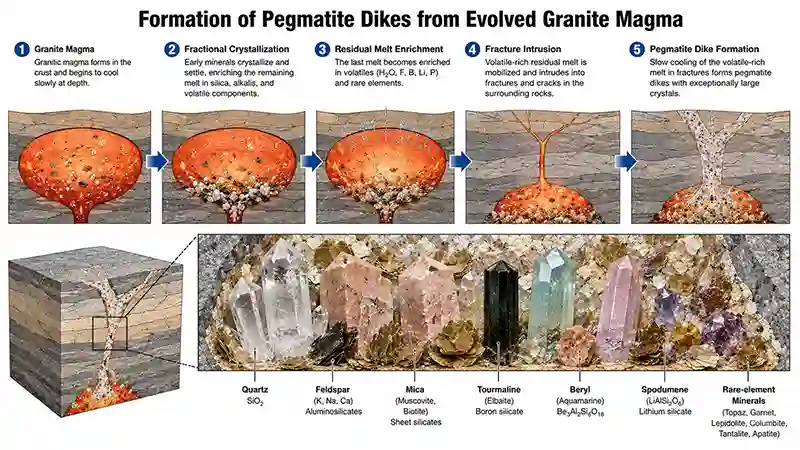
How Pegmatite Minerals Form
Pegmatites form during the final stages of magma crystallization.
The general process includes:
- Granite magma begins cooling.
- Common minerals crystallize first.
- Water, fluorine, boron, and rare elements become concentrated.
- Residual magma becomes highly mobile.
- Large crystals grow rapidly.
- Pegmatite dikes and veins intrude surrounding rocks.
Most pegmatites represent the final products of magma differentiation.
Conditions Required for Pegmatite Formation
Several geological conditions promote pegmatite development.
Water-Rich Magma
Water lowers magma viscosity and allows ions to move rapidly, promoting large crystal growth.
High Concentration of Volatiles
Important volatile components include:
- Water (H₂O)
- Fluorine
- Boron
- Phosphorus
- Carbon dioxide
Enrichment in Rare Elements
Late-stage magma commonly becomes enriched in:
- Lithium
- Beryllium
- Cesium
- Rubidium
- Tantalum
- Niobium
Slow Cooling
Although pegmatites may crystallize relatively quickly compared to granite, volatile-rich conditions allow exceptionally large crystals to develop.
Major Pegmatite Minerals
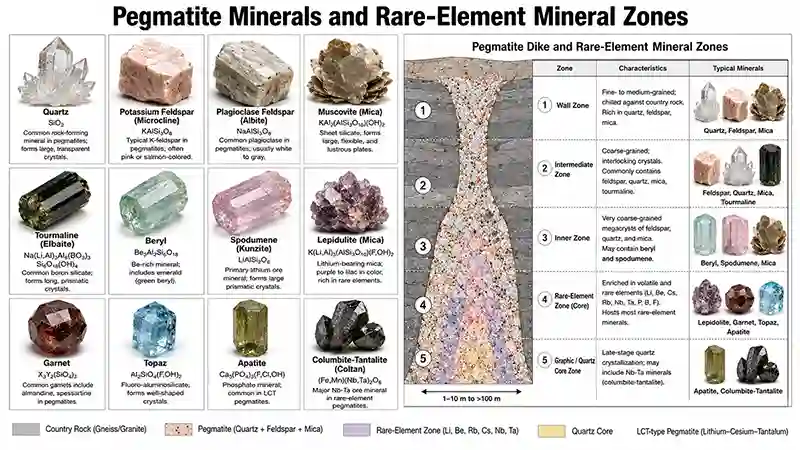
Quartz
Quartz is one of the most abundant pegmatite minerals.
Characteristics:
- Massive or giant crystals
- High purity
- Hardness 7
Uses:
- Glass
- Electronics
- Gemstones
Potassium Feldspar
Common varieties include:
- Microcline
- Orthoclase
Characteristics:
- Pink to white
- Very large crystals
- Common in granitic pegmatites
Plagioclase Feldspar
Occurs alongside potassium feldspar.
Usually forms:
- Albite
- Oligoclase
Muscovite
Large muscovite sheets were historically mined for electrical insulation.
Characteristics:
- Perfect basal cleavage
- Silvery appearance
Biotite
Common dark mica found in many pegmatites.
Tourmaline
One of the most spectacular pegmatite minerals.
Characteristics:
- Wide range of colors
- Prismatic crystals
- Valuable gemstone
Beryl
Chemical Formula: Be₃Al₂Si₆O₁₈
Gem varieties include:
- Emerald
- Aquamarine
- Morganite
- Heliodor
Beryl is the principal ore of beryllium.
Spodumene
Chemical Formula: LiAlSi₂O₆
Characteristics:
- Major lithium ore
- Large prismatic crystals
Gem varieties include:
- Kunzite
- Hiddenite
Lepidolite
Lithium-rich mica.
Characteristics:
- Purple to pink
- Important lithium source
Garnet
Pegmatites commonly contain:
- Almandine
- Spessartine
Used as:
- Gemstones
- Abrasives
Apatite
Occurs as accessory crystals rich in phosphorus.
Topaz
Fluorine-rich pegmatites often contain topaz. It is an important gemstone and collector mineral.
Columbite-Tantalite
Often called coltan.
Economic importance:
- Tantalum
- Niobium
Essential for electronic devices.
Accessory Pegmatite Minerals
Rare pegmatites may also contain:
- Zircon
- Monazite
- Pollucite
- Cassiterite
- Microlite
- Allanite
- Fluorite
These minerals are valuable sources of rare and critical elements.
Types of Pegmatites
Pegmatites are commonly classified by their dominant mineral assemblages.
| Pegmatite Type | Characteristic Minerals |
|---|---|
| Simple Pegmatite | Quartz, Feldspar, Mica |
| Rare-Element Pegmatite | Spodumene, Lepidolite, Beryl |
| Gem Pegmatite | Tourmaline, Aquamarine, Topaz |
| NYF Pegmatite | Niobium, Yttrium, Fluorine Minerals |
| LCT Pegmatite | Lithium, Cesium, Tantalum Minerals |
LCT pegmatites are among the world's most important sources of battery metals.
Pegmatites and Fractional Crystallization
Pegmatites represent the final stage of magma evolution.
During fractional crystallization:
- Early minerals remove common elements.
- Rare elements remain in the melt.
- Water content increases.
- Giant crystals develop.
- Rare minerals crystallize.
This makes pegmatites chemically unique.
Economic Importance
Pegmatites are major sources of:
- Lithium
- Tantalum
- Niobium
- Cesium
- Rubidium
- Beryllium
- Feldspar
- Quartz
- Mica
- Gemstones
They are increasingly important for renewable energy technologies and rechargeable batteries.
Laboratory Identification
Pegmatite minerals are studied using:
- Petrographic Microscopy
- X-Ray Diffraction (XRD)
- Electron Microprobe Analysis (EPMA)
- Scanning Electron Microscopy (SEM)
- X-Ray Fluorescence (XRF)
- Raman Spectroscopy
- Whole-rock geochemistry
These techniques identify mineral composition, zoning, and rare-element concentrations.
Geological Importance
Pegmatite minerals help geologists:
- Understand magma differentiation
- Study late-stage crystallization
- Explore critical mineral deposits
- Reconstruct granitic magma evolution
- Investigate volatile-rich magmatic systems
- Discover gemstone deposits
Pegmatites preserve the final chemical evolution of granitic magmas.
Applications
Pegmatite mineral studies are important in:
- Mineralogy
- Economic Geology
- Igneous Petrology
- Gemology
- Geochemistry
- Mining Geology
- Battery Mineral Exploration
- Critical Mineral Research
Advantages of Studying Pegmatite Minerals
Studying pegmatite minerals helps scientists:
- Discover critical mineral resources
- Understand rare-element enrichment
- Explore gemstone deposits
- Reconstruct magma evolution
- Improve mineral exploration models
- Support renewable energy industries
Limitations
Studying pegmatites may be challenging because:
- Mineral zoning can be extremely complex.
- Rare minerals often occur in small quantities.
- Chemical compositions vary greatly between pegmatites.
- Advanced analytical techniques are frequently required for accurate mineral identification.
For comprehensive interpretation, combine pegmatite studies with:
- Fractional Crystallization
- Magma Differentiation
- Partial Melting
- Mineral Formation
- Igneous Rocks Explained
- Petrographic Microscopy
- Mineral Chemistry Analysis
- X-Ray Diffraction in Mineralogy
Comparison Table
| Mineral | Chemical Formula | Main Economic Importance |
| Quartz | SiO₂ | Glass, Electronics |
| Potassium Feldspar | KAlSi₃O₈ | Ceramics |
| Muscovite | KAl₂(AlSi₃O₁₀)(OH)₂ | Insulation |
| Tourmaline | Complex Borosilicate | Gemstone |
| Beryl | Be₃Al₂Si₆O₁₈ | Beryllium, Gemstones |
| Spodumene | LiAlSi₂O₆ | Lithium |
| Lepidolite | Lithium Mica | Lithium |
| Columbite-Tantalite | (Fe,Mn)(Nb,Ta)₂O₆ | Niobium & Tantalum |
Summary Table
| Feature | Pegmatite Minerals |
| Main Formation Process | Late-Stage Magma Crystallization |
| Dominant Minerals | Quartz, Feldspar, Mica |
| Critical Minerals | Lithium, Tantalum, Cesium, Beryllium |
| Common Study Methods | Petrography, XRD, EPMA, SEM |
| Geological Importance | Rare Elements and Gemstone Formation |
Pegmatite minerals are coarse-grained minerals that crystallize from volatile-rich residual magma during the final stages of granite formation.
High concentrations of water and other volatiles increase ion mobility, allowing exceptionally large crystals to grow during crystallization.
Common pegmatite minerals include quartz, potassium feldspar, plagioclase feldspar, muscovite, tourmaline, beryl, spodumene, lepidolite, garnet, topaz, and columbite-tantalite.
Pegmatites are major sources of lithium, beryllium, tantalum, niobium, cesium, feldspar, quartz, mica, and many valuable gemstones used in electronics, renewable energy, and jewelry.
Geologists identify pegmatite minerals using petrographic microscopy, X-ray diffraction (XRD), electron microprobe analysis (EPMA), scanning electron microscopy (SEM), Raman spectroscopy, X-ray fluorescence (XRF), and geochemical analysis.
Final Thoughts
Pegmatite minerals represent the final and most chemically evolved stage of granitic magma crystallization. Their giant crystals, rare-element enrichment, and exceptional gemstone varieties make pegmatites some of the most fascinating and economically valuable igneous rocks on Earth. From lithium-bearing spodumene to emerald-quality beryl and colorful tourmaline, pegmatites preserve the concentrated products of magma differentiation.
By integrating field observations with petrographic microscopy, mineral chemistry, X-ray diffraction, electron microprobe analysis, and geochemical studies, geologists can reconstruct pegmatite evolution, discover critical mineral deposits, and better understand the late stages of igneous processes. Pegmatite minerals remain essential to mineralogy, economic geology, gemology, and the global transition toward clean energy technologies.
Continue Learning
Continue exploring igneous mineral formation with these related guides: