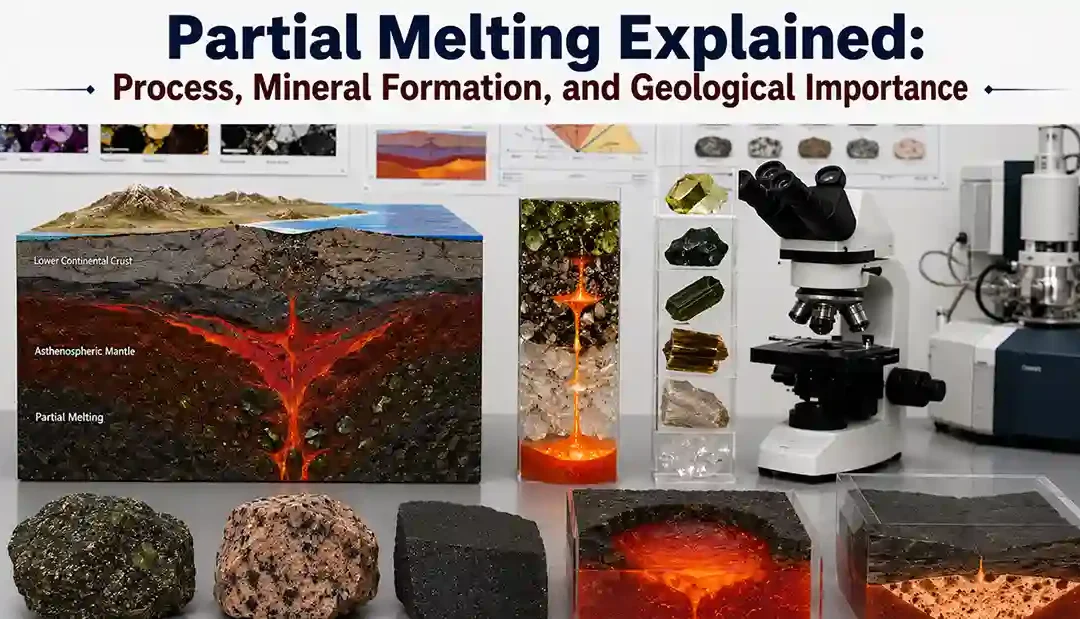
Partial melting is one of the most fundamental geological processes responsible for generating magma inside Earth. Unlike complete melting, where an entire rock becomes liquid, partial melting occurs when only certain minerals melt while others remain solid. Because minerals have different melting temperatures and chemical compositions, the first melt produced is chemically different from the original rock.
This process explains the formation of most igneous rocks, the development of Earth's continental crust, volcanic eruptions, and magma evolution. Partial melting occurs in the upper mantle, lower continental crust, and subduction zones, producing magma compositions that range from basaltic to granitic.
Understanding partial melting is essential in mineralogy, igneous petrology, volcanology, plate tectonics, and geochemistry.
This topic should be studied together with Fractional Crystallization, Bowen's Reaction Series, and Mantle Minerals.
What Is Partial Melting?
Partial melting is the process in which only a portion of a rock melts because different minerals have different melting temperatures.
During partial melting:
- Low-melting minerals melt first.
- High-melting minerals remain solid.
- Melt separates from the remaining rock.
- Magma composition differs from the source rock.
The unmelted portion is called the residue or restite.
Why Does Partial Melting Occur?
Different minerals melt under different conditions.
For example:
- Quartz melts at lower temperatures than olivine.
- Feldspar melts before pyroxene.
- Water-rich minerals melt more easily than dry minerals.
Because rocks contain many different minerals, they rarely melt all at once.
Conditions That Cause Partial Melting
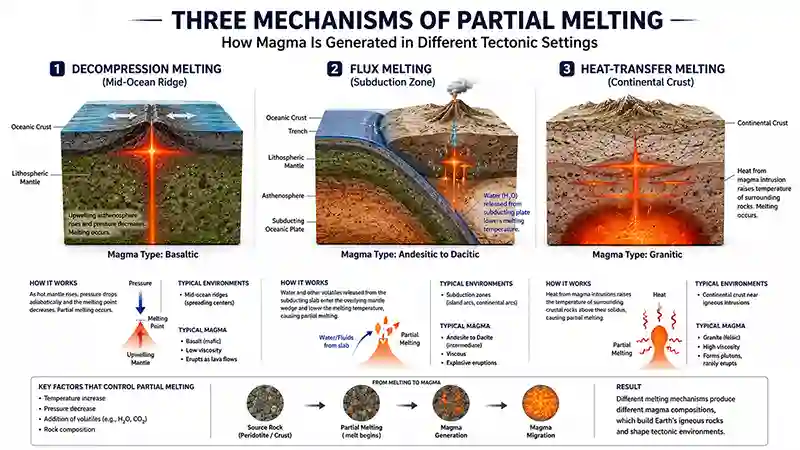
Several geological processes can trigger partial melting.
Temperature Increase
Heat supplied by:
- Rising magma
- Mantle plumes
- Crustal thickening
can raise rocks above their solidus temperature.
Pressure Decrease (Decompression Melting)
When mantle rocks rise toward Earth's surface:
- Pressure decreases.
- Melting temperature drops.
- Partial melting begins.
This process dominates at mid-ocean ridges.
Addition of Water (Flux Melting)
Water lowers the melting temperature of rocks.
This commonly occurs:
- At subduction zones
- Above descending oceanic plates
Flux melting produces many volcanic arcs.
Which Minerals Melt First?
Minerals melt in approximately the reverse order of Bowen's Reaction Series.
Early Melting Minerals
- Quartz
- Potassium Feldspar
- Muscovite
These contribute silica-rich melts.
Intermediate Melting Minerals
- Biotite
- Amphibole
- Sodium-rich Plagioclase
High-Temperature Minerals
These remain solid longer:
- Pyroxene
- Calcium-rich Plagioclase
- Olivine
They commonly remain in the mantle residue.
Partial Melting of Different Rocks
Mantle Peridotite
Partial melting of peridotite produces:
- Basaltic magma
- Mid-ocean ridge basalt
- Oceanic crust
Residual minerals:
- Olivine
- Pyroxene
Continental Crust
Partial melting of continental crust produces:
- Granitic magma
- Rhyolitic magma
Residual rocks become more refractory.
Subducting Oceanic Crust
Water released from the subducting slab triggers melting in the overlying mantle.
This generates:
- Andesitic magma
- Volcanic arc magma
Chemical Changes During Partial Melting
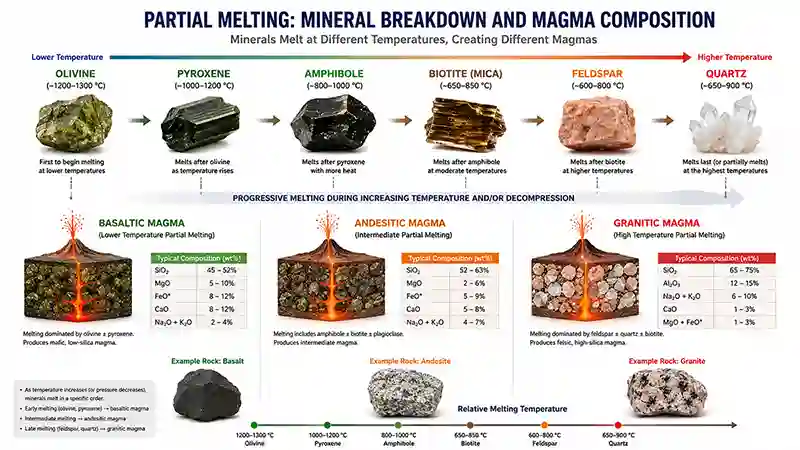
The first melt becomes enriched in:
- Silicon
- Sodium
- Potassium
- Aluminum
- Water
- Incompatible trace elements
The remaining solid becomes enriched in:
- Magnesium
- Iron
- Calcium
This chemical separation drives crustal differentiation.
Partial Melting and Plate Tectonics
Partial melting occurs in several tectonic settings.
| Tectonic Setting | Melting Mechanism | Typical Magma |
|---|---|---|
| Mid-Ocean Ridge | Decompression Melting | Basalt |
| Subduction Zone | Flux Melting | Andesite |
| Continental Collision | Heat Transfer | Granite |
| Mantle Plume | Decompression Melting | Basalt |
These settings generate most of Earth's magma.
Relationship with Fractional Crystallization
Partial melting and fractional crystallization work together.
Partial melting:
- Produces magma from solid rock.
Fractional crystallization:
- Changes magma composition during cooling.
Together they explain the diversity of igneous rocks.
Geological Importance
Partial melting explains:
- Formation of continental crust
- Oceanic crust generation
- Volcanic eruptions
- Mantle evolution
- Plate tectonics
- Igneous rock diversity
It is one of the most important processes inside Earth.
Economic Importance
Partial melting helps concentrate economically important elements.
Late-stage magmas may become enriched in:
- Lithium
- Tin
- Tungsten
- Uranium
- Rare Earth Elements
- Zirconium
These elements often form granitic pegmatites and hydrothermal ore deposits.
Laboratory Identification
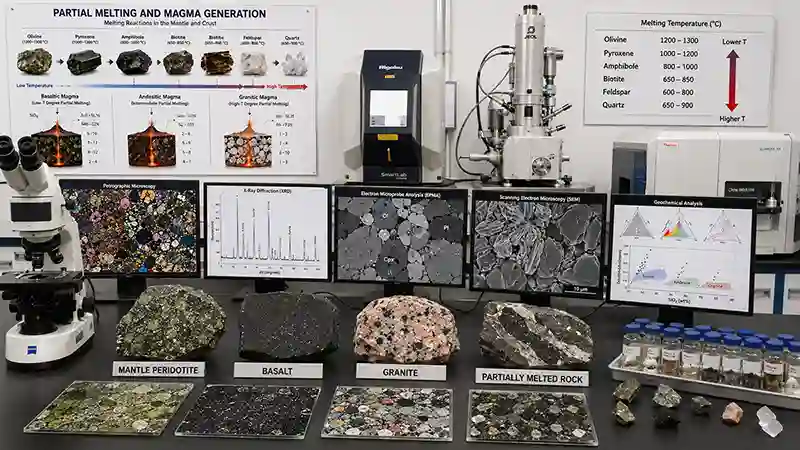
Partial melting is studied using:
- Petrographic Microscopy
- X-Ray Diffraction (XRD)
- Electron Microprobe Analysis (EPMA)
- Scanning Electron Microscopy (SEM)
- Experimental petrology
- Whole-rock geochemistry
- Isotope geochemistry
These methods reveal melting history and magma evolution.
Applications
Partial melting studies are important in:
- Igneous Petrology
- Mineralogy
- Volcanology
- Plate Tectonics
- Geochemistry
- Economic Geology
- Planetary Science
- Experimental Petrology
Advantages of Studying Partial Melting
Studying partial melting helps scientists:
- Understand magma generation
- Explain crustal evolution
- Predict volcanic behavior
- Explore mineral resources
- Interpret tectonic environments
- Reconstruct Earth's thermal history
Limitations
Interpreting partial melting may be challenging because:
- Rocks rarely melt under simple laboratory conditions.
- Magma mixing and crustal contamination may modify primary melts.
- Multiple melting events may occur during tectonic evolution.
- Accurate interpretation often requires geochemical and isotopic analyses.
For comprehensive interpretation, combine partial melting studies with:
- Fractional Crystallization
- Bowen's Reaction Series
- Mineral Formation
- Mantle Minerals
- Volcanic Minerals
- Petrographic Microscopy
- Mineral Chemistry Analysis
- X-Ray Diffraction in Mineralogy
Comparison Table
| Melting Mechanism | Main Cause | Common Tectonic Setting | Typical Magma |
| Heat Transfer | Temperature Increase | Continental Crust | Granite |
| Decompression | Pressure Decrease | Mid-Ocean Ridge | Basalt |
| Flux Melting | Water Addition | Subduction Zone | Andesite |
Summary Table
| Feature | Partial Melting |
| Main Process | Incomplete Melting of Rocks |
| Primary Controls | Temperature, Pressure, Water |
| Main Products | Basaltic, Andesitic, and Granitic Magmas |
| Common Study Methods | Petrography, XRD, EPMA, Geochemistry |
| Geological Importance | Magma Generation and Crust Formation |
Partial melting is the process in which only some minerals within a rock melt because each mineral has a different melting temperature. The resulting magma has a different composition from the original rock.
Rocks are made of multiple minerals, each with its own melting point. Lower-temperature minerals melt first, while higher-temperature minerals remain solid, producing only partial melting under most geological conditions.
Partial melting commonly occurs beneath mid-ocean ridges, above subduction zones, within continental crust, and beneath mantle plumes.
Partial melting creates magma from solid rock, whereas fractional crystallization changes the composition of magma as minerals crystallize and separate during cooling.
Geologists investigate partial melting using petrographic microscopy, X-ray diffraction (XRD), electron microprobe analysis (EPMA), scanning electron microscopy (SEM), experimental petrology, geochemical analyses, and isotope studies.
Final Thoughts
Partial melting is the starting point for most magma generation on Earth. By selectively melting low-temperature minerals while leaving more refractory minerals behind, it produces magmas with compositions that differ from their source rocks. This process explains the origin of basalt beneath mid-ocean ridges, andesite in volcanic arcs, and granite within continental crust.
When combined with fractional crystallization, partial melting accounts for the remarkable diversity of igneous rocks found on Earth. Through field studies, laboratory experiments, petrographic microscopy, geochemistry, and mineral analysis, geologists continue to improve our understanding of how partial melting shapes Earth's crust, drives volcanic activity, and forms valuable mineral deposits.
Continue Learning
Continue exploring igneous processes with these related guides: