
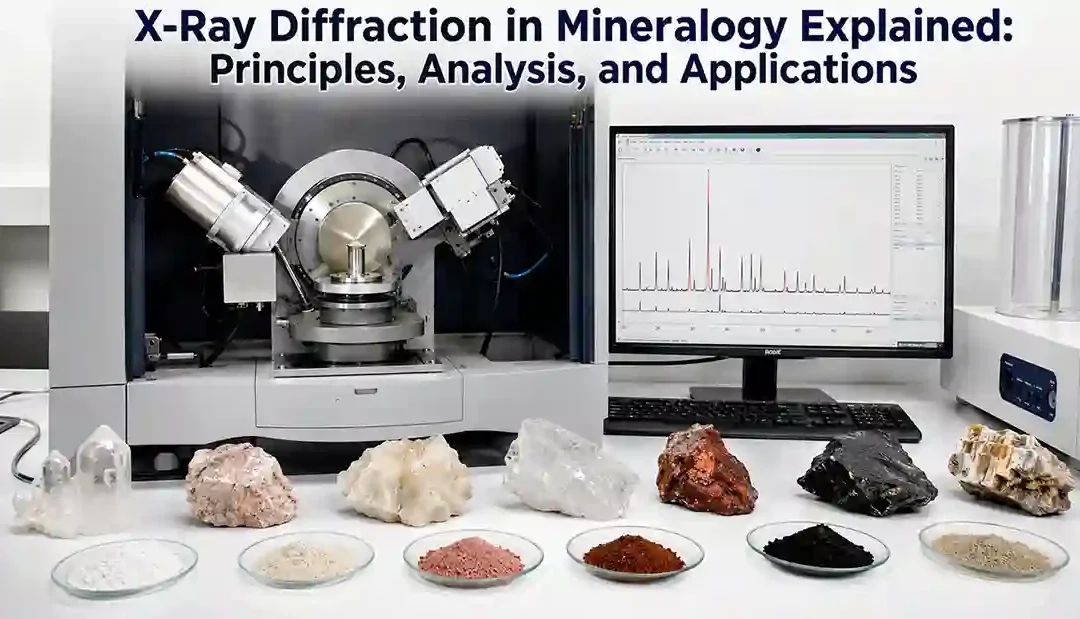
X-ray diffraction (XRD) is one of the most powerful laboratory techniques used in mineralogy to identify minerals and determine their crystal structures. Unlike hand-specimen observations or optical microscopy, XRD examines the arrangement of atoms inside a mineral by measuring how X-rays are diffracted by its crystal lattice.
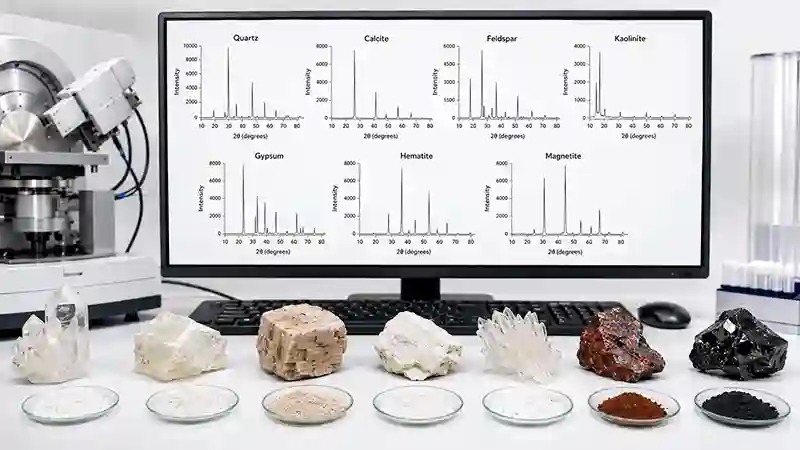
Every crystalline mineral produces a unique diffraction pattern that acts like a fingerprint. By comparing this pattern with reference databases, geologists can accurately identify minerals—even when the grains are microscopic or visually similar.
XRD is widely used in mineralogy, petrology, clay mineral studies, mining, environmental geology, materials science, and engineering. It is particularly valuable for identifying fine-grained minerals that are difficult or impossible to distinguish using a petrographic microscope.
For a complete understanding of mineral identification, XRD should be studied together with Petrographic Microscopy, Thin Section Mineral Analysis, and Crystal Structure Explained.
What Is X-Ray Diffraction (XRD)?
X-ray diffraction is an analytical technique that identifies crystalline materials by measuring how X-rays scatter when they strike a mineral.
When an X-ray beam interacts with a crystal:
- X-rays penetrate the crystal.
- Atomic planes scatter the X-rays.
- Constructive interference produces diffraction peaks.
- The detector records the diffraction pattern.
Each mineral produces a unique pattern because every crystal structure is different.
Why Is XRD Important?
XRD helps geologists:
- Identify unknown minerals
- Determine crystal structure
- Distinguish minerals with similar appearance
- Analyze clay minerals
- Measure crystallinity
- Study mineral transformations
It is one of the most accurate methods for mineral identification.
Principle of X-Ray Diffraction
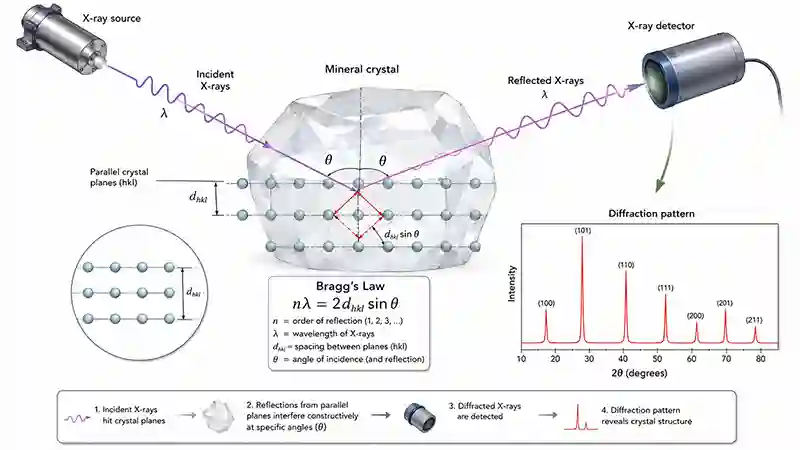
XRD is based on Bragg's Law, which explains how X-rays are reflected by crystal planes.
The diffraction angle depends on:
- X-ray wavelength
- Distance between crystal planes
- Crystal orientation
These relationships allow scientists to determine crystal structures precisely.
Main Components of an XRD Instrument
A modern X-ray diffractometer consists of:
- X-ray tube
- Collimator
- Sample holder
- Goniometer
- Detector
- Computer and analysis software
Each component contributes to producing an accurate diffraction pattern.
How Does XRD Work?
The analysis generally follows these steps.
Step 1
Collect a representative mineral or rock sample.
Step 2
Crush the sample into a fine powder.
Step 3
Place the powder into the sample holder.
Step 4
Expose the sample to an X-ray beam.
Step 5
Measure the angles and intensities of diffracted X-rays.
Step 6
Compare the diffraction pattern with reference databases to identify the mineral.
Why Are Powdered Samples Used?
Most mineralogical analyses use powder XRD because randomly oriented grains expose all crystal planes to the X-ray beam.
Advantages include:
- Representative diffraction pattern
- Faster analysis
- Better mineral identification
- Reduced orientation effects
Powder XRD is the standard method in mineralogy laboratories.
Information Obtained from XRD
X-ray diffraction provides information about:
- Mineral species
- Crystal structure
- Crystal symmetry
- Unit cell dimensions
- Degree of crystallinity
- Mineral mixtures
- Phase changes
It does not directly determine chemical composition but reveals the arrangement of atoms.
Minerals Commonly Identified by XRD
XRD can identify hundreds of minerals, including:
| Mineral | Typical Use of XRD |
|---|---|
| Quartz | Crystal identification |
| Feldspar | Feldspar species determination |
| Calcite | Carbonate identification |
| Dolomite | Carbonate differentiation |
| Gypsum | Hydrated sulfate identification |
| Kaolinite | Clay mineral analysis |
| Illite | Clay mineral analysis |
| Smectite | Clay mineral analysis |
| Hematite | Iron oxide identification |
| Magnetite | Iron oxide identification |
Clay minerals are among the most common materials identified using XRD because they are often too fine-grained for optical identification.
XRD vs Petrographic Microscopy
Both techniques are essential but provide different information.
| X-Ray Diffraction | Petrographic Microscopy |
| Identifies crystal structure | Identifies optical properties |
| Powder samples | Thin sections |
| Excellent for clay minerals | Excellent for rock textures |
| Quantitative phase analysis | Mineral relationships |
| Atomic-scale information | Microscopic observations |
Many geological laboratories use both methods together.
Applications in Mineralogy
XRD is widely used for:
- Mineral identification
- Crystal structure analysis
- Clay mineral studies
- Ore mineral analysis
- Metamorphic mineral identification
- Igneous rock research
- Sedimentary rock analysis
Applications in Industry
Industries use XRD for:
- Mining
- Cement manufacturing
- Ceramics
- Environmental monitoring
- Petroleum exploration
- Pharmaceuticals
- Materials science
Its ability to identify crystalline phases makes it valuable across many scientific fields.
Advantages of X-Ray Diffraction
XRD offers many advantages.
- Highly accurate mineral identification
- Non-destructive analysis
- Rapid results
- Excellent for fine-grained minerals
- Determines crystal structure
- Can analyze mineral mixtures
It is considered the standard laboratory technique for identifying crystalline materials.
Limitations
Despite its advantages, XRD has limitations.
- Amorphous materials produce weak or no diffraction patterns.
- Proper sample preparation is essential.
- Minerals with very similar crystal structures may require complementary analyses.
- Chemical composition usually requires additional techniques such as X-ray fluorescence (XRF) or electron microprobe analysis.
For the best results, combine XRD with:
- Petrographic Microscopy
- Thin Section Mineral Analysis
- Optical Properties of Minerals
- Crystal Structure Explained
- Scanning Electron Microscopy (SEM)
- X-Ray Fluorescence (XRF)
- How to Identify Minerals
Comparison Table
| Technique | Main Information |
| X-Ray Diffraction (XRD) | Crystal Structure & Mineral Identification |
| Petrographic Microscopy | Optical Properties & Rock Textures |
| X-Ray Fluorescence (XRF) | Chemical Composition |
| Scanning Electron Microscopy (SEM) | Surface Morphology & Microstructure |
| Hand Specimen Analysis | Physical Properties |
Summary Table
| Feature | X-Ray Diffraction |
| Main Purpose | Crystal Structure Analysis |
| Sample Type | Powdered Mineral Sample |
| Main Instrument | X-Ray Diffractometer |
| Best For | Mineral Identification |
| Scientific Importance | Mineralogy, Petrology, Materials Science |
X-ray diffraction (XRD) is a laboratory technique that identifies crystalline minerals by measuring how X-rays are diffracted by their crystal structures.
XRD identifies minerals based on their atomic crystal structure, making it especially useful for very fine-grained minerals such as clays that are difficult to identify under a microscope.
Most mineralogical studies use finely powdered mineral or rock samples to produce complete and representative diffraction patterns.
Not directly. XRD identifies crystal structures and mineral phases, while techniques such as X-ray fluorescence (XRF) are commonly used to determine elemental composition.
It provides accurate mineral identification, helps determine crystal structures, supports geological research, and is widely used in mining, petroleum exploration, environmental studies, and materials science.
Final Thoughts
X-ray diffraction has transformed mineralogy by allowing scientists to identify minerals through their unique crystal structures rather than appearance alone. From common minerals such as quartz and calcite to complex clay minerals and ore deposits, XRD provides reliable and highly accurate information that is essential for geological research and industrial applications.
When combined with petrographic microscopy, thin section analysis, optical mineralogy, and chemical analysis, XRD offers one of the most complete approaches to understanding Earth's minerals and rocks. Its precision, speed, and versatility make it an indispensable tool in modern mineralogical laboratories.
Continue Learning
Expand your mineralogy knowledge with these related guides: