
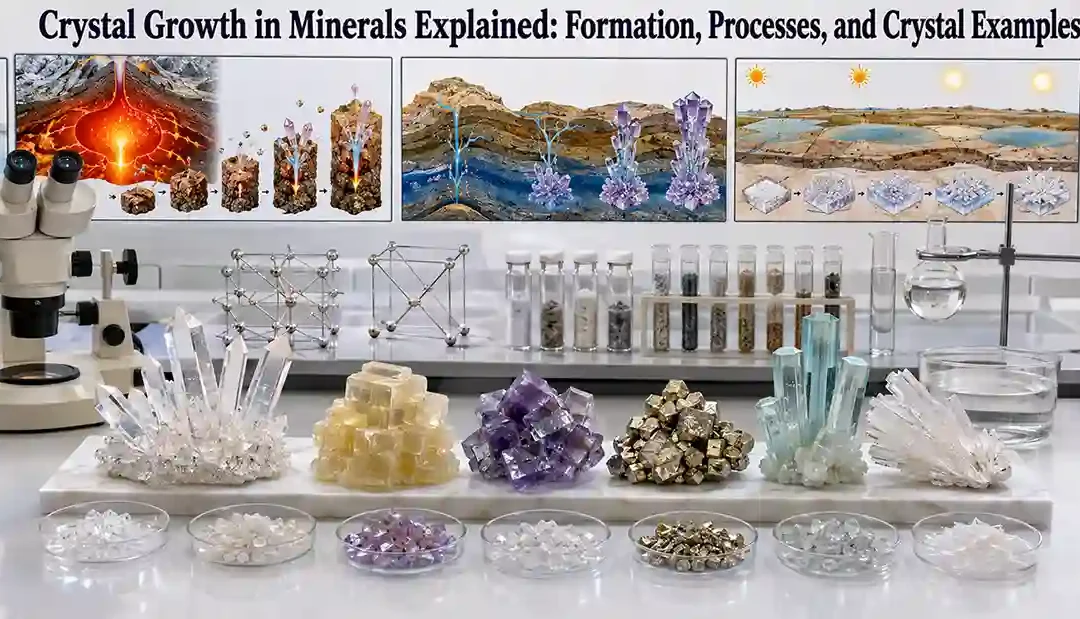
Crystal growth is the natural process through which minerals develop their characteristic crystal shapes and internal atomic structures. Every mineral crystal begins as atoms, ions, or molecules that gradually arrange themselves into an orderly repeating pattern called a crystal lattice. As more material is added, the crystal grows larger while maintaining its unique crystal structure.
Crystal growth occurs in many geological environments, including cooling magma, hydrothermal fluids, evaporating lakes, caves, and metamorphic rocks. The size, shape, and quality of a crystal depend on temperature, pressure, chemical composition, available space, and the rate of growth.
Understanding crystal growth helps geologists explain why minerals form different crystal habits, why some crystals become gemstones, and how ore deposits develop. It is one of the fundamental concepts in mineralogy and crystallography.
If you are studying mineral formation, this topic is best learned alongside Crystal Systems Explained and How to Identify Minerals.
What Is Crystal Growth?
Crystal growth is the process by which atoms, ions, or molecules attach themselves to a growing crystal surface in a regular, repeating arrangement.
As the crystal continues to grow, its internal structure remains consistent, producing:
- Flat crystal faces
- Sharp crystal edges
- Characteristic crystal shapes
- Ordered atomic arrangement
Every mineral species grows according to its unique crystal structure.
How Does Crystal Growth Begin?
Crystal growth starts with nucleation. A tiny cluster of atoms forms a stable nucleus.
Once this nucleus becomes stable:
- More atoms attach.
- Crystal faces develop.
- The crystal becomes larger.
- The internal lattice continues expanding.
Without nucleation, crystal growth cannot begin.
Stages of Crystal Growth
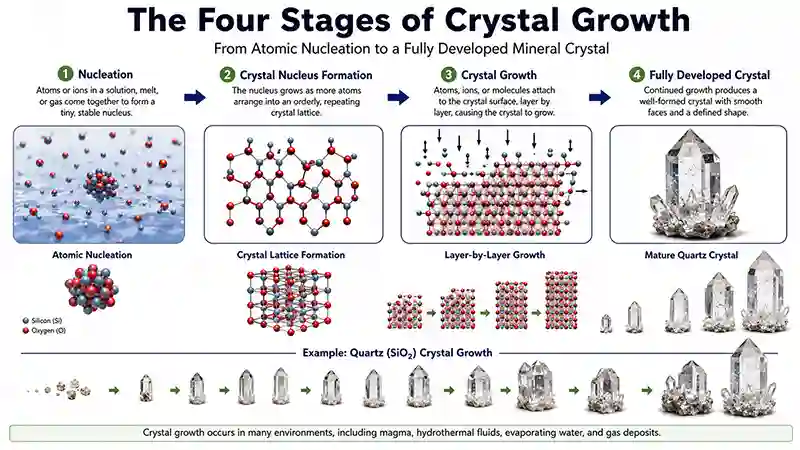
Crystal growth generally occurs in four stages.
1. Nucleation
Small groups of atoms form the first stable crystal nucleus.
2. Initial Growth
Atoms begin attaching to the nucleus.
3. Crystal Development
Crystal faces become visible and well defined.
4. Mature Crystal
Growth slows as available material decreases.
Where Do Mineral Crystals Grow?
Minerals crystallize in several geological environments.
Igneous Rocks
Cooling magma forms minerals such as:
- Quartz
- Feldspar
- Olivine
- Pyroxene
Hydrothermal Veins
Hot mineral-rich fluids produce:
- Quartz
- Fluorite
- Galena
- Sphalerite
- Calcite
Sedimentary Environments
Evaporating water forms:
- Halite
- Gypsum
- Sylvite
Metamorphic Rocks
Heat and pressure produce:
- Garnet
- Kyanite
- Andalusite
- Staurolite
Factors Affecting Crystal Growth
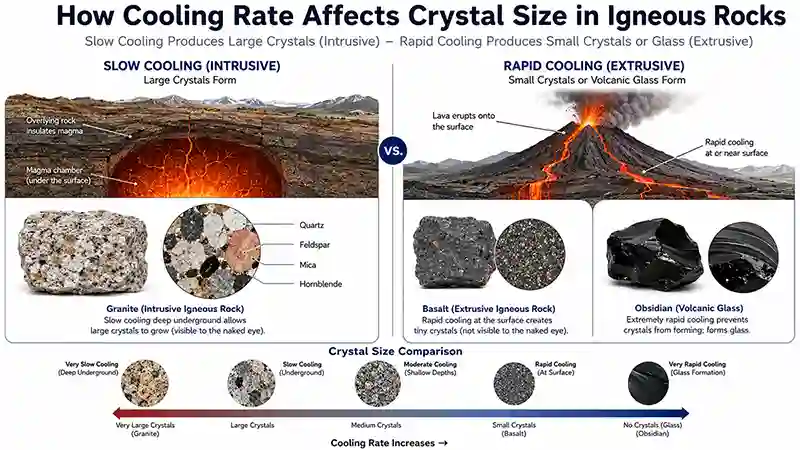
Several conditions influence crystal size and quality.
Temperature
Slow cooling allows large crystals to develop. Rapid cooling produces small crystals.
Pressure
Pressure affects crystal stability and mineral species.
Chemical Composition
Available elements determine which minerals form.
Available Space
Open cavities allow crystals to grow freely. Crowded environments produce irregular crystal shapes.
Cooling Rate
Cooling rate strongly controls crystal size.
| Cooling Rate | Crystal Size |
|---|---|
| Very Slow | Large |
| Moderate | Medium |
| Rapid | Small |
| Extremely Rapid | Glass |
This explains why granite contains large crystals while volcanic glass lacks crystals.
Crystal Growth Mechanisms
Minerals grow through different mechanisms.
Layer-by-Layer Growth
Atoms attach to flat crystal faces.
Spiral Growth
Growth continues around tiny crystal defects.
Dendritic Growth
Rapid crystal growth forms tree-like patterns. Native copper commonly forms dendritic crystals.
Fibrous Growth
Crystals grow as long fibers.
Examples include:
- Chrysotile
- Gypsum (satin spar)
Euhedral, Subhedral, and Anhedral Crystals
Crystal shape depends on available space.
| Crystal Form | Description |
| Euhedral | Well-developed crystal faces |
| Subhedral | Partially developed faces |
| Anhedral | No visible crystal faces |
Large cavities often contain beautiful euhedral crystals.
Crystal Growth in Common Minerals
| Mineral | Typical Growth Environment |
| Quartz | Hydrothermal Veins, Igneous Rocks |
| Calcite | Limestone Caves, Hydrothermal Veins |
| Fluorite | Hydrothermal Veins |
| Halite | Evaporating Lakes |
| Pyrite | Hydrothermal Deposits |
| Beryl | Pegmatites |
| Garnet | Metamorphic Rocks |
Each mineral grows under specific geological conditions.
Crystal Growth and Gemstones
Many gemstones form through slow crystal growth.
Examples include:
- Diamond
- Emerald
- Ruby
- Sapphire
- Topaz
- Aquamarine
Slow growth often produces:
- Better transparency
- Fewer inclusions
- Larger crystal size
These characteristics increase gemstone quality.
Crystal Defects During Growth
Perfect crystals are rare.
Common defects include:
- Inclusions
- Twinning
- Growth zoning
- Dislocations
- Fractures
These features help geologists reconstruct a crystal's growth history.
Why Crystal Growth Matters
Crystal growth is important for understanding:
- Mineral identification
- Igneous petrology
- Metamorphic geology
- Ore deposit formation
- Gemology
- Materials science
The size and shape of crystals provide valuable clues about geological history.
Applications
Crystal growth research supports:
- Semiconductor manufacturing
- Synthetic gemstone production
- Electronics
- Medical crystals
- Optical materials
- Scientific research
Many modern technologies rely on carefully grown synthetic crystals.
Advantages of Studying Crystal Growth
Understanding crystal growth helps geologists:
- Interpret cooling history
- Reconstruct geological environments
- Identify minerals
- Evaluate gemstone quality
- Explore ore deposits
Limitations
Crystal size alone cannot identify a mineral because:
- Different minerals may have similar habits.
- Environmental conditions influence crystal shape.
- Weathering can modify crystal surfaces.
For reliable identification, combine crystal growth observations with:
- Crystal Structure Explained
- Crystal Systems Explained
- Crystal Habit Explained
- Optical Properties of Minerals
- Mineral Hardness Test
- Cleavage Test Explained
- How to Identify Minerals
Comparison Table
| Environment | Typical Crystal Growth |
| Magma | Quartz, Feldspar |
| Hydrothermal Fluids | Quartz, Fluorite |
| Evaporating Water | Halite, Gypsum |
| Metamorphism | Garnet, Kyanite |
Summary Table
| Feature | Crystal Growth |
| Begins With | Nucleation |
| Controlled By | Temperature, Pressure, Chemistry |
| Main Result | Ordered Crystal Lattice |
| Best Examples | Quartz, Calcite, Halite |
| Scientific Importance | Mineral Formation & Identification |
Crystal growth is the process by which atoms, ions, or molecules join a crystal in a regular pattern, allowing it to increase in size while maintaining its crystal structure.
Crystal size mainly depends on cooling rate, available space, temperature, pressure, and the availability of chemical components.
Large crystals usually form when minerals grow slowly in environments where there is enough space and time for crystal faces to develop.
Minerals crystallize in cooling magma, hydrothermal veins, evaporating lakes, caves, metamorphic rocks, and sedimentary environments.
Crystal growth helps geologists understand mineral formation, identify minerals, interpret geological history, evaluate gemstones, and explore ore deposits.
Final Thoughts
Crystal growth is one of the most fundamental processes in mineralogy because it controls how minerals develop their characteristic shapes, sizes, and internal structures. From tiny microscopic crystals to giant quartz specimens weighing several tons, every mineral records the geological conditions under which it formed.
By understanding nucleation, crystal growth mechanisms, and the environmental factors that influence crystallization, geologists can reconstruct Earth's geological history and better understand the origin of rocks, ore deposits, and gemstones. Combined with crystal systems, crystal structure, hardness, optical properties, and other mineral characteristics, crystal growth provides an essential foundation for studying minerals and their formation.
Continue Learning
Continue exploring mineral crystallography with these related guides:
- Crystal Structure Explained
- Crystal Systems Explained
- Crystal Habit Explained
- Mineral Formation Explained
- Optical Properties of Minerals
- Refractive Index in Minerals
- How to Identify Minerals
- Mineral Hardness Test