
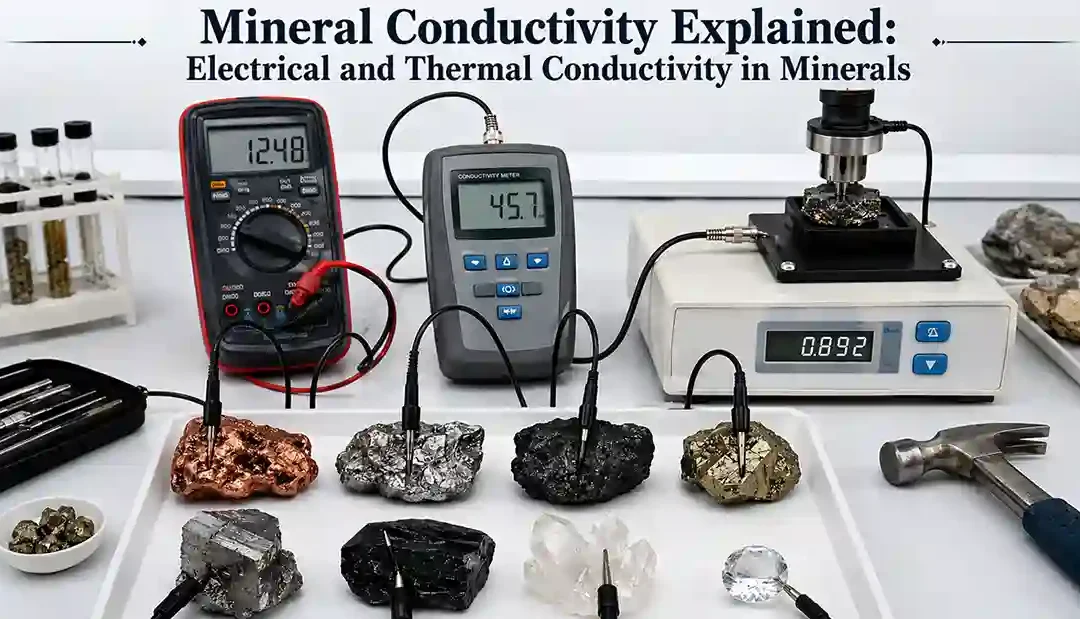
Conductivity is an important physical property that describes how easily a mineral transfers electricity or heat. While most minerals are poor electrical conductors, some native metals and carbon-rich minerals conduct electricity extremely well. Likewise, certain minerals, such as diamond, are excellent thermal conductors despite being poor electrical conductors.
Geologists, mineralogists, and gemologists use conductivity tests to identify minerals, distinguish gemstones, evaluate ore deposits, and understand mineral composition. Although conductivity is not the first test performed during mineral identification, it becomes highly valuable when combined with hardness, density, magnetism, streak, cleavage, fracture, and optical properties.
If you are learning mineral identification, conductivity should be studied together with Magnetism in Minerals, Mineral Density Test, and How to Identify Minerals.
What Is Mineral Conductivity?
Mineral conductivity is the ability of a mineral to transfer:
- Electrical current
- Thermal energy (heat)
These two properties are related but not identical.
A mineral may conduct heat very well while conducting electricity poorly, or vice versa.
Types of Mineral Conductivity
There are two main forms of conductivity.
Electrical Conductivity
Electrical conductivity measures how easily electric current passes through a mineral. Good electrical conductors contain electrons that move freely.
Examples include:
- Native Copper
- Native Silver
- Graphite
Thermal Conductivity
Thermal conductivity measures how efficiently heat moves through a mineral.
Excellent thermal conductors include:
- Diamond
- Native Copper
- Silver
Thermal conductivity is particularly important in gem identification.
Why Are Some Minerals Conductive?
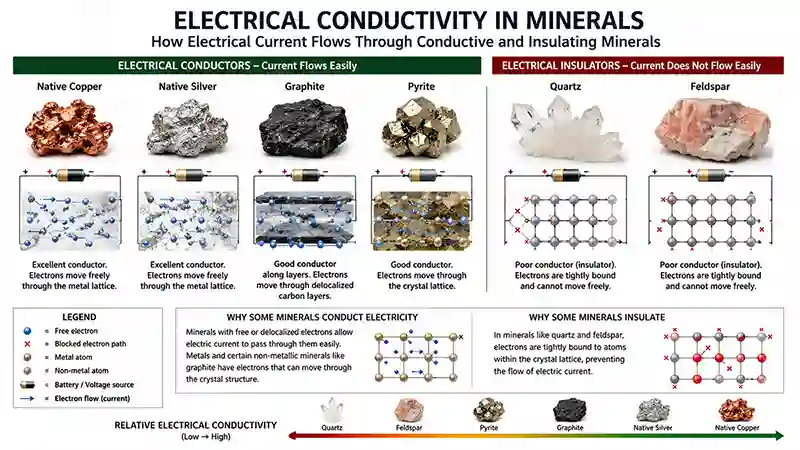
Conductivity depends on:
- Chemical composition
- Crystal structure
- Metallic bonding
- Free electrons
- Atomic arrangement
Native metals contain abundant free electrons, making them excellent electrical conductors. Silicate minerals lack free-moving electrons and therefore conduct electricity poorly.
Electrical Conductivity of Common Minerals
| Mineral | Electrical Conductivity |
|---|---|
| Native Silver | Excellent |
| Native Copper | Excellent |
| Graphite | Excellent |
| Native Gold | Excellent |
| Galena | Moderate |
| Pyrite | Moderate |
| Magnetite | Weak to Moderate |
| Hematite | Weak |
| Quartz | Very Poor |
| Calcite | Very Poor |
| Feldspar | Very Poor |
| Diamond | Very Poor |
Most rock-forming minerals are electrical insulators.
Thermal Conductivity of Common Minerals
Heat conductivity differs from electrical conductivity.
| Mineral | Thermal Conductivity |
| Diamond | Excellent |
| Silver | Excellent |
| Copper | Excellent |
| Quartz | Moderate |
| Calcite | Moderate |
| Fluorite | Low |
Diamond is famous for having one of the highest thermal conductivities of any naturally occurring material.
Conductors vs Insulators
| Good Conductors | Poor Conductors |
| Copper | Quartz |
| Silver | Feldspar |
| Gold | Calcite |
| Graphite | Gypsum |
| Galena | Fluorite |
This distinction is important in geology, electronics, and materials science.
How Is Conductivity Measured?
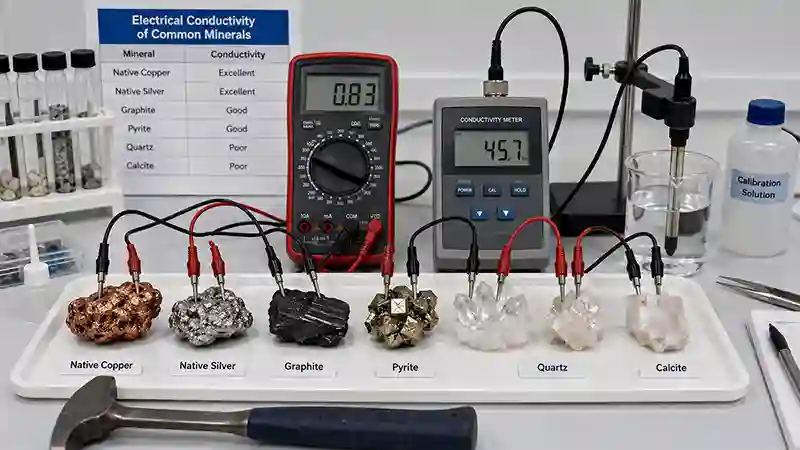
Several methods are used depending on the type of conductivity.
Electrical Conductivity
Measured using:
- Digital multimeter
- Conductivity meter
- Electrical resistance tester
Thermal Conductivity
Measured using:
- Thermal conductivity tester
- Diamond tester
- Laboratory heat-flow instruments
Conductivity in Gemology
Thermal conductivity is widely used to identify gemstones.
Diamond testers work because:
- Diamond conducts heat extremely well.
- Cubic zirconia and glass conduct heat much more slowly.
Modern gemstone testers often combine thermal and electrical conductivity measurements to distinguish:
- Diamond
- Moissanite
- Cubic Zirconia
This allows rapid and non-destructive gemstone identification.
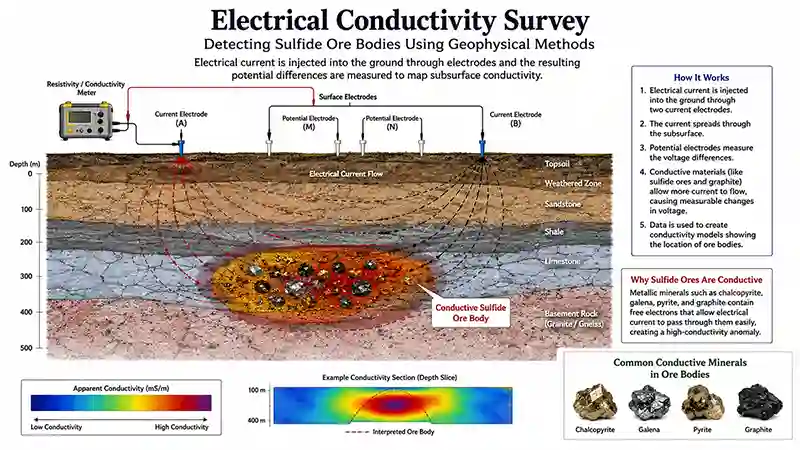
Conductivity in Ore Exploration
Electrical conductivity is important in mineral exploration.
Highly conductive ore minerals include:
- Chalcopyrite
- Galena
- Graphite
- Massive Sulfides
Geophysical surveys measure conductivity to locate buried ore deposits without excavation.
Applications of Mineral Conductivity
Conductivity testing is used in:
- Mineral identification
- Gemology
- Ore exploration
- Geological mapping
- Mining
- Materials science
- Academic research
Electrical and thermal conductivity provide valuable information about mineral composition and economic importance.
Factors Affecting Conductivity
Several factors influence conductivity.
Chemical Composition
Metal-rich minerals usually conduct electricity better.
Crystal Structure
Electron mobility depends on atomic arrangement.
Temperature
Conductivity changes slightly with temperature.
Impurities
Trace elements may increase or decrease conductivity.
Moisture
Surface moisture can affect conductivity measurements.
Advantages of Conductivity Testing
Conductivity testing is:
- Fast
- Non-destructive
- Highly accurate
- Useful for ore minerals
- Valuable in gem identification
It complements many other mineral identification methods.
Limitations
Conductivity alone cannot identify every mineral because:
- Many silicate minerals have similar low conductivity.
- Weathering can affect measurements.
- Surface contamination may produce inaccurate results.
- Different minerals can have overlapping conductivity ranges.
For reliable identification, combine conductivity with:
- How to Identify Minerals
- Mineral Density Test
- Magnetism in Minerals
- Optical Properties of Minerals
- Refractive Index in Minerals
- Mineral Hardness Test
- Cleavage Test Explained
- Fracture in Minerals
Comparison Table
| Test | Measures |
| Conductivity Test | Electrical or Thermal Conductivity |
| Magnetism Test | Magnetic Properties |
| Density Test | Mass per Unit Volume |
| Hardness Test | Scratch Resistance |
| Refractive Index | Light Refraction |
| Acid Test | Carbonate Reaction |
Summary Table
| Feature | Mineral Conductivity |
| Main Types | Electrical & Thermal |
| Best Electrical Conductors | Silver, Copper, Graphite |
| Best Thermal Conductor | Diamond |
| Common Equipment | Multimeter, Conductivity Meter |
| Identification Value | High (with other tests) |
Mineral conductivity is the ability of a mineral to transfer electrical current or thermal energy.
Native silver is the best natural electrical conductor, followed closely by native copper and native gold.
Diamond has one of the highest thermal conductivities of any naturally occurring mineral.
Quartz lacks free-moving electrons, making it an excellent electrical insulator.
Conductivity testing helps distinguish conductive metallic minerals from insulating silicate minerals and is widely used in gemology and ore exploration.
Final Thoughts
Mineral conductivity provides valuable insight into the physical behavior of minerals and has applications ranging from mineral identification to gemstone testing and geophysical exploration. While native metals such as silver and copper excel at conducting electricity, diamond stands out as an exceptional thermal conductor. These differences reflect each mineral's unique chemical composition and crystal structure.
Although conductivity is not sufficient on its own to identify a mineral, it becomes a powerful diagnostic property when combined with hardness, density, magnetism, optical properties, cleavage, and fracture. Understanding conductivity gives geologists and gemologists another important tool for accurately identifying minerals and evaluating Earth's valuable natural resources.
Continue Learning
Expand your mineral identification knowledge with these related guides: