
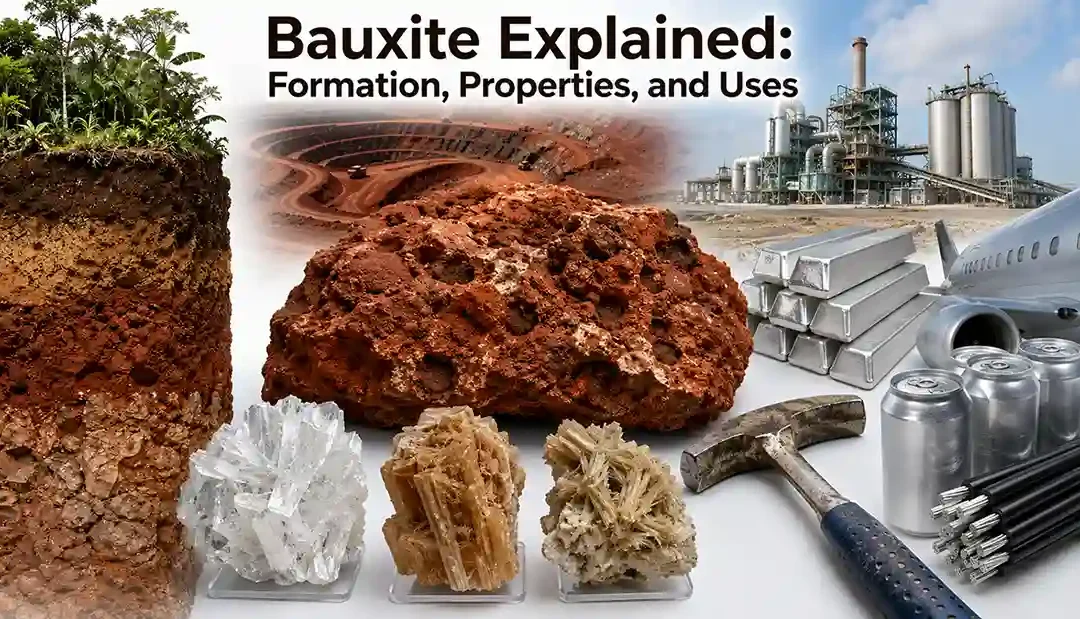
Bauxite is the world's primary ore of aluminum and one of the most economically important industrial mineral resources. Nearly all aluminum products—including aircraft, automobiles, beverage cans, electrical cables, packaging materials, and construction products—originate from bauxite.
Unlike many metallic ores, bauxite is not a single mineral but a rock composed mainly of aluminum hydroxide minerals formed through intense tropical weathering. Its abundance and high aluminum content make it the principal raw material for global aluminum production.
What Is Bauxite?
Bauxite is a sedimentary residual rock composed primarily of aluminum-bearing minerals.
It is the world's principal source of:
- aluminum metal
- alumina
- refractory materials
- abrasives
- cement additives
Bauxite is classified as an ore rather than a single mineral.
Major Bauxite Minerals
Gibbsite
Most common aluminum hydroxide mineral.
Chemical formula:
Boehmite
Common in many commercial deposits.
Chemical formula:
Diaspore
Occurs in some high-grade deposits.
Chemical formula:
Common impurities include:
- iron oxides
- silica
- titanium dioxide
- clay minerals
Composition of Bauxite
| Component | Typical Minerals |
|---|---|
| Aluminum | Gibbsite, Boehmite, Diaspore |
| Iron | Hematite, Goethite |
| Silica | Quartz, Kaolinite |
| Titanium | Anatase, Rutile |
Chemical Composition
Although bauxite is a rock and has no single chemical formula, its principal aluminum-bearing minerals are:
- Gibbsite → Al(OH)₃
- Boehmite → AlO(OH)
- Diaspore → AlO(OH)
Commercial bauxite typically contains:
- 30–60% Al₂O₃
- iron oxides
- silica
- titanium oxides
Formation of Bauxite
Most bauxite forms through Lateritic Weathering. Intense rainfall and warm climates remove:
- sodium
- potassium
- calcium
- magnesium
while concentrating on aluminum hydroxides. This process requires millions of years of chemical weathering.
Geological Conditions Required
Bauxite commonly develops where there is:
- tropical climate
- heavy rainfall
- good drainage
- stable land surface
- aluminum-rich parent rock
These conditions favor intense chemical weathering.
Types of Bauxite Deposits
Lateritic Bauxite
Most abundant worldwide.
Karst Bauxite
Forms in limestone depressions.
Tikhvin-Type Bauxite
Develops in sedimentary environments.
Lateritic deposits account for the majority of global production.
Bauxite Deposit Types
| Deposit Type | Formation Environment |
|---|---|
| Lateritic | Tropical Weathering |
| Karst | Limestone Cavities |
| Sedimentary | Ancient Sedimentary Basins |
Physical Properties
| Property | Typical Value |
|---|---|
| Color | Red, Brown, Yellow, White |
| Hardness | 1–3 |
| Luster | Earthy |
| Streak | White |
| Specific Gravity | 2.0–2.7 |
The red color is mainly caused by iron oxides.
Major Bauxite-Producing Countries
Leading producers include:
- Australia
- Guinea
- China
- Brazil
- India
- Indonesia
- Jamaica
Major Bauxite Mines
Some of the world's largest operations include:
- Weipa Mine
- Boké Region
- Huntly Mine
These mines supply a large share of the world's aluminum industry.
Bauxite Mining
Bauxite is generally extracted using:
- open-pit mining
- bulldozers
- excavators
- haul trucks
- crushing
- washing
Because most deposits occur near the surface, underground mining is rarely required.
Uses of Bauxite
Bauxite is used to manufacture:
- aluminum metal
- aircraft components
- automobiles
- beverage cans
- electrical transmission cables
- kitchen utensils
- packaging materials
- construction products
- refractory bricks
- abrasives
Nearly every industry uses aluminum produced from bauxite.
Environmental Considerations
Bauxite mining may affect:
- forests
- biodiversity
- soil
- water resources
Responsible mining practices include:
- progressive land rehabilitation
- reforestation
- water management
- red mud storage management
Bauxite Summary
Modern aluminum production begins with bauxite mining and continues through refining and electrolytic smelting.
| Feature | Bauxite |
|---|---|
| Classification | Aluminum Ore Rock |
| Main Minerals | Gibbsite, Boehmite, Diaspore |
| Main Metal | Aluminum (Al) |
| Largest Deposit Type | Lateritic |
| Main Mining Method | Open-Pit Mining |
| Main Products | Alumina, Aluminum |
No. Bauxite is a rock composed mainly of aluminum-bearing minerals such as gibbsite, boehmite, and diaspore.
Bauxite is the primary raw material used to produce alumina and aluminum for transportation, construction, packaging, electronics, and many other industries.
Bauxite forms through intense tropical weathering (lateritization), where rainfall removes soluble elements and concentrates aluminum hydroxide minerals.
Australia is one of the world's largest producers, followed by Guinea, China, Brazil, India, Indonesia, and Jamaica.
Bauxite is the world's principal source of aluminum, one of the most widely used and recyclable metals in modern industry.
Final Thoughts
Bauxite is one of the world's most strategically important ore resources because it supplies nearly all of the aluminum used in modern society. Formed through millions of years of tropical weathering, this aluminum-rich rock supports industries ranging from aerospace and transportation to construction, renewable energy, and consumer products.
Understanding how bauxite forms, its mineral composition, and the processes used to transform it into aluminum highlights its essential role in economic geology and global industrial development.
Continue learning with → /economic-geology-explained/, /mineral-resources/, /mining-and-mineral-extraction/, and /smelting-and-refining-minerals/.