
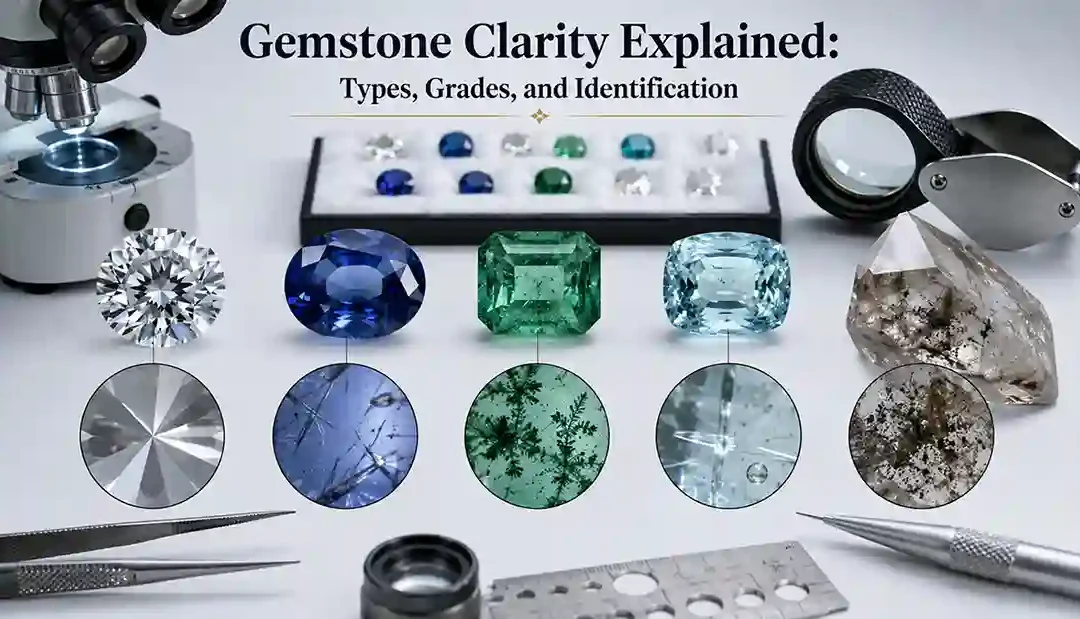
Gemstone clarity is one of the most important factors used to evaluate a gemstone's beauty, quality, and value. It refers to the presence or absence of internal features called inclusions and external imperfections known as blemishes.
Although perfectly flawless gemstones are extremely rare, many natural gemstones contain small internal characteristics that formed during crystal growth. In some cases, these inclusions can even help gemologists identify a gemstone's origin and confirm that it is natural.
Understanding clarity helps buyers, collectors, and jewelers make informed decisions when selecting gemstones.
What Is Gemstone Clarity?
Gemstone clarity describes the number, size, visibility, and location of internal and external imperfections within a gemstone.
Clarity affects:
- brilliance
- transparency
- appearance
- rarity
- market value
Higher clarity generally increases a gemstone's value, although expectations vary between different gem species.
Internal vs External Features
Two Types of Imperfections
Inclusions
Features located inside the gemstone.
Examples include:
- mineral crystals
- fractures
- fluid inclusions
- needles
- growth zoning
Blemishes
Features found on the surface.
Examples include:
- scratches
- chips
- polishing marks
- abrasions
Clarity Features
| Type | Location | Examples |
|---|---|---|
| Inclusions | Internal | Crystals, Needles, Fractures |
| Blemishes | Surface | Scratches, Chips, Abrasions |
How Gemologists Evaluate Clarity
Professional gemologists examine gemstones using:
- 10× magnification
- gemological microscope
- loupe
- fiber-optic lighting
- darkfield illumination
These tools reveal internal characteristics that may not be visible to the naked eye.
Common Types of Inclusions
Natural Crystal Features
Crystal Inclusions
Tiny mineral crystals trapped during growth.
Needle Inclusions
Thin, elongated mineral crystals.
Feather Inclusions
Small internal fractures resembling feathers.
Fluid Inclusions
Tiny pockets containing liquids or gases.
Growth Zoning
Color or growth variations formed during crystallization.
Eye-Clean Gemstones
A gemstone is considered eye-clean when:
- no inclusions are visible to the naked eye
- imperfections can only be seen under magnification
Eye-clean gemstones are highly desirable because they appear flawless in normal viewing conditions.
Gemstone Clarity Grades
While colored gemstones do not follow a single universal grading system like diamonds, clarity is often described using these general categories:
| Grade | Description |
|---|---|
| Flawless (FL) | No visible inclusions or blemishes under 10× magnification |
| Internally Flawless (IF) | No internal inclusions; only minor surface blemishes |
| Very Slightly Included (VS) | Minute inclusions difficult to detect |
| Slightly Included (SI) | Small inclusions visible under magnification |
| Included (I) | Obvious inclusions visible with or without magnification |
Diamond Clarity Scale
Diamonds use the internationally recognized clarity grading system.
Common grades include:
- FL (Flawless)
- IF (Internally Flawless)
- VVS1–VVS2
- VS1–VS2
- SI1–SI2
- I1–I3
Diamonds with fewer inclusions are generally more valuable.
Clarity Expectations for Colored Gemstones
Different gemstones naturally contain different amounts of inclusions.
| Gemstone | Typical Clarity |
|---|---|
| Diamond | Usually Very Clean |
| Aquamarine | Eye-Clean |
| Topaz | Eye-Clean |
| Spinel | Eye-Clean |
| Sapphire | Slightly Included |
| Ruby | Slightly Included |
| Emerald | Often Included |
| Tourmaline | Variable |
| Quartz | Usually Clean |
For example, emeralds commonly contain natural inclusions known as jardin, and these are often accepted as part of the stone's character.
What Is Jardin?
The French word jardin means "garden." It describes the moss-like or branch-like internal inclusions commonly found in emeralds. Natural jardin often helps distinguish genuine emeralds from synthetic stones.
Do Inclusions Reduce Value?
Generally, yes—but not always.
Value depends on:
- visibility
- location
- size
- type
- gemstone species
A small inclusion near the edge of a gemstone may have little effect, while a large inclusion at the center can significantly reduce value.
Can Inclusions Be Beneficial?
Some inclusions actually increase scientific or collector value.
Examples include:
- confirming natural origin
- identifying geographic source
- creating optical effects
- producing star gemstones (asterism)
- creating cat's-eye gemstones (chatoyancy)
Certain inclusions are responsible for unique gemstone phenomena.
Clarity vs Transparency
| Property | Meaning |
|---|---|
| Clarity | Number and visibility of inclusions |
| Transparency | Amount of light passing through the gemstone |
A gemstone may have excellent clarity but still be translucent rather than transparent.
How Clarity Affects Jewelry
Higher clarity generally results in:
- greater brilliance
- improved transparency
- better light return
- increased value
However, durability also depends on the type and position of inclusions. Large fractures may weaken a gemstone.
Clarity Enhancement Treatments
Some gemstones receive treatments to improve apparent clarity.
Common methods include:
- fracture filling
- oil treatment (especially emerald)
- resin filling
- glass filling
Professional disclosure of treatments is important when buying gemstones.
Gemstone Clarity Examination
Gemologists combine clarity examination with:
- color analysis
- cut evaluation
- carat measurement
- optical testing
to identify and grade gemstones accurately.
Factors Affecting Gemstone Clarity
| Factor | Influence |
|---|---|
| Inclusion Size | Larger inclusions reduce clarity |
| Number of Inclusions | More inclusions lower clarity |
| Position | Central inclusions are more noticeable |
| Color Contrast | Dark inclusions are easier to see |
| Transparency | Transparent gems reveal inclusions more clearly |
Tips for Choosing a Gemstone
When buying gemstones:
- prioritize eye-clean appearance
- consider gemstone type
- examine under proper lighting
- request disclosure of treatments
- purchase from reputable sellers
A natural gemstone with minor inclusions can still be exceptionally beautiful.
Gemstone clarity measures the visibility and amount of internal inclusions and surface blemishes.
Inclusions are natural internal features trapped within a gemstone during its formation.
An eye-clean gemstone has no visible inclusions when viewed without magnification.
Emerald commonly contains natural inclusions called jardin, which are generally accepted in high-quality stones.
Not necessarily. Color, cut, rarity, durability, and overall appearance are also important factors in determining gemstone quality and value.
Final Thoughts
Gemstone clarity is a key aspect of gemological evaluation, but it is only one part of a gemstone's overall beauty and value. Natural inclusions often tell the story of a gemstone's formation and can even confirm its authenticity. While flawless gemstones are exceptionally rare, many of the world's most admired gems contain minor inclusions that do not diminish their beauty.
By understanding clarity, inclusions, and grading standards, buyers and collectors can better appreciate the unique characteristics that make every natural gemstone one of a kind.
Continue learning with → /crystal-healing-minerals/, /gemstone-hardness-guide/, and /how-to-identify-minerals/.