
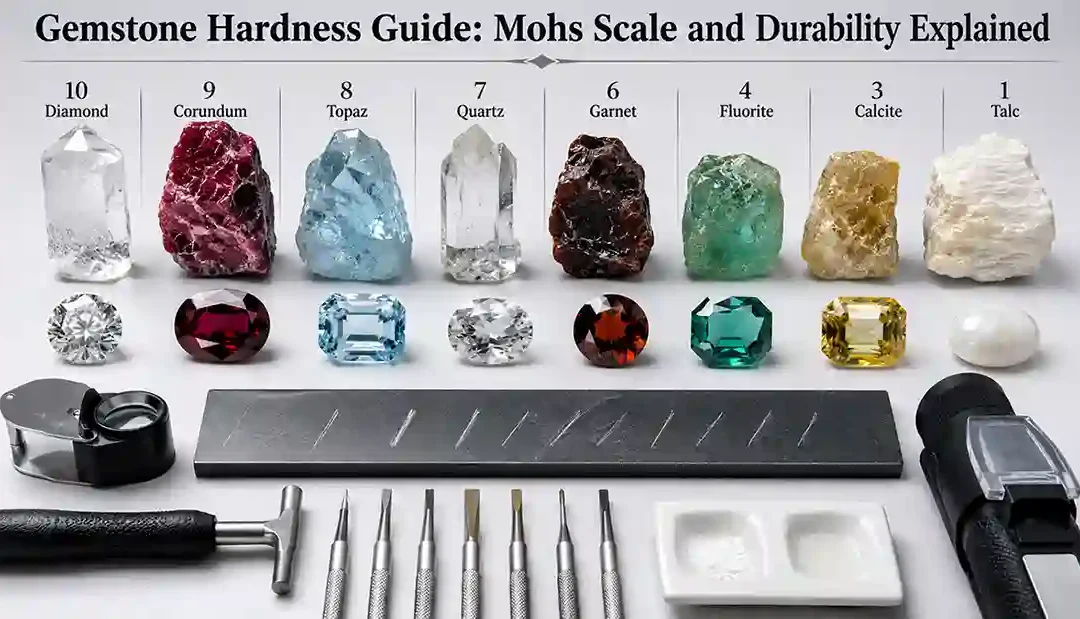
Hardness is one of the most important properties used to identify gemstones and minerals. It measures a gemstone's resistance to scratching and helps gemologists determine durability, suitability for jewelry, and mineral identity. The most widely used hardness system is the Mohs Hardness Scale, developed by German mineralogist Friedrich Mohs in 1812.
Understanding gemstone hardness helps collectors, jewelers, and geologists choose the right gemstone for different applications.
What Is Gemstone Hardness?
Gemstone hardness refers to resistance to scratching. A harder gemstone can scratch a softer gemstone.
Hardness does not measure:
- toughness
- durability
- resistance to breaking
It only measures scratch resistance.
The Mohs Hardness Scale
The Mohs scale ranks minerals from:
where:
- 1 = softest
- 10 = hardest
Each mineral can scratch all minerals below it.
Mohs Hardness Scale
| Hardness | Reference Mineral |
|---|---|
| 1 | Talc |
| 2 | Gypsum |
| 3 | Calcite |
| 4 | Fluorite |
| 5 | Apatite |
| 6 | Orthoclase Feldspar |
| 7 | Quartz |
| 8 | Topaz |
| 9 | Corundum |
| 10 | Diamond |
Why Hardness Matters
Hardness affects:
- scratch resistance
- gemstone longevity
- jewelry durability
- gemstone identification
- polishing quality
Harder gemstones generally retain their appearance longer.
Hardness vs Toughness
Hardness and toughness are not the same.
Hardness
Resistance to scratching.
Toughness
Resistance to breaking or chipping.
Example:
Diamond
- Hardness = 10
- Can still chip if struck hard enough.
Jade
- Lower hardness
- Extremely tough
Hardness vs Toughness
| Property | Measures |
|---|---|
| Hardness | Scratch Resistance |
| Toughness | Break Resistance |
| Durability | Overall Wear Resistance |
Hardness of Popular Gemstones
| Gemstone | Hardness |
|---|---|
| Diamond | 10 |
| Sapphire | 9 |
| Ruby | 9 |
| Chrysoberyl | 8.5 |
| Topaz | 8 |
| Spinel | 8 |
| Emerald | 7.5–8 |
| Aquamarine | 7.5–8 |
| Morganite | 7.5–8 |
| Garnet | 6.5–7.5 |
| Quartz (Amethyst, Citrine) | 7 |
| Tourmaline | 7–7.5 |
| Peridot | 6.5–7 |
| Opal | 5.5–6.5 |
| Turquoise | 5–6 |
| Lapis Lazuli | 5–5.5 |
| Fluorite | 4 |
Diamond: The Hardest Gemstone
Diamond consists of pure carbon: its atomic structure makes it the hardest natural material known. Diamond can scratch every other gemstone.
Corundum Gemstones
Ruby
Hardness:
Sapphire
Hardness:
These gemstones are second only to diamond in hardness.
Quartz Gemstones
Includes:
- amethyst
- citrine
- rose quartz
- smoky quartz
Hardness:
Quartz is durable enough for most jewelry applications.
Soft Gemstones
Some gemstones require extra care.
| Gemstone | Hardness |
|---|---|
| Opal | 5.5–6.5 |
| Turquoise | 5–6 |
| Moonstone | 6–6.5 |
| Lapis Lazuli | 5–5.5 |
| Fluorite | 4 |
These stones are more susceptible to scratches.
Gemstones Suitable for Everyday Rings
For daily wear, gemologists often recommend hardness 7 or Higher
Examples:
- diamond
- ruby
- sapphire
- spinel
- garnet
- aquamarine
- emerald
- quartz
These gemstones resist scratches better during daily use.
Hardness and Jewelry Wear
| Hardness | Wearability |
|---|---|
| 9–10 | Excellent |
| 8–9 | Very Good |
| 7–8 | Good |
| 6–7 | Moderate |
| Below 6 | Requires Care |
How Hardness Is Tested
A harder mineral scratches a softer one.
For example:
Quartz:
can scratch:
- calcite (3)
- fluorite (4)
- apatite (5)
but cannot scratch:
- corundum (9)
- diamond (10)
Relative Nature of the Mohs Scale
The Mohs scale is not linear.
For example:
Diamond (10) is far harder than corundum (9).
The jump between:
9 → 10
is much larger than:
4 → 5
This is why diamond is uniquely valuable for industrial cutting applications.
Hardness and Gemstone Identification
Hardness helps identify gemstones.
Examples:
Quartz
Hardness 7.
Topaz
Hardness 8.
Corundum
Hardness 9.
Diamond
Hardness 10.
Combined with other properties, hardness assists mineral identification.
Industrial Uses of Hard Minerals
Hard minerals are used for:
Cutting Tools
Diamond blades.
Abrasives
Garnet and corundum.
Polishing
Diamond powders.
Manufacturing
Precision machining.
Hardness is important beyond jewelry applications.
Quick Hardness Reference
| Gemstone | Mohs Hardness |
|---|---|
| Diamond | 10 |
| Ruby | 9 |
| Sapphire | 9 |
| Chrysoberyl | 8.5 |
| Topaz | 8 |
| Spinel | 8 |
| Emerald | 7.5–8 |
| Aquamarine | 7.5–8 |
| Quartz | 7 |
| Garnet | 6.5–7.5 |
| Opal | 5.5–6.5 |
| Turquoise | 5–6 |
Gemstone hardness measures resistance to scratching.
Diamond is the hardest natural gemstone with a Mohs hardness of 10.
No. Hardness measures scratch resistance, while toughness measures resistance to breaking.
Gemstones with hardness 7 or greater are generally recommended for everyday wear.
It helps identify minerals and evaluate gemstone durability.
Final Thoughts
Gemstone hardness is one of the most important concepts in gemology. By understanding the Mohs scale, collectors and jewelry enthusiasts can better evaluate gemstone durability, identify minerals, and choose stones suitable for daily wear.
From diamond at the top of the scale to softer gemstones such as turquoise and opal, hardness provides valuable insight into how gemstones perform both in nature and in jewelry. Combined with toughness, rarity, and beauty, hardness remains a key factor in understanding Earth's remarkable mineral treasures.
Continue learning with → /mineral-hardness-test/, /mohs-hardness-scale-explained/, and /how-to-identify-minerals/.