
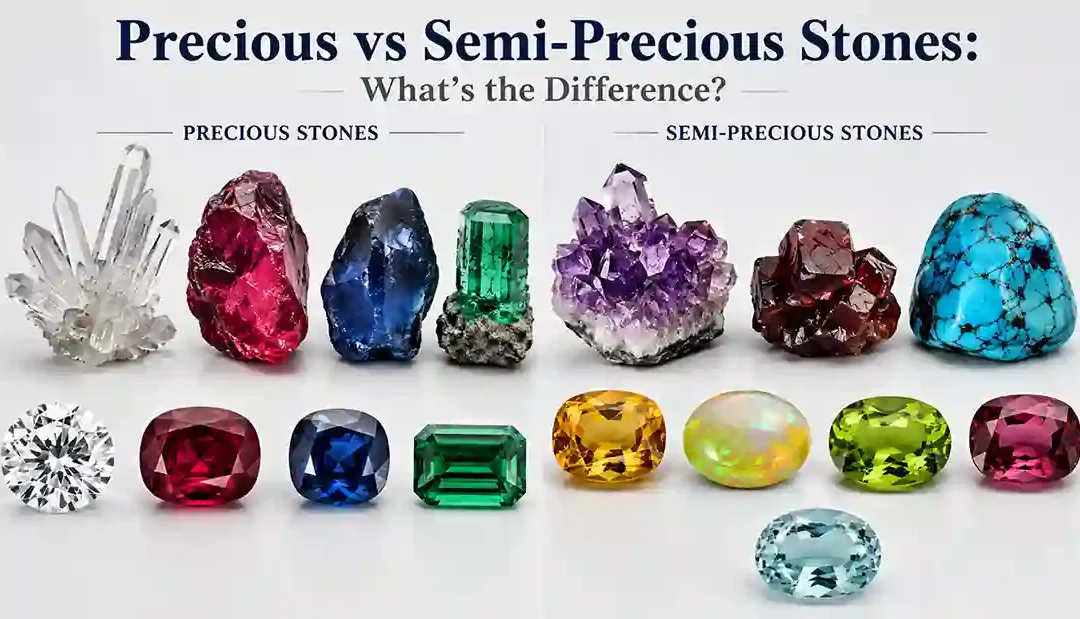
The terms precious and semi-precious stones have been used for centuries to classify gemstones. Traditionally, only four gemstones were considered precious, while all others were grouped into the semi-precious category.
However, modern gemologists recognize that this system is often misleading because many so-called semi-precious gemstones can be rarer and more valuable than some precious stones.
Today, gemstone value depends on factors such as rarity, quality, color, clarity, and demand rather than whether a stone is labeled precious or semi-precious.
What Are Precious Stones?
Historically, four gemstones were classified as precious:
| Precious Stone | Mineral Group |
|---|---|
| Diamond | Native Carbon |
| Ruby | Corundum |
| Sapphire | Corundum |
| Emerald | Beryl |
These gemstones were prized because of their:
- rarity
- beauty
- durability
- historical importance
The Four Precious Gemstones
Diamond
Chemical formula: C
Known for:
- exceptional hardness
- brilliance
- durability
Ruby
Chemical formula: Al₂O₃
Known for:
- deep red color
- rarity
- historical significance
Sapphire
Also a variety of corundum.
Known for:
- blue color
- durability
- gemstone quality
Emerald
Chemical formula: Be₃Al₂Si₆O₁₈
Known for:
- rich green color
- rarity
- collector value
What Are Semi-Precious Stones?
Semi-precious stones include all gemstones outside the traditional precious group.
Examples include:
- amethyst
- garnet
- topaz
- opal
- aquamarine
- turquoise
- spinel
- peridot
- tourmaline
- zircon
- tanzanite
- alexandrite
Hundreds of gemstone varieties fall into this category.
Traditional Gemstone Classification
| Category | Examples |
|---|---|
| Precious | Diamond, Ruby, Sapphire, Emerald |
| Semi-Precious | All Other Gemstones |
Why the Classification Exists
The distinction developed because these four gemstones were historically:
- difficult to obtain
- widely traded
- favored by royalty
- exceptionally durable
Ancient civilizations considered them the most valuable gems available.
Why Modern Gemologists Avoid the Term
Modern gemology increasingly avoids using "semi-precious" because it can be misleading.
Many semi-precious stones are:
- rarer than diamonds
- more valuable than lower-quality precious stones
- highly sought after by collectors
For example:
Alexandrite
Often sells for more than many rubies or sapphires.
Paraíba Tourmaline
Can be among the most expensive gemstones in the world.
Value Is Not Determined by Category
Gemstone value depends on:
Color
Most important factor for many gems.
Clarity
Fewer inclusions increase value.
Cut
Enhances brilliance and appearance.
Carat Weight
Larger gems are usually more valuable.
Rarity
Rare stones command higher prices.
Demand
Market trends affect pricing.
Modern Factors Affecting Gemstone Value
| Factor | Importance |
|---|---|
| Color | Very High |
| Rarity | Very High |
| Clarity | High |
| Cut | High |
| Size | Moderate to High |
| Demand | Moderate |
Semi-Precious Stones More Valuable Than Precious Stones
Some gemstones classified as semi-precious may exceed precious stones in value.
Examples include:
Alexandrite
Color-changing chrysoberyl.
Paraíba Tourmaline
Electric blue-green tourmaline.
Red Beryl
One of the rarest gemstones on Earth.
Fine Jadeite
Exceptional-quality jade can be extremely valuable.
Comparison of Famous Gemstones
| Gemstone | Traditional Category |
|---|---|
| Diamond | Precious |
| Ruby | Precious |
| Sapphire | Precious |
| Emerald | Precious |
| Alexandrite | Semi-Precious |
| Tanzanite | Semi-Precious |
| Opal | Semi-Precious |
| Spinel | Semi-Precious |
| Tourmaline | Semi-Precious |
| Aquamarine | Semi-Precious |
Precious Stone Properties
High Durability
Generally suitable for jewelry.
Historical Importance
Used by royalty and nobility.
Strong Market Demand
Global recognition.
Long Trading History
Established gemstone markets.
Semi-Precious Stone Advantages
Semi-precious stones offer:
- wider color ranges
- unique optical effects
- greater variety
- often lower prices
- collector appeal
Many gemstone enthusiasts prefer semi-precious gems because of their uniqueness.
Rare Semi-Precious Gemstones
Some of the rarest gemstones include:
- Alexandrite
- Red Beryl
- Paraíba Tourmaline
- Benitoite
- Jeremejevite
Many people are surprised to learn these gems are classified as semi-precious.
Precious vs Semi-Precious: Key Differences
| Feature | Precious Stones | Semi-Precious Stones |
|---|---|---|
| Traditional Count | 4 | Hundreds |
| Historical Prestige | Very High | Variable |
| Variety | Limited | Extensive |
| Modern Value Indicator | No | No |
| Collector Interest | High | High |
Today, neither category guarantees value.
Popular Semi-Precious Gemstones
Popular examples include:
- amethyst
- garnet
- turquoise
- citrine
- peridot
- tourmaline
- aquamarine
- opal
These gemstones remain highly desirable in jewelry.
Is Diamond Always More Valuable?
Not necessarily.
A small high-quality alexandrite or Paraíba tourmaline may be worth significantly more per carat than many diamonds. Modern gemstone pricing depends on quality and rarity rather than traditional categories.
The Modern Gemological View
Most professional gemologists focus on:
- species
- variety
- quality
- rarity
- treatment status
rather than simply labeling stones as precious or semi-precious.
Quick Reference Chart
| Gemstone | Traditional Classification |
|---|---|
| Diamond | Precious |
| Ruby | Precious |
| Sapphire | Precious |
| Emerald | Precious |
| Amethyst | Semi-Precious |
| Garnet | Semi-Precious |
| Opal | Semi-Precious |
| Tourmaline | Semi-Precious |
| Alexandrite | Semi-Precious |
| Tanzanite | Semi-Precious |
Traditionally, diamond, ruby, sapphire, and emerald are classified as precious stones.
Semi-precious stones include all other gemstones outside the traditional precious category.
No. Many semi-precious gemstones are rarer and more expensive than some precious stones.
Because it can incorrectly imply that these gemstones are less valuable or less important.
Color, rarity, clarity, cut, size, and market demand are the primary factors.
Final Thoughts
The distinction between precious and semi-precious stones is largely historical rather than scientific. While diamonds, rubies, sapphires, and emeralds have long been considered the most prestigious gemstones, modern gemology recognizes that many so-called semi-precious gems can equal or exceed them in rarity, beauty, and value.
Understanding gemstone quality, rarity, and geological origin provides a far more accurate picture than traditional classifications. Whether precious or semi-precious, every gemstone represents a remarkable product of Earth's geological processes and natural beauty.
Continue learning with → /birthstones-explained/, /beryl-minerals-explained/, and /alexandrite-mineral-explained/.