
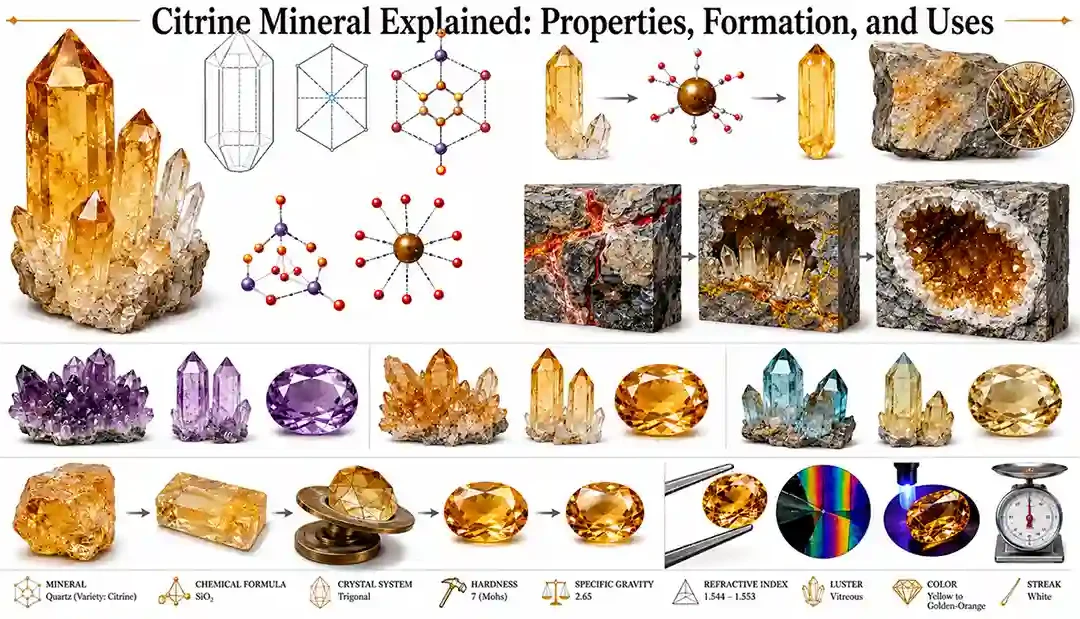
Citrine is one of the most popular and affordable gemstone varieties of quartz. Famous for its warm yellow, golden, and orange colors, citrine has been prized for centuries as a symbol of prosperity, energy, and success.
Its bright appearance, durability, and availability make it one of the most widely used gemstones in jewelry worldwide.
Natural citrine is relatively rare, making high-quality specimens especially valuable to collectors and gem enthusiasts.
What Is Citrine?
Citrine is the yellow to orange variety of quartz.
Its attractive color is primarily caused by trace amounts of iron within the crystal structure.
Citrine is valued for:
- golden-yellow color
- gemstone clarity
- durability
- affordability
- jewelry applications
The name "citrine" comes from the French word citron, meaning lemon.
Citrine Mineral Profile
| Property | Value |
|---|---|
| Mineral Group | Quartz |
| Chemical Formula | SiO₂ |
| Color | Yellow, Golden, Orange |
| Hardness | 7 |
| Crystal System | Trigonal |
| Luster | Vitreous |
| Streak | White |
| Specific Gravity | 2.65 |
What Causes Citrine's Color?
The yellow coloration is mainly produced by:
Iron Impurities
Trace iron atoms within the quartz structure.
Natural Heating
Geological heating processes can alter iron oxidation states.
Radiation Effects
Natural radiation may contribute to color development.
The intensity of color can range from pale yellow to deep amber-orange.
Crystal Structure
Citrine crystallizes in the:
Trigonal Crystal System
Characteristics include:
- hexagonal crystal appearance
- prismatic crystals
- pyramidal crystal terminations
- well-developed crystal faces
Learn more → trigonal-crystal-system
Physical Properties
Hardness
Luster
Vitreous (glass-like).
Transparency
Transparent to translucent.
Cleavage
None.
Fracture
Conchoidal.
Its hardness makes citrine suitable for everyday jewelry wear.
Formation of Citrine
Citrine forms in several geological environments.
Hydrothermal Veins
Mineral-rich fluids deposit quartz crystals.
Pegmatites
Large crystals grow in slowly cooled magma.
Geodes
Quartz crystals develop inside cavities.
Volcanic Rocks
Silica-rich fluids promote crystal growth.
Most natural citrine forms through geological heating of iron-bearing quartz.
Natural Citrine vs Heat-Treated Citrine
Much of the citrine sold today is produced by heating amethyst.
| Feature | Natural Citrine | Heat-Treated Citrine |
|---|---|---|
| Origin | Natural Geological Process | Artificial Heating |
| Color | Pale Yellow to Golden | Deep Orange-Brown |
| Rarity | Rare | Common |
| Value | Higher | Lower |
Both are genuine quartz, but natural citrine is generally more valuable.
Major Sources of Citrine
Important citrine-producing countries include:
- Brazil
- Madagascar
- Russia
- Bolivia
- Spain
- United States
Brazil is the world's largest producer of citrine gemstones.
Citrine vs Yellow Topaz
These gemstones are often confused.
| Property | Citrine | Topaz |
|---|---|---|
| Mineral Group | Quartz | Topaz |
| Hardness | 7 | 8 |
| Formula | SiO₂ | Al₂SiO₄(F,OH)₂ |
| Cleavage | None | Perfect |
| Price | Generally Lower | Generally Higher |
Citrine is usually easier to identify because it lacks topaz's perfect cleavage.
Citrine vs Yellow Sapphire
| Property | Citrine | Yellow Sapphire |
|---|---|---|
| Mineral Group | Quartz | Corundum |
| Hardness | 7 | 9 |
| Formula | SiO₂ | Al₂O₃ |
| Value | Moderate | Higher |
Yellow sapphire is considerably harder and usually more expensive.
Citrine in Jewelry
Citrine is commonly used in:
- rings
- earrings
- necklaces
- bracelets
- pendants
Its warm color pairs beautifully with:
- yellow gold
- white gold
- rose gold
- silver
Citrine as a Birthstone
Citrine is one of the traditional birthstones for November. It is often paired with topaz as a November birthstone.
Factors Affecting Citrine Value
Color
Rich golden-yellow tones are most desirable.
Clarity
Eye-clean stones command higher prices.
Cut
Excellent cutting improves brilliance.
Carat Weight
Larger stones are more valuable.
Natural Origin
Natural citrine is generally more valuable than heat-treated material.
Citrine Mining and Gemstones
Citrine is commonly recovered from:
- quartz veins
- pegmatites
- volcanic geodes
- alluvial deposits
Many specimens are cut into gemstones because of their clarity and color.
Why Citrine Is Popular
Citrine remains popular because of:
- bright cheerful color
- durability
- affordability
- gemstone clarity
- wide availability
It offers the beauty of a colored gemstone at a relatively accessible price.
Citrine Identification Summary
| Property | Citrine |
|---|---|
| Formula | SiO₂ |
| Mineral Group | Quartz |
| Hardness | 7 |
| Crystal System | Trigonal |
| Color | Yellow to Orange |
| Streak | White |
| Luster | Vitreous |
Citrine is the yellow-to-orange variety of quartz.
Trace amounts of iron within the quartz crystal structure create its yellow coloration.
Yes. Natural citrine exists, although much commercial citrine is produced by heating amethyst.
Citrine has a Mohs hardness of 7.
Major sources include Brazil, Madagascar, Bolivia, Russia, Spain, and the United States.
Final Thoughts
Citrine is one of the most attractive members of the quartz family. Its warm golden colors, durability, and affordability have made it a favorite gemstone for centuries.
From hydrothermal veins and quartz geodes deep within Earth's crust to sparkling jewelry pieces around the world, citrine showcases the beauty that simple silica and trace elements can create. Its combination of beauty, practicality, and geological interest ensures its continued popularity among collectors, gemologists, and jewelry enthusiasts.
Continue learning with → quartz-mineral-explained