
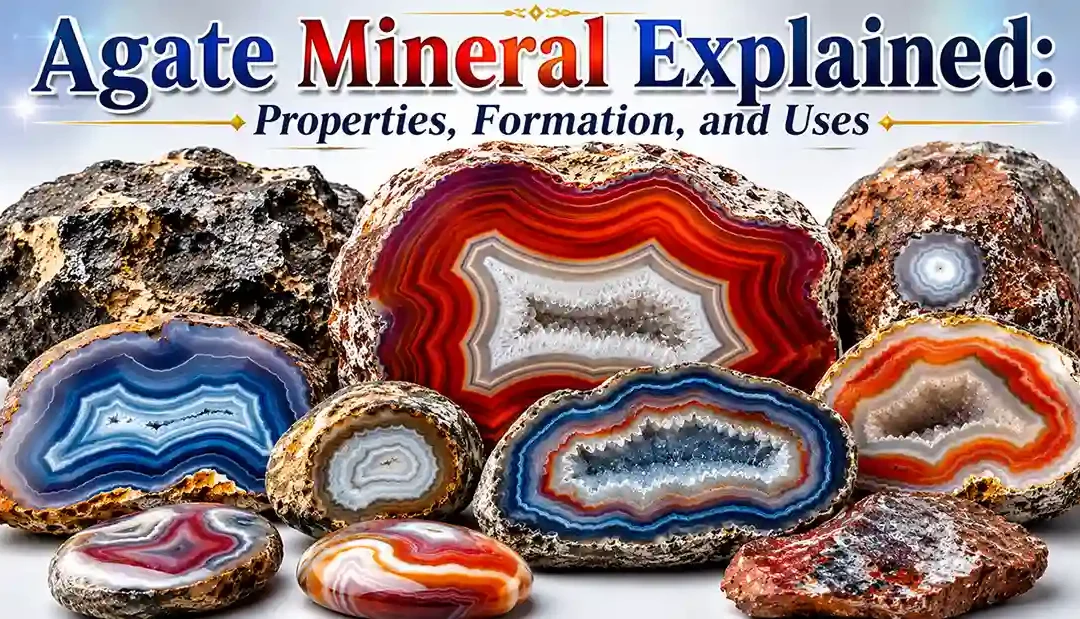
Agate is one of the most recognizable and popular ornamental gemstones in the world. Known for its beautiful banded patterns and wide range of colors, agate has been used for jewelry, carvings, decorative objects, and spiritual artifacts for thousands of years.
Agate belongs to the quartz family and is a variety of chalcedony composed of microscopic quartz crystals.
Its distinctive layered appearance makes every agate specimen unique.
What Is Agate?
Agate is a banded variety of chalcedony, a cryptocrystalline form of quartz.
It is characterized by:
- concentric bands
- layered color patterns
- translucent appearance
- high polishability
- remarkable variety
Agate forms when silica-rich fluids deposit successive layers inside cavities within rocks.
Agate Mineral Profile
| Property | Value |
|---|---|
| Mineral Group | Quartz (Chalcedony) |
| Chemical Formula | SiO₂ |
| Color | Multicolored |
| Hardness | 6.5–7 |
| Crystal System | Trigonal |
| Luster | Waxy to Vitreous |
| Streak | White |
| Specific Gravity | 2.58–2.64 |
Why Is Agate Banded?
The beautiful bands form through repeated deposition of silica-rich solutions.
As fluids enter cavities in volcanic or sedimentary rocks:
- silica precipitates
- impurities create colors
- layers accumulate over time
This produces the distinctive concentric patterns seen in agates.
Formation of Agate
Agate commonly forms in:
Volcanic Rocks
Gas bubbles create cavities.
Lava Flows
Silica-rich fluids fill voids.
Sedimentary Rocks
Groundwater deposits silica.
Hydrothermal Environments
Hot fluids contribute minerals.
Over long periods, the cavities become filled with layered chalcedony.
How Agate Forms
Step 1
Gas bubbles form cavities in lava.
Step 2
Silica-rich groundwater enters the cavities.
Step 3
Successive layers of chalcedony are deposited.
Step 4
Colorful bands develop due to impurities.
Step 5
The cavity becomes a complete agate nodule.
Physical Properties
Hardness
Luster
Waxy to vitreous.
Transparency
Transparent to translucent.
Fracture
Conchoidal.
Cleavage
None.
These properties make agate durable and suitable for jewelry.
Colors of Agate
Agate occurs in many colors, including:
- white
- gray
- blue
- red
- orange
- yellow
- brown
- black
- green
Colors are produced by trace elements and mineral inclusions.
Common Agate Varieties
Banded Agate
Classic concentric layering.
Moss Agate
Contains plant-like mineral inclusions.
Fire Agate
Displays iridescent colors.
Blue Lace Agate
Delicate blue and white banding.
Botswana Agate
Fine parallel bands.
Crazy Lace Agate
Complex swirling patterns.
Dendritic Agate
Tree-like manganese inclusions.
Popular Agate Varieties
| Variety | Distinctive Feature |
|---|---|
| Blue Lace Agate | Blue Bands |
| Moss Agate | Green Inclusions |
| Fire Agate | Iridescence |
| Botswana Agate | Fine Banding |
| Crazy Lace Agate | Swirling Patterns |
| Dendritic Agate | Tree-Like Structures |
Agate vs Jasper
Both belong to the quartz family.
| Property | Agate | Jasper |
|---|---|---|
| Transparency | Translucent | Opaque |
| Banding | Common | Rare |
| Structure | Layered | Massive |
| Appearance | Banded | Uniform |
Agate generally exhibits greater translucency and banding.
Agate vs Chalcedony
Agate is actually a variety of chalcedony.
Chalcedony
Broad mineral category.
Agate
Banded form of chalcedony.
All agates are chalcedony, but not all chalcedony is agate.
Major Sources of Agate
Important agate-producing regions include:
- Brazil
- Uruguay
- India
- Mexico
- United States
- Madagascar
Brazil and Uruguay are particularly famous for large agate geodes.
Agate in Jewelry and Decoration
Agate is widely used in:
- necklaces
- bracelets
- rings
- pendants
- carvings
- bookends
- decorative objects
Its durability and attractive patterns make it highly versatile.
Agate Geodes
Some agates contain:
- quartz crystals
- amethyst crystals
- hollow centers
These are known as agate geodes and are highly prized by collectors.
Why Agate Is Popular
Agate remains popular because of:
- beautiful natural patterns
- durability
- affordability
- wide color range
- unique appearance
No two agates are exactly alike.
Agate Mining and Specimens
Agates are commonly collected from:
- volcanic terrains
- river gravels
- weathered lava flows
- sedimentary deposits
Many specimens are cut and polished to reveal their internal patterns.
Agate in History
Agate has been used since ancient times by:
- Egyptians
- Greeks
- Romans
- Persians
It was commonly carved into:
- seals
- amulets
- jewelry
- ceremonial objects
Its use spans thousands of years of human history.
Agate Identification Summary
| Property | Agate |
|---|---|
| Formula | SiO₂ |
| Mineral Group | Chalcedony |
| Hardness | 6.5–7 |
| Crystal System | Trigonal |
| Streak | White |
| Luster | Waxy-Vitreous |
| Key Feature | Banded Layers |
Agate is a banded variety of chalcedony, which is a cryptocrystalline form of quartz.
Bands form from repeated deposition of silica-rich solutions inside rock cavities.
Yes. Agate is a variety of quartz with the chemical formula SiO₂.
Major sources include Brazil, Uruguay, India, Mexico, Madagascar, and the United States.
Agate has a Mohs hardness of approximately 6.5–7.
Final Thoughts
Agate is one of the most fascinating members of the quartz family. Its colorful banding, diverse varieties, and remarkable geological formation process have made it a favorite among collectors, gem enthusiasts, and geologists for centuries.
From volcanic cavities deep within Earth to polished gemstones and decorative pieces, agate showcases the beauty that can emerge from simple silica-rich fluids over geological time. Its endless variety ensures that every agate specimen tells a unique geological story.
Continue learning with → quartz-mineral-explained