
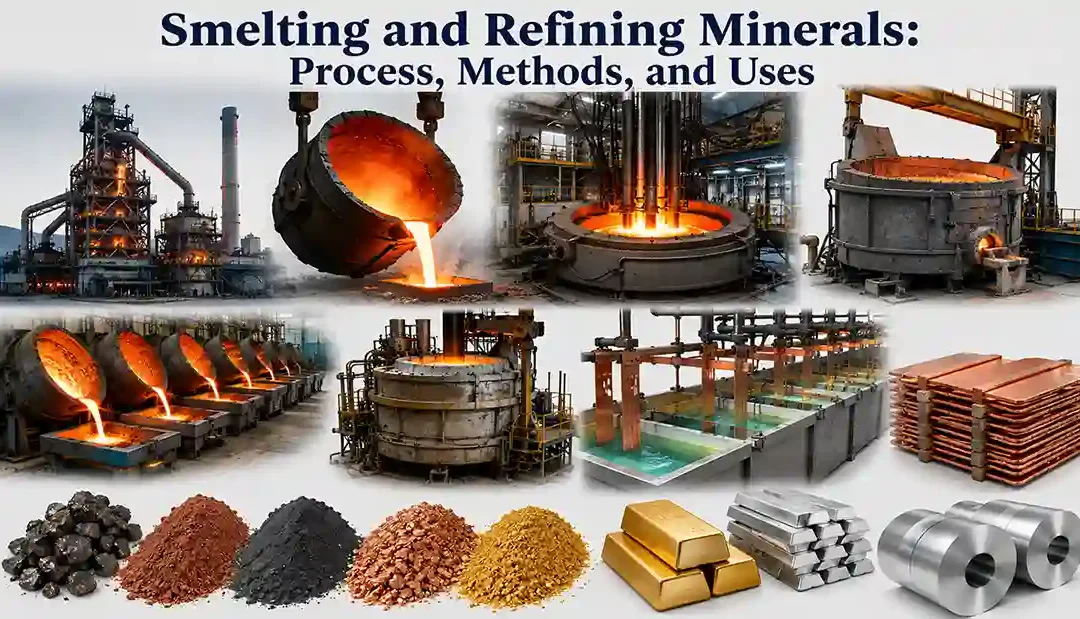
After minerals have been mined and concentrated through mineral processing, valuable metals still remain locked within mineral compounds. Smelting and refining are the final stages of metal production that transform mineral concentrates into pure, usable metals.
These processes are responsible for producing:
- copper
- iron
- aluminum
- zinc
- lead
- nickel
- gold
- silver
Without smelting and refining, modern industries would not have access to the high-purity metals required for manufacturing, construction, transportation, and technology.
What Is Smelting?
Smelting is a high-temperature metallurgical process that extracts metals from ores or concentrates.
The process uses:
- heat
- chemical reactions
- reducing agents
to separate metal from unwanted materials.
Smelting is one of the oldest industrial technologies used by humans.
What Is Refining?
Refining is the process of purifying extracted metal after smelting.
The objective is to remove:
- impurities
- unwanted elements
- residual contaminants
to produce high-purity metal suitable for industrial use.
Smelting vs Refining
| Process | Purpose |
|---|---|
| Smelting | Extract Metal from Ore |
| Refining | Purify Extracted Metal |
| Smelting Product | Crude Metal |
| Refining Product | High-Purity Metal |
Why Smelting and Refining Are Important
These processes help:
Produce Pure Metals
Improve metal quality.
Increase Economic Value
Pure metals are worth significantly more.
Remove Impurities
Enhance performance and durability.
Supply Modern Industries
Provide materials for manufacturing and technology.
The Metal Production Chain
The journey from ore to metal typically follows:
1. Exploration
Discover mineral deposits.
2. Mining
Extract ore.
3. Mineral Processing
Produce concentrates.
4. Smelting
Extract crude metal.
5. Refining
Produce pure metal.
6. Manufacturing
Create finished products.
Ore-to-Metal Workflow
| Stage | Output |
|---|---|
| Mining | Ore |
| Processing | Concentrate |
| Smelting | Crude Metal |
| Refining | Pure Metal |
| Manufacturing | Products |
How Smelting Works
Smelting generally involves:
Heating
Ore concentrate is heated.
Reduction
Oxygen is removed from metal compounds.
Separation
Metal separates from waste materials.
Collection
Molten metal is recovered.
Most smelting operations use temperatures exceeding 1,000°C.
Key Components of Smelting
Ore Concentrate
Source of metal.
Flux
Helps remove impurities.
Examples:
- limestone
- silica
Fuel
Provides heat.
Examples:
- coal
- coke
- natural gas
- electricity
Furnace
Contains the smelting process.
Slag Formation
Impurities combine with fluxes to form slag.
Slag typically contains:
- silica
- oxides
- waste materials
Benefits include:
- impurity removal
- cleaner metal production
- improved recovery
Types of Smelting
Blast Furnace Smelting
Used primarily for iron production.
Flash Smelting
Common in copper extraction.
Electric Furnace Smelting
Uses electrical energy.
Reverberatory Smelting
Traditional large-scale smelting.
Iron Smelting
Iron is commonly produced from hematite and magnetite ores.
Major raw materials:
- iron ore
- coke
- limestone
Iron oxide reduction can be represented by:
The resulting molten iron is collected from the blast furnace.
Copper Smelting
Copper is one of the most important smelting products.
Common copper ores include:
- chalcopyrite
- bornite
- chalcocite
Copper concentrates are smelted to produce:
Matte
Intermediate copper sulfide product.
Blister Copper
Approximately 98–99% pure copper.
Further refining is required for high-purity copper.
Gold Smelting
Gold smelting involves:
- melting concentrates
- separating impurities
- producing dore bars
Gold refining then produces extremely pure gold for industrial and investment use.
Refining Methods
Several refining methods are used.
Fire Refining
Uses heat and oxidation.
Common for:
- copper
- lead
Electrorefining
Uses electrical current to purify metals.
Common for:
- copper
- nickel
- zinc
Electrorefined copper can exceed 99.99% purity.
Chemical Refining
Uses chemical reactions.
Common for:
- precious metals
- specialty metals
Zone Refining
Produces ultra-high-purity materials.
Used for:
- semiconductors
- silicon
Major Refining Methods
| Method | Common Metals |
|---|---|
| Fire Refining | Copper, Lead |
| Electrorefining | Copper, Nickel |
| Chemical Refining | Gold, Silver |
| Zone Refining | Silicon |
Electrorefining of Copper
Copper electrorefining uses:
Anode
Impure copper.
Cathode
Pure copper sheet.
Electrolyte
Copper sulfate solution.
The process transfers copper ions from the anode to the cathode, producing highly pure copper.
Hydrometallurgy
Hydrometallurgy extracts metals using chemical solutions.
Common techniques:
Leaching
Dissolves metals.
Solvent Extraction
Separates metal ions.
Electrowinning
Recovers metal from solution.
Widely used for:
- copper
- uranium
- gold
Pyrometallurgy
Pyrometallurgy uses heat to extract metals.
Includes:
- roasting
- smelting
- converting
Common for:
- iron
- copper
- nickel
- lead
Environmental Considerations
Modern smelters use:
Emission Controls
Reduce air pollution.
Sulfur Recovery Systems
Capture sulfur dioxide.
Waste Recycling
Recover valuable materials.
Energy Efficiency
Reduce environmental impact.
Modern facilities are far cleaner than historical smelters.
Modern Smelting and Refining Technologies
Modern technologies include:
- automation
- AI-based process control
- continuous smelting
- advanced filtration
- energy-efficient furnaces
These innovations improve recovery and sustainability.
Metals Commonly Produced
| Metal | Major Refining Method |
|---|---|
| Copper | Electrorefining |
| Iron | Blast Furnace |
| Gold | Chemical Refining |
| Silver | Electrorefining |
| Nickel | Electrorefining |
| Zinc | Electrowinning |
| Aluminum | Electrolysis |
Why Smelting and Refining Matter
These processes:
- convert minerals into usable metals
- support manufacturing
- enable technological development
- improve resource efficiency
- increase economic value
They form the final link between geology and modern industry.
Smelting is a high-temperature process that extracts metals from ores or mineral concentrates.
Refining is the purification of extracted metal to remove impurities and improve quality.
Slag is a waste product formed when impurities combine with fluxes during smelting.
Electrorefining uses electricity to produce highly pure metals such as copper and nickel.
Smelting extracts metal from ore, while refining purifies the extracted metal.
Final Thoughts
Smelting and refining are critical stages in the production of metals that power modern civilization. Through thermal, chemical, and electrochemical processes, these technologies transform mineral concentrates into pure metals used in construction, transportation, electronics, energy systems, and countless industrial applications.
Understanding smelting and refining provides an essential connection between economic geology, mining, mineral processing, and metallurgy, revealing how Earth's mineral resources become the materials that shape our world.
Continue learning with → /mineral-processing-basics/, /mining-and-mineral-extraction/, and /economic-geology-explained/.