
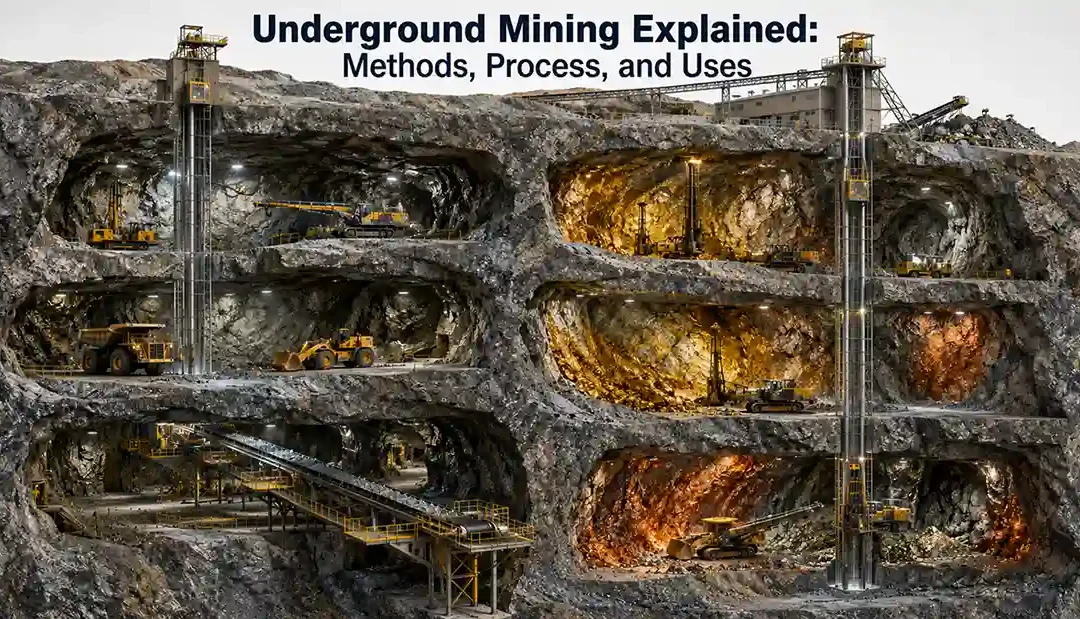
Underground mining is a method used to extract valuable minerals and ore deposits located deep beneath Earth's surface. When mineral resources occur too deep for economical surface mining, underground mining provides access through tunnels, shafts, and underground workings.
Many valuable resources are mined underground, including:
- gold
- copper
- silver
- zinc
- lead
- diamonds
- uranium
Although underground mining is generally more expensive than surface mining, it allows extraction of deep, high-grade ore deposits that would otherwise be inaccessible.
What Is Underground Mining?
Underground mining is the process of extracting minerals and ore from beneath Earth's surface through a network of shafts, tunnels, and excavated chambers.
Unlike open pit mining, underground mining minimizes surface disturbance while accessing deep mineral deposits.
It is commonly used when:
- ore occurs at great depth
- stripping ratios are too high
- surface mining becomes uneconomic
- environmental footprint must be reduced
Underground Mining at a Glance
| Feature | Description |
|---|---|
| Mining Type | Subsurface Mining |
| Typical Depth | Hundreds to Thousands of Meters |
| Initial Cost | High |
| Production Rate | Moderate |
| Main Resources | Gold, Copper, Zinc, Uranium |
Why Underground Mining Is Used
Underground mining becomes necessary when:
Ore Deposits Are Deep
Surface mining becomes too expensive.
High-Grade Ore Exists
Deep deposits may contain valuable concentrations.
Surface Disturbance Must Be Reduced
Smaller surface footprint than open pit mining.
Geological Conditions Are Suitable
Rock stability supports underground excavation.
Main Components of an Underground Mine
Shaft
Vertical access opening.
Decline Ramp
Sloping tunnel for vehicle access.
Drift
Horizontal tunnel following the ore body.
Stope
Excavated area where ore is removed.
Ventilation System
Provides fresh air underground.
Hoisting System
Lifts ore and workers.
Underground Mine Infrastructure
| Component | Function |
|---|---|
| Shaft | Vertical access |
| Ramp | Vehicle access |
| Drift | Horizontal access |
| Stope | Ore extraction |
| Ventilation | Air circulation |
| Hoist | Material transport |
Underground Mining Process
1. Exploration
Geologists identify deep ore deposits.
2. Mine Development
Shafts and tunnels are constructed.
3. Ore Access
Ore zones are reached underground.
4. Extraction
Ore is mined from stopes.
5. Hauling
Ore is transported to the surface.
6. Processing
Minerals are recovered from ore.
7. Closure and Reclamation
Mine is safely closed and restored.
Underground Mining Methods
Different methods are used depending on ore geometry and rock conditions.
1. Room and Pillar Mining
Ore is mined while leaving pillars of rock to support the roof.
Commonly used for:
- coal
- potash
- salt
- industrial minerals
Advantages:
- simple design
- good stability
- relatively low cost
2. Cut and Fill Mining
Ore is removed in sections and excavated areas are filled with waste material.
Suitable for:
- steep ore bodies
- irregular deposits
- high-grade resources
Provides excellent ground support.
3. Longwall Mining
Widely used in coal mining.
Features include:
- mechanized extraction
- moving roof supports
- high productivity
Common in large coal operations.
4. Sublevel Stoping
Ore is blasted from multiple underground levels.
Used for:
- steeply dipping ore bodies
- hard rock mines
Offers high production rates.
5. Block Caving
A large ore body is undercut and allowed to collapse under gravity.
Advantages:
- low operating cost
- high production capacity
Commonly used in:
- copper mines
- porphyry deposits
Major Underground Mining Methods
| Method | Typical Commodity |
|---|---|
| Room and Pillar | Coal |
| Cut and Fill | Gold |
| Longwall | Coal |
| Sublevel Stoping | Copper |
| Block Caving | Copper, Gold |
Underground Mining Equipment
Modern underground mines use specialized machinery.
Jumbo Drills
Create blast holes.
Load-Haul-Dump (LHD) Machines
Load and transport ore.
Underground Trucks
Move ore to shafts and ramps.
Bolting Machines
Install rock support.
Conveyor Systems
Transport material efficiently.
Ground Support Systems
Underground mines require support systems such as:
- rock bolts
- steel mesh
- shotcrete
- support arches
These systems help prevent rock falls and maintain safe working conditions.
Ventilation in Underground Mines
Ventilation is critical for:
- fresh air supply
- dust control
- gas removal
- temperature regulation
Modern mines use large ventilation fans and extensive airflow networks.
Underground Mining and Ore Bodies
Underground mining is commonly used for:
Vein Deposits
Gold and silver veins.
Massive Sulfide Deposits
Copper, zinc, and lead.
Kimberlite Pipes
Diamond deposits.
Deep Porphyry Deposits
Copper and gold resources.
Underground vs Open Pit Mining
| Feature | Underground | Open Pit |
|---|---|---|
| Depth | Deep Deposits | Shallow Deposits |
| Surface Disturbance | Lower | Higher |
| Cost | Higher | Lower |
| Production Rate | Lower | Higher |
| Infrastructure | Complex | Simpler |
Safety in Underground Mining
Modern underground mines focus heavily on:
Ground Control
Preventing rock failures.
Ventilation
Maintaining air quality.
Monitoring Systems
Tracking mine conditions.
Emergency Planning
Ensuring worker safety.
Technology has greatly improved underground mining safety over the past decades.
Famous Underground Mines
Notable underground mines include:
- Mponeng Gold Mine
- Kiruna Mine
- Oyu Tolgoi Underground Mine
- Creighton Mine
These operations demonstrate the scale and complexity of modern underground mining.
Future of Underground Mining
Modern underground mines increasingly use:
- automation
- autonomous loaders
- remote-controlled equipment
- artificial intelligence
- real-time monitoring
- digital mine planning
These innovations improve safety, productivity, and efficiency.
Common Minerals Extracted Underground
| Mineral | Typical Deposit Type |
|---|---|
| Gold | Veins & Lodes |
| Copper | Sulfide & Porphyry |
| Silver | Hydrothermal Veins |
| Zinc | Massive Sulfides |
| Uranium | Deep Ore Bodies |
| Diamonds | Kimberlite Pipes |
Underground mining is the extraction of minerals from beneath Earth's surface through shafts, tunnels, and underground excavations.
It is used when ore deposits are too deep for economical surface mining.
A stope is an underground excavation where ore is removed.
Block caving is a mining method where a large ore body collapses under gravity and is collected below.
Yes. Underground mining generally has higher development and operating costs but can access deep, high-grade ore deposits.
Final Thoughts
Underground mining is one of the most advanced and technically challenging methods of mineral extraction. Through shafts, tunnels, and specialized mining techniques, it provides access to valuable resources located deep within Earth's crust.
From gold and copper to diamonds and uranium, underground mining plays a vital role in supplying the raw materials needed for modern industry, technology, and economic development.
Continue learning with → /open-pit-mining-explained/, /mining-and-mineral-extraction/, and /ore-deposits-explained/.