
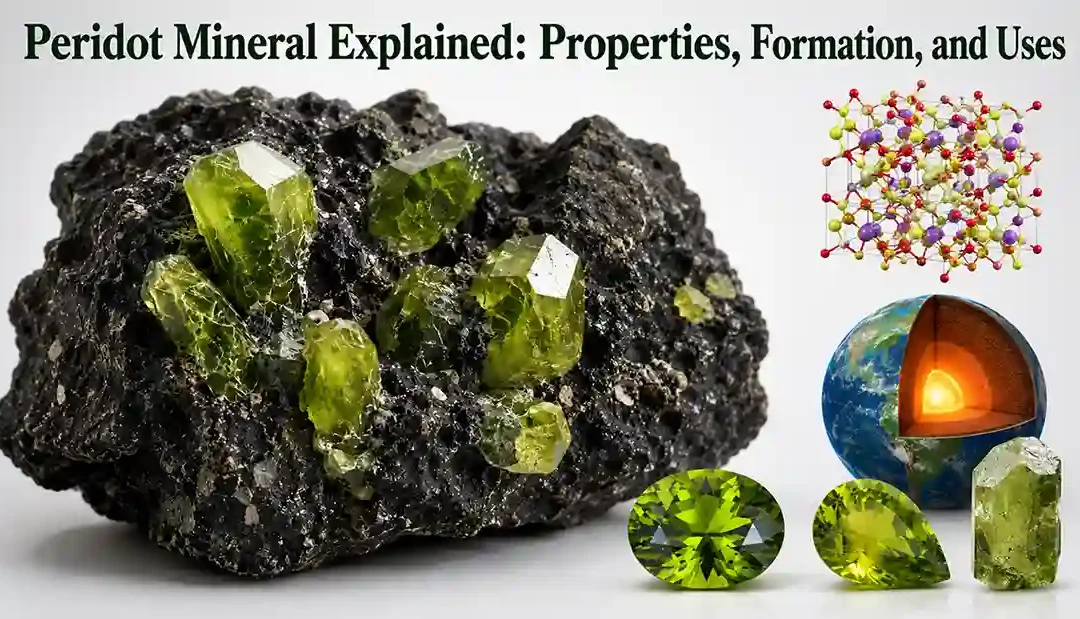
Peridot is the gemstone variety of the mineral olivine and is one of the few gemstones that occurs naturally in only shades of green. Its distinctive olive-green color comes from iron within its crystal structure rather than impurities.
Peridot is famous for its:
- vibrant green color
- volcanic origins
- mantle-derived formation
- gemstone quality transparency
Unlike many gemstones, peridot often forms deep within Earth's mantle before being transported to the surface by volcanic activity.
Learn more → olivine mineral explained
What Is Peridot?
Peridot is the gem-quality variety of olivine. Its chemical formula is
Peridot contains:
- magnesium
- iron
- silicon
- oxygen
It belongs to the nesosilicate mineral group.
Basic Properties of Peridot
| Property | Value |
|---|---|
| Chemical Formula | (Mg,Fe)₂SiO₄ |
| Mineral Group | Olivine |
| Crystal System | Orthorhombic |
| Hardness | 6.5–7 |
| Streak | White |
| Luster | Vitreous |
Why Is Peridot Green?
Unlike emerald or tourmaline, peridot's color comes directly from iron in its structure.
Colors range from:
- yellowish green
- olive green
- lime green
- deep green
The amount of iron controls the intensity of the color.
Because iron is an essential component of peridot, the gemstone is always green.
Crystal Structure of Peridot
Peridot contains:
- isolated silica tetrahedra
- magnesium ions
- iron ions
Its crystal structure creates:
- high transparency
- vitreous luster
- gemstone-quality clarity
Learn more → crystal structure in minerals
Crystal System of Peridot
Peridot belongs to the orthorhombic crystal system. Its crystallographic relationship is:
Common crystal habits include:
- granular crystals
- short prisms
- massive aggregates
Learn more → orthorhombic crystal system
Physical Properties of Peridot
| Property | Description |
|---|---|
| Color | Olive green to yellow-green |
| Streak | White |
| Luster | Vitreous |
| Hardness | 6.5–7 |
| Cleavage | Poor |
| Transparency | Transparent to translucent |
| Specific Gravity | 3.2–4.4 |
Peridot and the Mohs Hardness Scale
Peridot ranks hardness 6.5–7 on the Mohs Hardness Scale.
This hardness makes peridot suitable for:
- rings
- pendants
- earrings
- gemstone jewelry
Although durable, it is softer than sapphire and ruby.
Learn more → mohs hardness scale
How Peridot Forms
Mantle Formation
Most peridot originates deep within Earth's mantle.
Volcanic Activity
Volcanoes transport crystals to the surface.
Basaltic Rocks
Commonly found in basalt and related rocks.
Meteorites
Some peridot crystals occur in stony meteorites.
A Gemstone from Earth's Mantle
Peridot is unique because it often forms at depths exceeding 50−150 km within Earth's upper mantle. Volcanic eruptions rapidly transport these crystals to the surface before they can alter.
This makes peridot one of the few gemstones that originate directly from the mantle.
Peridot in Meteorites
Peridot has even been discovered in:
- pallasite meteorites
- extraterrestrial rocks
- some lunar materials
These occurrences make peridot one of the few gemstones found beyond Earth.
Peridot vs Emerald
| Property | Peridot | Emerald |
|---|---|---|
| Mineral | Olivine | Beryl |
| Formula | (Mg,Fe)₂SiO₄ | Be₃Al₂Si₆O₁₈ |
| Color Source | Iron | Chromium/Vanadium |
| Hardness | 6.5–7 | 7.5–8 |
Although both are green gemstones, they belong to completely different mineral groups.
Learn more → emerald mineral explained
Major Peridot-Producing Countries
Important sources include:
- Pakistan
- Myanmar
- China
- United States
- Vietnam
- Egypt
Pakistan is famous for producing some of the world's finest gem-quality peridot crystals.
Uses of Peridot
Jewelry
The primary commercial use.
Mineral Collections
Highly valued by collectors.
Museum Displays
Large crystals are popular exhibit specimens.
Geological Research
Important for studying mantle processes.
Major Uses of Peridot
| Industry | Application |
|---|---|
| Jewelry | Gemstones |
| Collecting | Mineral specimens |
| Museums | Displays |
| Research | Mantle geology |
Peridot in Mineral Identification
Geologists identify peridot using:
- olive-green color
- vitreous luster
- hardness of 6.5–7
- lack of cleavage
- association with volcanic rocks
Its characteristic olive-green color is one of the easiest identification features.
Learn more → mineral identification guide
Peridot Identification Summary
| Property | Peridot |
|---|---|
| Formula | (Mg,Fe)₂SiO₄ |
| Hardness | 6.5–7 |
| Crystal System | Orthorhombic |
| Color | Green |
| Luster | Vitreous |
| Mineral Group | Olivine |
Peridot is the gemstone variety of olivine with the formula (Mg,Fe)₂SiO₄.
Its green color comes directly from iron within its crystal structure.
Yes. Peridot-quality olivine occurs in some pallasite meteorites.
Peridot belongs to the orthorhombic crystal system.
Most peridot forms deep within Earth's mantle and is brought to the surface by volcanic eruptions.
Final Thoughts
Peridot is one of the most fascinating gemstones in geology because of its deep mantle origin and distinctive green color. Unlike many gemstones that form in Earth's crust, peridot often begins its journey far below the surface before volcanic eruptions transport it upward.
From volcanic rocks and meteorites to fine jewelry and museum displays, peridot provides a unique connection between Earth's deep interior and the beautiful gemstones we see at the surface.