
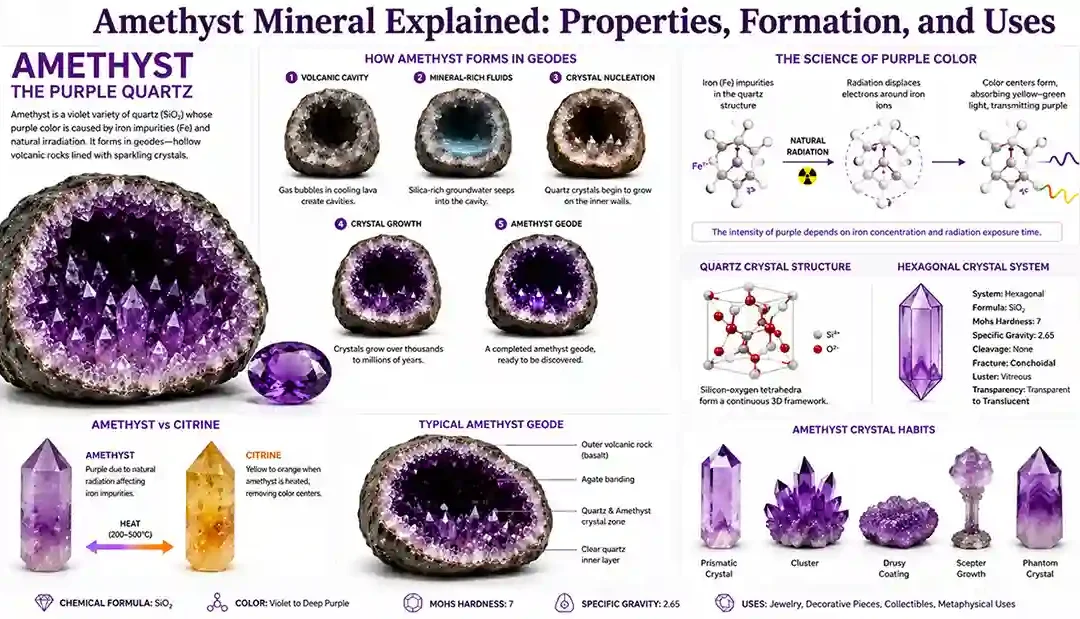
Amethyst is the purple variety of quartz and one of the world's most popular gemstones. Its striking violet color, abundance, and beautiful crystal formations have made it highly valued for jewelry, mineral collections, and decorative displays for thousands of years.
Amethyst is famous for:
- deep purple coloration
- spectacular geode formations
- affordability compared to other gemstones
- widespread occurrence around the world
As a variety of quartz, amethyst combines beauty with durability, making it one of the most important gemstone minerals in geology and gemology.
Learn more → quartz mineral explained
What Is Amethyst?
Amethyst is the purple gemstone variety of quartz. Its chemical formula is:
Amethyst consists of:
- silicon
- oxygen
Its purple color results from:
- iron impurities
- natural radiation exposure
- crystal lattice defects
Basic Properties of Amethyst
| Property | Value |
|---|---|
| Chemical Formula | SiO₂ |
| Mineral Group | Silicate |
| Crystal System | Hexagonal |
| Hardness | 7 |
| Streak | White |
| Luster | Vitreous |
Why Is Amethyst Purple?
Iron and Natural Radiation
Pure quartz is colorless.
Amethyst develops its purple color when:
- trace iron enters the crystal structure
- natural radiation alters iron ions
- color centers form within the crystal lattice
Colors range from:
- pale lavender
- violet
- deep purple
- reddish purple
The richest purple colors are generally the most valuable.
Crystal Structure of Amethyst
Amethyst shares the same structure as quartz.
Its crystal structure consists of:
- silicon-oxygen tetrahedra
- interconnected crystal networks
- hexagonal symmetry
This arrangement gives amethyst:
- hardness
- durability
- crystal transparency
Learn more → crystal structure in minerals
Crystal System of Amethyst
Crystal Classification
Amethyst belongs to the hexagonal crystal system. Its crystallographic relationship is:
Common crystal habits include:
- hexagonal prisms
- terminated crystal points
- crystal clusters
- geode linings
Learn more → hexagonal crystal system
Physical Properties of Amethyst
| Property | Description |
|---|---|
| Color | Purple to violet |
| Streak | White |
| Luster | Vitreous |
| Hardness | 7 |
| Cleavage | None |
| Transparency | Transparent to translucent |
| Specific Gravity | 2.65 |
Amethyst and the Mohs Hardness Scale
Amethyst ranks hardness 7 on the Mohs Hardness Scale.
This means amethyst is harder than:
- calcite
- fluorite
- apatite
but softer than:
- topaz
- corundum
- diamond
Learn more → mohs hardness scale
How Amethyst Forms
Volcanic Cavities
Most amethyst forms inside gas bubbles within volcanic rocks.
Hydrothermal Fluids
Silica-rich fluids deposit quartz crystals.
Geode Development
Crystal growth occurs inside hollow cavities.
Low-Temperature Mineralization
Forms relatively late in geological processes.
Amethyst Geodes
One of the most famous occurrences of amethyst is amethyst geodes
These develop when:
- Gas bubbles form in lava.
- Cavities remain after cooling.
- Silica-rich fluids enter.
- Quartz crystals grow inward.
Some geodes reach several meters in height.
Major Amethyst-Producing Countries
Important amethyst sources include:
- Brazil
- Uruguay
- Zambia
- Namibia
- Russia
- Madagascar
Brazil and Uruguay are particularly famous for giant amethyst geodes.
Amethyst vs Citrine
Both gemstones belong to the quartz family.
| Property | Amethyst | Citrine |
|---|---|---|
| Formula | SiO₂ | SiO₂ |
| Color | Purple | Yellow-Orange |
| Mineral | Quartz | Quartz |
| Hardness | 7 | 7 |
Heating amethyst can sometimes produce citrine-like colors.
Learn more → quartz mineral explained
Uses of Amethyst
Jewelry
Most important commercial use.
Decorative Geodes
Popular home and office displays.
Mineral Collections
Highly sought by collectors.
Museum Exhibits
Large geodes attract worldwide attention.
Major Uses of Amethyst
| Industry | Application |
|---|---|
| Jewelry | Gemstones |
| Decoration | Geodes |
| Museums | Displays |
| Collecting | Mineral specimens |
Amethyst in Mineral Identification
Geologists identify amethyst using:
- purple coloration
- quartz crystal habit
- hardness of 7
- vitreous luster
- absence of cleavage
Its distinctive color makes it one of the easiest quartz varieties to recognize.
Learn more → mineral identification guide
Amethyst Identification Summary
| Property | Amethyst |
|---|---|
| Formula | SiO₂ |
| Hardness | 7 |
| Crystal System | Hexagonal |
| Color | Purple |
| Luster | Vitreous |
| Mineral Group | Quartz |
Amethyst is the purple variety of quartz and consists of silicon dioxide (SiO₂).
Its purple color comes from iron impurities and natural radiation affecting the crystal structure.
Amethyst belongs to the hexagonal crystal system.
Amethyst commonly forms inside volcanic geodes and hydrothermal veins.
Amethyst has a hardness of 7 on the Mohs scale.
Final Thoughts
Amethyst is one of the most recognizable gemstone varieties in the world and a spectacular example of quartz mineralization. Its beautiful purple color, impressive geode formations, and widespread occurrence make it valuable to both geologists and gemstone enthusiasts.
From giant geodes in volcanic rocks to elegant jewelry pieces, amethyst demonstrates how trace impurities and geological processes can create extraordinary natural beauty.