
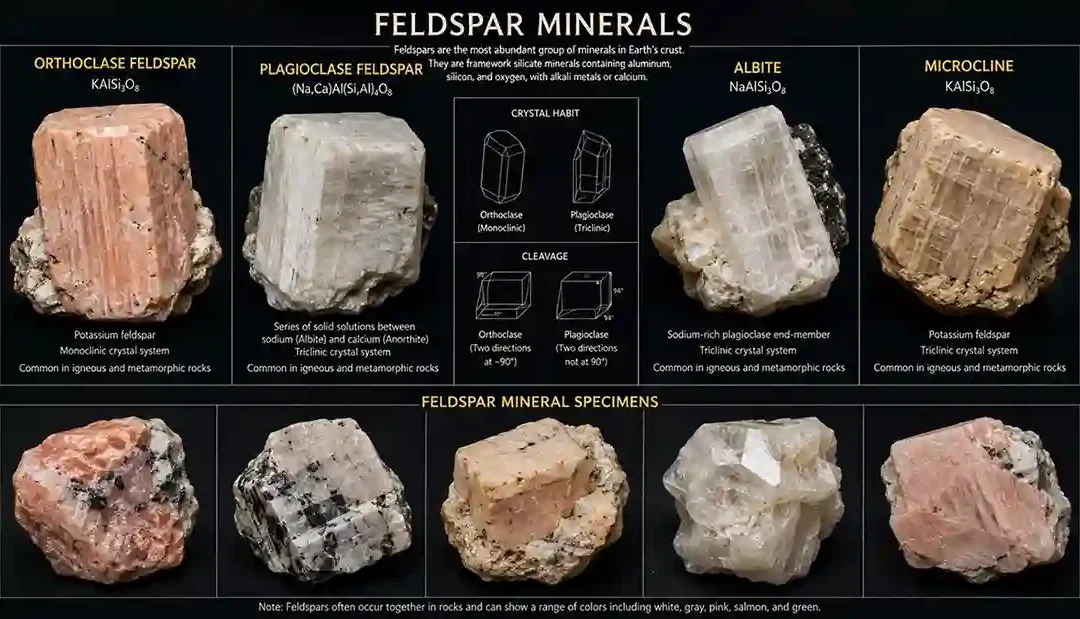
Feldspar is the most abundant mineral group in Earth's crust, making up approximately 50–60% of many rocks. These minerals are essential components of igneous, metamorphic, and sedimentary rocks and play a major role in understanding geological processes.
Feldspars are important because they:
- form many common rocks
- help classify igneous rocks
- reveal geological history
- provide valuable industrial materials
The feldspar group includes several minerals with similar crystal structures but different chemical compositions.
Learn more → mineral classification system
What Is Feldspar?
Feldspar is a group of rock-forming silicate minerals. Rather than being a single mineral, feldspar is a family of closely related minerals.
The two major feldspar groups are:
Potassium Feldspar (K-Feldspar)
Contains potassium.
Plagioclase Feldspar
Contains sodium and calcium.
Together, these minerals form a major portion of Earth's continental crust.
Basic Feldspar Properties
| Property | Typical Value |
|---|---|
| Mineral Group | Silicate |
| Hardness | 6–6.5 |
| Luster | Vitreous |
| Cleavage | Two directions |
| Streak | White |
| Crystal System | Monoclinic or Triclinic |
Chemical Composition of Feldspar
Feldspar minerals contain combinations of:
- silicon (Si)
- oxygen (O)
- aluminum (Al)
- potassium (K)
- sodium (Na)
- calcium (Ca)
Common feldspar formulas include:
Orthoclase
KAlSi3O8
Albite
NaAlSi3O8
Anorthite
CaAl2Si2O8
Major Types of Feldspar
Potassium Feldspar (K-Feldspar)
Common examples:
- Orthoclase
- Microcline
- Sanidine
Characteristics:
- rich in potassium
- commonly pink, white, or cream-colored
- abundant in granite
Plagioclase Feldspar
Common examples:
- Albite
- Oligoclase
- Labradorite
- Anorthite
Characteristics:
- sodium-calcium rich
- often white or gray
- common in basalt and gabbro
Feldspar Classification
| Feldspar Group | Common Minerals |
|---|---|
| Potassium Feldspar | Orthoclase, Microcline, Sanidine |
| Plagioclase Feldspar | Albite, Labradorite, Anorthite |
How Feldspar Forms
Feldspar commonly forms through:
Magmatic Crystallization
Cooling magma produces feldspar crystals.
Metamorphism
Heat and pressure can recrystallize feldspars.
Sedimentary Processes
Weathered feldspar grains may accumulate in sediments.
Feldspar is one of the earliest minerals to crystallize from magma.
Orthoclase Feldspar
Characteristics
- Potassium-rich feldspar
- Monoclinic crystal system
- Hardness of about 6
Common Occurrence
- Granite
- Pegmatites
- Metamorphic rocks
Orthoclase is one of the most important rock-forming minerals.
Learn more → monoclinic crystal system
Microcline Feldspar
Microcline is a potassium feldspar that belongs to the triclinic crystal system. A green variety called amazonite is a popular gemstone and collector mineral.
Learn more → triclinic crystal system
Plagioclase Feldspar
Plagioclase feldspars are recognized by
Polysynthetic Twinning
This creates parallel stripes visible under a microscope. Plagioclase minerals are extremely important in
- basalt
- andesite
- gabbro
- diorite
Learn more → crystal twinning explained
Common Feldspar Minerals
| Mineral | Feldspar Type |
|---|---|
| Orthoclase | Potassium Feldspar |
| Microcline | Potassium Feldspar |
| Sanidine | Potassium Feldspar |
| Albite | Plagioclase Feldspar |
| Labradorite | Plagioclase Feldspar |
| Anorthite | Plagioclase Feldspar |
Feldspar Cleavage
Feldspars possess Two Perfect Cleavage Directions. These cleavage planes intersect at approximately: 90∘. This property is extremely useful for mineral identification.
Learn more → mineral cleavage vs fracture.
Feldspar in Rocks
Feldspar is abundant in:
Igneous Rocks
- Granite
- Syenite
- Diorite
- Basalt
- Gabbro
Metamorphic Rocks
- Gneiss
- Schist
Sedimentary Rocks
- Arkose sandstone
Many rocks are classified partly by their feldspar content.
Industrial Uses of Feldspar
Feldspar is widely used in:
Ceramics
Provides strength and durability.
Glass Manufacturing
Acts as a flux to lower melting temperatures.
Paints and Fillers
Used in industrial products.
Construction Materials
Important in tiles and countertops.
Major Uses of Feldspar
| Industry | Application |
|---|---|
| Ceramics | Tiles and porcelain |
| Glass | Manufacturing |
| Paint | Fillers |
| Construction | Building materials |
Feldspar and Weathering
Feldspar is less resistant to weathering than quartz.
Over time feldspar can alter into:
- clay minerals
- kaolinite
- other secondary minerals
This process contributes significantly to soil formation.
Learn more → quartz mineral explained
Feldspar in Mineral Identification
Geologists identify feldspar using:
- hardness of 6–6.5
- two cleavage directions
- vitreous luster
- white streak
- crystal twinning
These characteristics help distinguish feldspar from quartz and other silicate minerals.
Learn more → mineral identification guide
Feldspar is a group of rock-forming silicate minerals that make up much of Earth's crust.
No. Feldspar is a mineral group containing many related minerals.
Potassium feldspar and plagioclase feldspar.
Most feldspars have a hardness between 6 and 6.5.
It is one of the most abundant mineral groups and is widely used in geology, ceramics, and glass manufacturing.
Final Thoughts
Feldspar is the most abundant mineral group in Earth's crust and one of the most important components of rocks. Its diverse varieties, widespread occurrence, and industrial uses make it essential in geology and mineralogy.
By understanding feldspar minerals such as orthoclase, microcline, and plagioclase, geologists can better interpret rock formation, geological history, and Earth's crustal processes.
Continue learning with → quartz mineral explained and crystal twinning explained.