
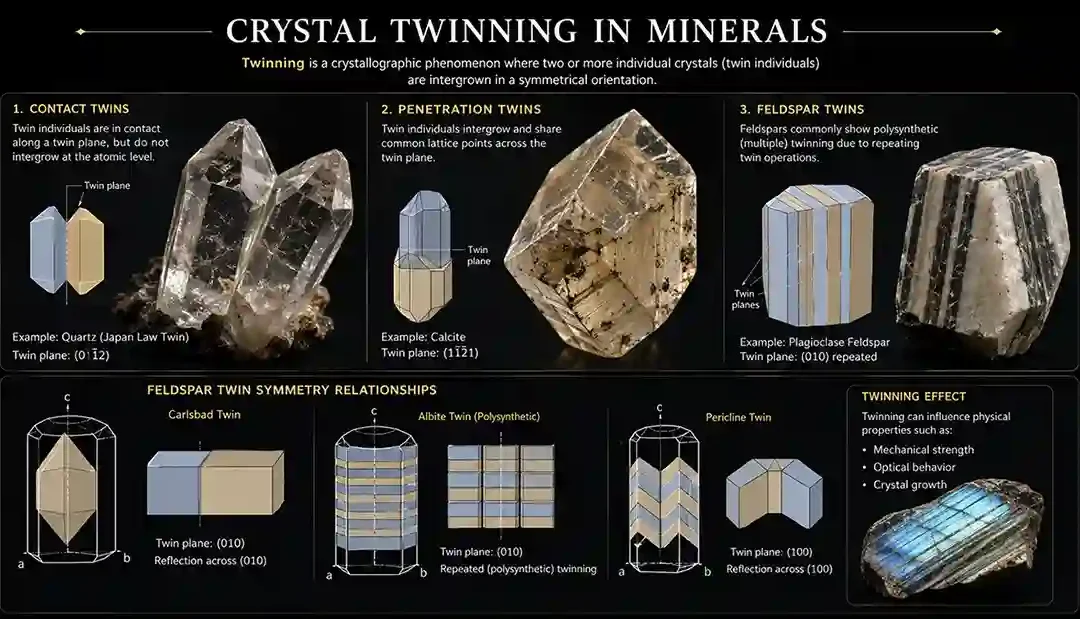
Crystal twinning occurs when two or more crystals of the same mineral grow together in a symmetrical and predictable arrangement. Although the crystals share the same chemical composition and crystal structure, they are oriented differently according to specific crystallographic rules.
Crystal twinning is common in many minerals and often creates unusual crystal shapes that help geologists identify mineral species.
Studying crystal twinning helps scientists:
- identify minerals
- understand crystal growth
- interpret geological conditions
- classify crystal structures
Many well-known minerals such as feldspar, calcite, gypsum, and quartz commonly display twinning.
Learn more → crystal symmetry explained
What Is Crystal Twinning?
Crystal twinning is the symmetrical intergrowth of two or more crystals of the same mineral. The individual crystals are called Twin Components. They share a common crystal lattice relationship known as a Twin Law. The twin law defines how the crystals are oriented relative to one another.
Crystal Twinning vs Normal Crystal Growth
| Feature | Normal Crystal | Twinned Crystal |
|---|---|---|
| Crystal Orientation | Single | Multiple |
| Symmetry | Standard | Modified |
| Crystal Components | One crystal | Two or more crystals |
| Identification Value | Moderate | High |
How Crystal Twinning Forms
Crystal twinning may occur during:
Crystal Growth
Atoms arrange themselves in a twin orientation while the crystal grows.
Transformation
Changes in temperature or pressure may create twins.
Deformation
Stress can cause crystal lattices to reorganize into twinned structures. These processes produce characteristic twin patterns.
Twin Law
A twin law is the crystallographic rule controlling twin orientation. Each mineral may have one or more common twin laws.
The twin law determines:
- crystal orientation
- twin symmetry
- twin appearance
Twin laws are important in mineral identification and crystallography.
Contact Twinning
Contact Twinning occurs when two crystals share a common twin plane.
Characteristics:
- flat contact surface
- mirror-image appearance
- simple twin geometry
Common Examples
- Orthoclase feldspar
- Gypsum
The twin boundary is usually easy to observe.
Penetration Twinning
Penetration Twinning occurs when two crystals grow through each other.
Characteristics:
- intergrown crystals
- no obvious twin plane
- complex geometry
Common Examples
- Pyrite
- Fluorite
Penetration twins often create striking crystal shapes.
Main Types of Crystal Twinning
| Twin Type | Description |
|---|---|
| Contact Twin | Joined along a twin plane |
| Penetration Twin | Intergrown crystals |
| Polysynthetic Twin | Repeated parallel twins |
| Cyclic Twin | Multiple twins arranged in a circle |
Polysynthetic Twinning
Polysynthetic Twinning consists of multiple parallel twin planes.
Characteristics:
- repeated twin bands
- striped appearance
- common in feldspars
Common Example
- Plagioclase Feldspar
Under a microscope, polysynthetic twins appear as parallel stripes.
Cyclic Twinning
Cyclic Twinning occurs when several twin crystals grow around a common center.
This can produce:
- star-shaped crystals
- circular arrangements
- complex symmetrical forms
Common Examples
- Aragonite
- Chrysoberyl
Feldspar Twinning
Feldspars are among the most important twinned minerals.
Orthoclase Feldspar
Common twin:
- Carlsbad Twin
Plagioclase Feldspar
Common twin:
- Albite Twin
Twinning helps geologists distinguish feldspar varieties.
Learn more → monoclinic crystal system
Common Minerals That Show Twinning
| Mineral | Common Twin Type |
|---|---|
| Orthoclase | Contact Twin |
| Plagioclase | Polysynthetic Twin |
| Calcite | Contact Twin |
| Gypsum | Contact Twin |
| Pyrite | Penetration Twin |
Crystal Twinning and Mineral Identification
Crystal twinning is extremely useful because it:
- identifies mineral species
- reveals crystal structure
- distinguishes similar minerals
- helps classify crystal systems
Many minerals can be identified partly by their characteristic twinning patterns.
Learn more → mineral identification guide
Twinning and Crystal Symmetry
Twinning often creates apparent additional symmetry. Although each crystal follows its own symmetry rules, the combined twin may appear more symmetrical than a single crystal. This makes twinning an important topic in crystallography.
Crystal Growth and Twinning Relationship
Crystal Growth→Twin Law→Crystal Twinning→Twin Form. This sequence illustrates how crystal growth conditions influence twin development.
Importance of Crystal Twinning
Crystal twinning is important in:
- mineral identification
- crystallography
- petrology
- materials science
- gemstone studies
Twinning provides valuable information about mineral growth history and geological conditions.
Learn more → crystal faces explained
Crystal twinning is the symmetrical intergrowth of two or more crystals of the same mineral.
It can form during crystal growth, deformation, or changes in temperature and pressure.
Contact twinning and polysynthetic twinning are among the most common forms.
Plagioclase feldspar is famous for polysynthetic twinning.
It helps geologists identify minerals and understand crystal growth processes.
Final Thoughts
Crystal twinning is a fascinating crystallographic phenomenon that reveals how minerals grow and interact during formation. From simple contact twins to complex cyclic twins, twinning provides important clues about mineral identity, crystal structure, and geological history.
Understanding crystal twinning helps geologists interpret crystal growth patterns and recognize many common minerals in both hand specimens and microscopic studies.