
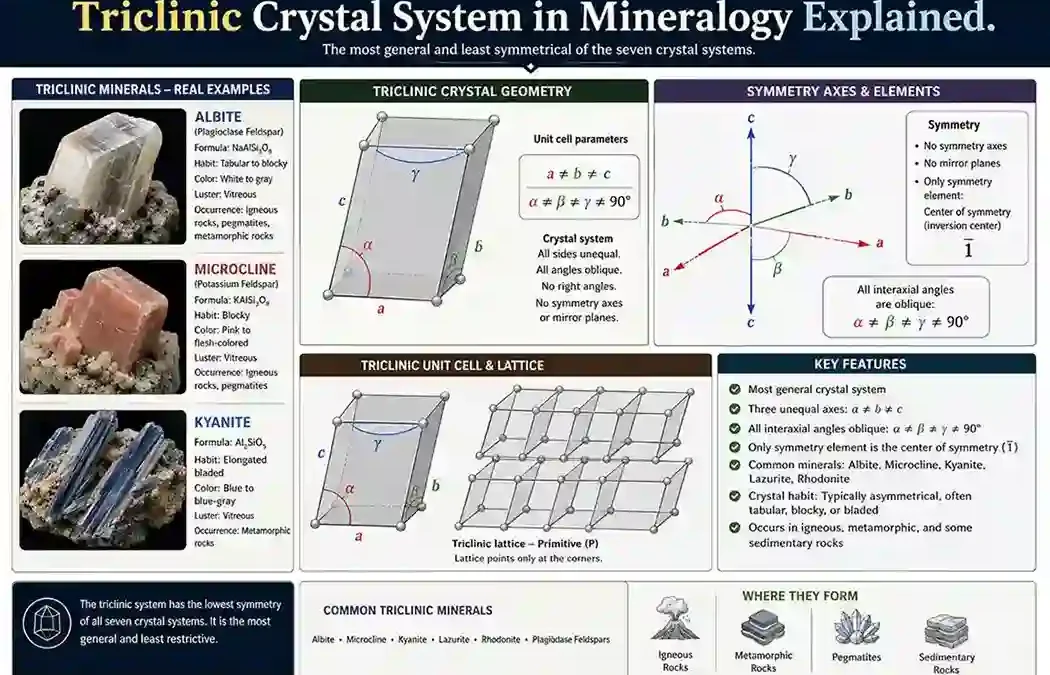
The Triclinic Crystal System is the least symmetrical of the seven crystal systems used in mineralogy. Minerals in this system have three crystal axes of unequal lengths, and none of the angles between the axes are exactly 90 degrees.
Because of its low symmetry, triclinic crystals often appear irregular, distorted, or asymmetrical compared with crystals from other systems.
Several important minerals belong to the triclinic crystal system, including:
- Albite
- Microcline
- Kyanite
- Turquoise
- Rhodonite
Understanding the triclinic system helps geologists identify minerals and appreciate how crystal structure influences crystal shape.
Learn more → crystal systems explained
What Is the Triclinic Crystal System?
The triclinic crystal system is a crystal system with three unequal crystal axes and no right angles
The crystallographic relationship is:
Key Characteristics
- Often irregular crystal shapes
- Three crystal axes
- All axes different lengths
- No angles equal to 90°
- Lowest crystal symmetry
Triclinic Crystal System Properties
| Property | Value |
|---|---|
| Crystal Axes | 3 |
| Axis Lengths | All unequal |
| Right Angles | None |
| Symmetry | Lowest |
| Common Forms | Tabular and elongated crystals |
Why Triclinic Crystals Look Irregular
Because all crystal axes have different lengths and angles, triclinic crystals lack geometric balance.
This often results in:
- asymmetrical crystals
- tilted crystal faces
- distorted crystal forms
- lower overall symmetry
These features make triclinic crystals unique among mineral crystal systems.
Common Crystal Forms
Tabular Crystals
Flat, plate-like crystals commonly seen in feldspars.
Elongated Crystals
Long crystals with irregular cross-sections.
Distorted Prisms
Prism-like forms that lack the symmetry of higher crystal systems.
Common Triclinic Crystal Forms
| Crystal Form | Appearance |
|---|---|
| Tabular | Flat and plate-like |
| Elongated | Long and narrow |
| Distorted Prism | Irregular prism shape |
Albite: A Common Triclinic Feldspar
Albite is one of the most common triclinic minerals.
Characteristics
- White to gray color
- Member of the plagioclase feldspar group
- Common in igneous and metamorphic rocks
Albite is widely used in geological studies because of its abundance.
Microcline Feldspar
Microcline is another important triclinic feldspar.
Characteristics
- Potassium-rich feldspar
- Common in granite
- May occur as green amazonite
Microcline is one of the most abundant minerals in continental crust.
Learn more → mineral classification system
Kyanite and the Triclinic System
Kyanite is a well-known metamorphic mineral.
Characteristics
- Blue color
- Bladed crystal habit
- Variable hardness depending on direction
Kyanite is an important indicator mineral in metamorphic geology.
Common Minerals of the Triclinic System
| Mineral | Typical Crystal Form |
|---|---|
| Albite | Tabular |
| Microcline | Blocky crystals |
| Kyanite | Bladed crystals |
| Turquoise | Massive |
| Rhodonite | Prismatic |
Triclinic vs Monoclinic Crystal System
| Property | Triclinic | Monoclinic |
|---|---|---|
| Axis Lengths | Unequal | Unequal |
| Right Angles | None | Two |
| Symmetry | Lowest | Higher |
| Crystal Shape | More irregular | Less irregular |
The absence of any 90° angles is the defining feature of the triclinic system.
Learn more → monoclinic crystal system
Crystal Structure and Triclinic Symmetry
The triclinic system is controlled by crystal structure
Atomic arrangement determines:
- crystal angles
- symmetry
- crystal habit
- growth direction
The low symmetry of the crystal lattice produces the irregular forms seen in triclinic minerals.
Learn more → crystal structure in minerals
Crystal System Symmetry Ranking
| Crystal System | Relative Symmetry |
|---|---|
| Isometric | Highest |
| Hexagonal | Very High |
| Tetragonal | High |
| Orthorhombic | Moderate |
| Monoclinic | Low |
| Trigonal | Variable |
| Triclinic | Lowest |
Importance of the Triclinic Crystal System
The triclinic system is important in:
- mineral identification
- metamorphic geology
- crystallography
- petrology
- feldspar classification
Many important rock-forming minerals belong to this crystal system.
Triclinic Minerals in Geology
Geologists study triclinic minerals to understand:
- metamorphic conditions
- granite formation
- feldspar evolution
- crustal processes
Minerals such as albite and microcline provide important information about Earth's crust and geological history.
Learn more → mineral habit explained
It is a crystal system with three unequal axes and no angles equal to 90 degrees.
Albite, microcline, kyanite, turquoise, and rhodonite are common examples.
Because all crystal axes and angles differ, resulting in the lowest level of symmetry among crystal systems.
Some feldspars, including albite and microcline, belong to the triclinic crystal system.
The monoclinic system has two right angles, while the triclinic system has none.
Final Thoughts
The Triclinic Crystal System is the lowest-symmetry crystal system in mineralogy, characterized by three unequal axes and no right angles. Although less symmetrical than other systems, it includes many important minerals such as albite, microcline, and kyanite.
Understanding the triclinic system helps geologists interpret crystal growth, classify minerals, and better understand the geological processes that shape Earth's crust.
Continue learning with → monoclinic crystal system and crystal structure in minerals.