
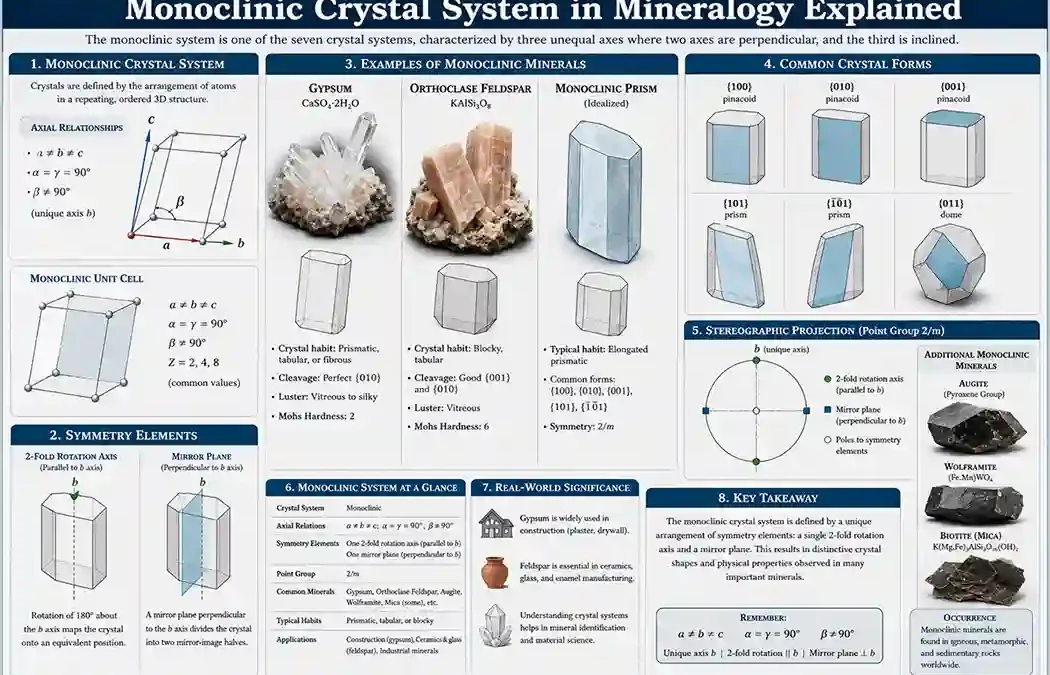
The Monoclinic Crystal System is one of the seven crystal systems used to classify minerals according to their crystal geometry and symmetry. It is characterized by three unequal crystal axes, with two axes intersecting at right angles while the third is inclined.
Many common rock-forming and industrial minerals belong to the monoclinic system, making it one of the most important crystal systems in geology.
Famous monoclinic minerals include:
- Gypsum
- Orthoclase Feldspar
- Muscovite
- Biotite
- Azurite
Understanding the monoclinic crystal system helps geologists identify minerals and understand how crystals develop under different geological conditions.
Learn more → crystal systems explained
What Is the Monoclinic Crystal System?
The monoclinic crystal system is a crystal system with three unequal crystal axes where one angle differs from 90°
The crystallographic relationship is:
a=b=c,α=γ=90∘,β=90∘
Key Characteristics
- Three unequal crystal axes
- Two angles equal 90°
- One angle not equal to 90°
- Lower symmetry than orthorhombic crystals
- Commonly forms prismatic crystals
Monoclinic Crystal System Properties
| Property | Value |
|---|---|
| Crystal Axes | 3 |
| Axis Lengths | All unequal |
| Right Angles | 2 |
| Inclined Angle | 1 |
| Symmetry | Moderate to low |
Why Monoclinic Crystals Appear Tilted
Unlike orthorhombic crystals, one crystal axis is inclined.
This causes many monoclinic crystals to appear:
- tilted
- asymmetrical
- skewed
The inclined axis is one of the easiest ways to distinguish monoclinic crystals from orthorhombic crystals.
Common Crystal Forms
Monoclinic Prism
The most common crystal form.
Characteristics:
- elongated shape
- inclined faces
- asymmetrical appearance
Monoclinic Pyramid
A crystal form with sloping faces caused by lower symmetry. Many monoclinic minerals combine prism and pyramid forms.
Common Monoclinic Crystal Forms
| Crystal Form | Appearance |
|---|---|
| Prism | Elongated and inclined |
| Pyramid | Sloping crystal faces |
| Tabular | Flat plate-like crystals |
Gypsum: A Classic Monoclinic Mineral
Gypsum is one of the best-known monoclinic minerals.
Characteristics
- Soft mineral (hardness 2)
- Transparent to translucent
- Forms large crystals
Uses
- Drywall
- Plaster
- Cement production
Gypsum crystals often display excellent monoclinic symmetry.
Orthoclase Feldspar
Orthoclase Feldspar is a major rock-forming mineral.
Characteristics
- Hardness around 6
- Common in granite
- Important feldspar group member
Orthoclase is one of the most abundant monoclinic minerals in Earth's crust.
Learn more → mineral classification system
Muscovite and Biotite Mica
Common Monoclinic Micas
- Muscovite
- Biotite
These minerals are famous for:
- perfect cleavage
- thin flexible sheets
- shiny appearance
Learn more → mineral cleavage vs fracture
Common Minerals of the Monoclinic System
| Mineral | Typical Crystal Form |
|---|---|
| Gypsum | Prism |
| Orthoclase | Blocky crystals |
| Muscovite | Sheets |
| Biotite | Sheets |
| Azurite | Prism |
Monoclinic vs Orthorhombic Crystal System
| Property | Monoclinic | Orthorhombic |
|---|---|---|
| Axis Lengths | Unequal | Unequal |
| Angles | One not 90° | All 90° |
| Symmetry | Lower | Higher |
| Crystal Shape | Tilted | More rectangular |
The inclined angle is the main feature that separates the monoclinic system from the orthorhombic system.
Learn more → orthorhombic crystal system
Crystal Structure and Monoclinic Symmetry
The monoclinic crystal system is controlled by crystal structure
Atomic arrangement determines:
- crystal angles
- crystal symmetry
- crystal faces
- growth direction
This internal structure produces the tilted crystal geometry characteristic of monoclinic minerals.
Learn more → crystal structure in minerals
Symmetry Comparison
SymmetryOrthorhombic>SymmetryMonoclinic>SymmetryTriclinic
The monoclinic system has less symmetry than the orthorhombic system but more than the triclinic system.
Importance of the Monoclinic Crystal System
The monoclinic system is important in:
- mineral identification
- petrology
- crystallography
- economic geology
- construction materials
Many common minerals used in industry belong to this crystal system.
Monoclinic Minerals in Geology
Geologists use monoclinic minerals to study:
- igneous rocks
- sedimentary environments
- metamorphic processes
- hydrothermal systems
Because feldspars and micas are so abundant, the monoclinic system is extremely important in Earth science.
Learn more → mineral habit explained
It is a crystal system with three unequal axes where one angle differs from 90 degrees.
Gypsum, orthoclase feldspar, muscovite, biotite, and azurite are common examples.
The monoclinic system has one inclined angle, while the orthorhombic system has all angles at 90 degrees.
Yes. Gypsum is one of the most famous monoclinic minerals.
One crystal axis intersects at an angle other than 90 degrees, creating an inclined crystal shape.
Final Thoughts
The Monoclinic Crystal System is one of the most important crystal systems in mineralogy because it includes many common rock-forming and industrial minerals. Its distinctive inclined crystal geometry, unequal axes, and widespread occurrence make it essential for understanding mineral identification and crystal growth.
By studying monoclinic minerals such as gypsum, orthoclase, and mica, geologists gain valuable insights into Earth's rocks, resources, and geological history.
Continue learning with → orthorhombic crystal system and crystal structure in minerals.