
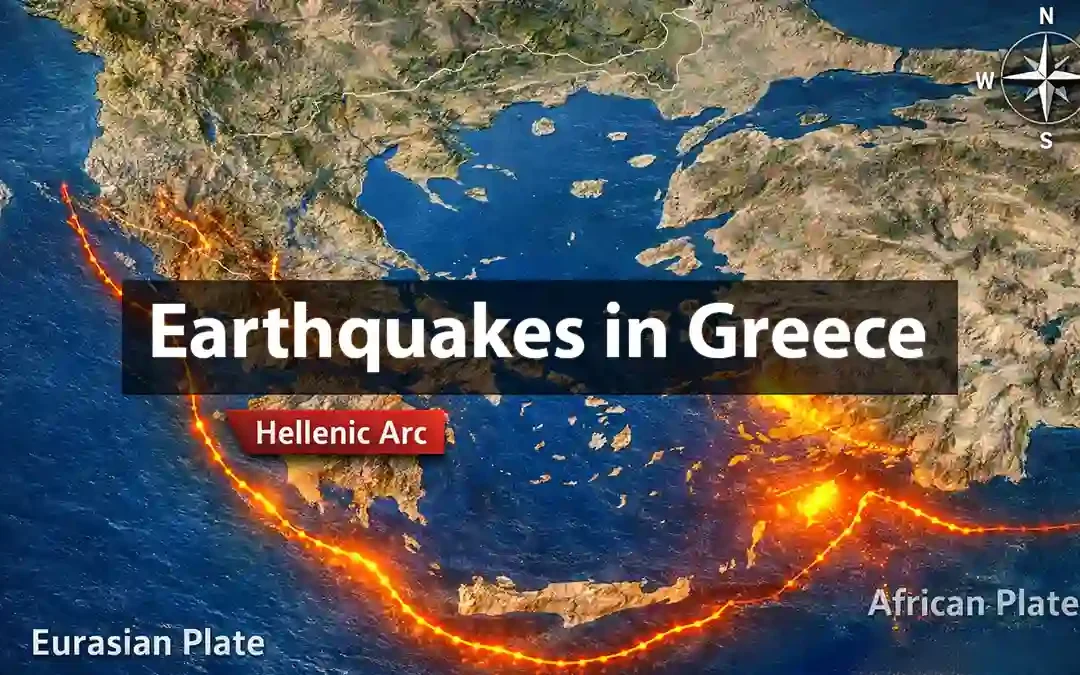
Greece is one of the most earthquake-prone countries in Europe.
While many people associate earthquakes with places like California or Japan, Greece experiences frequent seismic activity due to its unique geological position.
To understand the basics, see our guide on what causes earthquakes
Why Greece Has So Many Earthquakes
Greece lies at the boundary between major tectonic plates:
- African Plate
- Eurasian Plate
The African Plate is slowly moving northward and pushing beneath the Eurasian Plate.
This process is called subduction, and it creates:
- intense pressure
- frequent earthquakes
Learn more in our fault lines guide
The Hellenic Arc: Greece’s Main Seismic Zone
One of the most active areas in Greece is the Hellenic Arc.
This region:
- runs south of mainland Greece
- includes areas near Crete
- is one of Europe’s most active seismic zones
It is responsible for many of the country’s strongest earthquakes.
How Dangerous Are Earthquakes in Greece?
Earthquakes in Greece can be dangerous, but their impact varies.
Factors include:
- magnitude
- depth
- location
- building quality
Coastal and island regions are especially affected due to proximity to active zones.
Greece vs Other Earthquake Regions
Greece shares similarities with other active regions:
Like Japan:
- located near subduction zones
- frequent seismic activity
Like California:
- multiple fault systems
- ongoing tectonic movement
Learn more:
What Happens During an Earthquake in Greece
Typical process:
- Plates move and build stress
- Pressure increases along faults
- Sudden slip releases energy
- Seismic waves spread outward
- Shaking reaches land areas
Learn how seismic waves move
Can Earthquakes in Greece Cause Tsunamis?
Yes — especially if they occur underwater.
Undersea earthquakes can:
- displace large volumes of water
- create tsunami waves
These waves can affect coastal areas within minutes.
How Often Do Earthquakes Happen in Greece?
- Small earthquakes occur frequently
- Moderate earthquakes are common
- Strong earthquakes happen occasionally
Greece is one of the most seismically active regions in Europe.
Why Some Areas Shake More Than Others
Shaking depends on:
- distance from the epicenter
- soil type
- terrain
Learn more about magnitude vs intensity
Can Earthquakes in Greece Be Predicted?
No — earthquakes cannot be predicted precisely.
However:
- scientists monitor seismic zones
- early warning systems may provide alerts
Learn more about can earthquakes be predicted
Because it lies on a tectonic plate boundary with active subduction zones.
Yes — especially small to moderate ones.
Yes — strong earthquakes do occur occasionally.
Yes — especially from underwater earthquakes.