

The asteroid belt is a region of space located between the orbits of Mars and Jupiter. It contains millions of rocky objects known as asteroids that orbit the Sun.
These asteroids are remnants from the early formation of the solar system about 4.6 billion years ago. Scientists believe that the strong gravitational influence of Jupiter prevented these materials from forming into a planet.
Today, the asteroid belt is an important area for studying the history and evolution of our solar system.
Where Is the Asteroid Belt Located?
The asteroid belt lies between the inner planets and outer planets of the solar system.
It is located between:
Mars → fourth planet from the Sun
Jupiter → fifth planet from the Sun
The region stretches roughly from 2.2 AU to 3.2 AU from the Sun.
This means the asteroid belt is more than 300 million kilometers wide.
What Is Inside the Asteroid Belt?
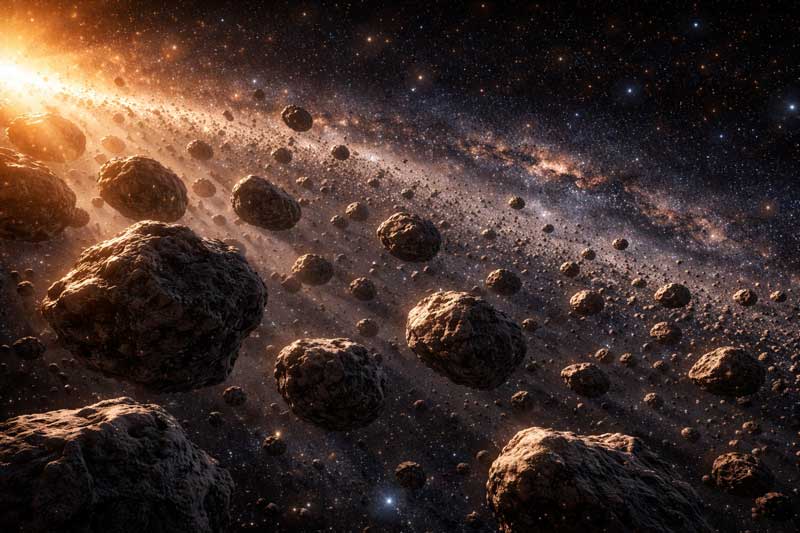
The asteroid belt contains a large number of rocky objects that vary greatly in size.
Some are only a few meters across, while others are hundreds of kilometers wide.
These objects include:
- rocky asteroids
- metallic asteroids
- carbon-rich asteroids
- the dwarf planet Ceres
Although millions of asteroids exist in the belt, the region is still mostly empty space.
Largest Objects in the Asteroid Belt
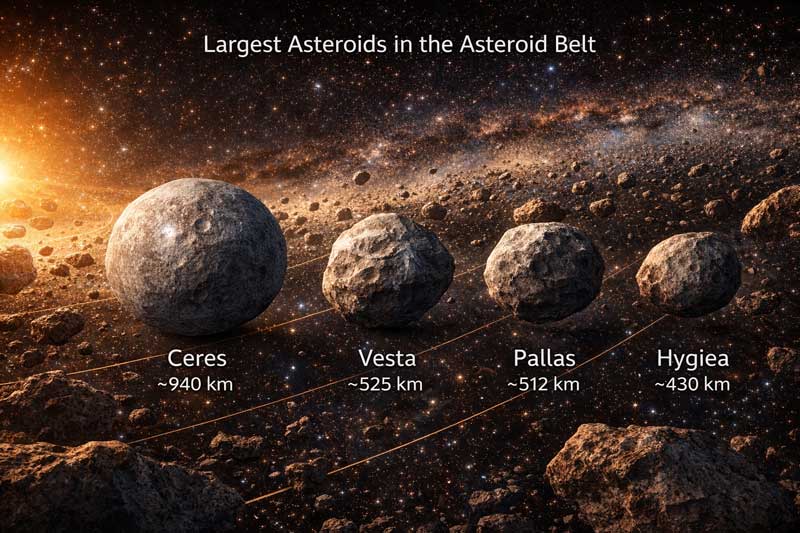
Several large bodies dominate the asteroid belt.
| Object | Diameter |
|---|---|
| Ceres | 940 km |
| Vesta | 525 km |
| Pallas | 512 km |
| Hygiea | 434 km |
Ceres is the largest object in the asteroid belt and is classified as a dwarf planet.
How Did the Asteroid Belt Form?
Scientists believe the asteroid belt formed from leftover material that never combined into a planet.
During the early solar system, gravitational forces from Jupiter disrupted the formation of a planet in this region.
Instead, the material remained scattered as rocky fragments that now form the asteroid belt.
Why the Asteroid Belt Is Important
The asteroid belt provides valuable information about the early solar system.
Studying asteroids helps scientists understand:
- planetary formation
- composition of early solar system materials
- potential resources for future space missions
Some asteroids may also contain metals and minerals that could be useful for future space exploration.
Interesting Facts About the Asteroid Belt
- The asteroid belt contains millions of asteroids.
- Ceres is the only dwarf planet in the asteroid belt.
- Despite the large number of asteroids, spacecraft can easily travel through the region.
- NASA’s Dawn spacecraft studied Ceres and Vesta.
FAQ
The asteroid belt is located between the orbits of Mars and Jupiter.
Scientists estimate there are millions of asteroids in the asteroid belt.
No. Asteroids are spread far apart, so spacecraft can safely pass through the region.
Conclusion
The asteroid belt is a fascinating region of our solar system filled with rocky remnants from its formation. Located between Mars and Jupiter, it contains millions of asteroids and even a dwarf planet, Ceres.
By studying the asteroid belt, scientists gain important insights into the early history of the solar system and the processes that shaped the planets we see today.