
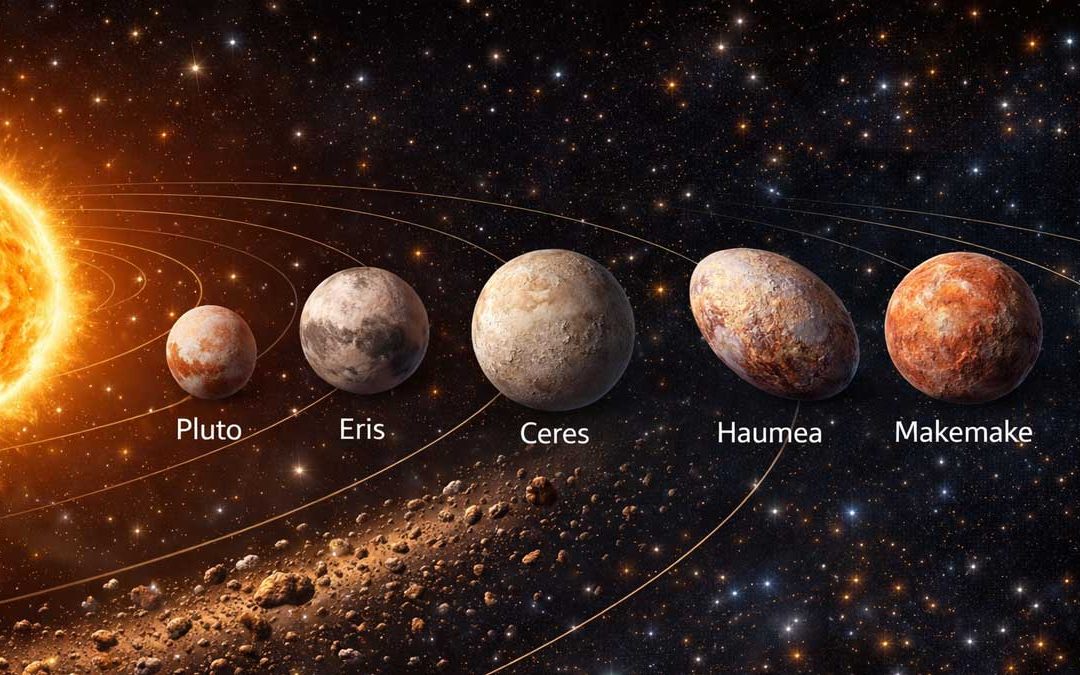
Dwarf planets are celestial bodies that orbit the Sun and share some characteristics with regular planets but differ in a few important ways. The most famous dwarf planet is Pluto, which was once considered the ninth planet of the solar system.
In 2006, the International Astronomical Union (IAU) officially classified Pluto as a dwarf planet. Since then, scientists have identified several other dwarf planets in our solar system.
What Is a Dwarf Planet?
According to the International Astronomical Union, a dwarf planet must meet three main criteria:
- It must orbit the Sun
- It must have enough gravity to form a nearly round shape
- It has not cleared its orbital neighborhood
The third condition means dwarf planets share their orbital path with other objects such as asteroids or Kuiper Belt objects.
List of Known Dwarf Planets
Currently, scientists recognize five official dwarf planets in our solar system.
| Dwarf Planet | Location | Discovery Year |
|---|---|---|
| Pluto | Kuiper Belt | 1930 |
| Eris | Scattered Disk | 2005 |
| Ceres | Asteroid Belt | 1801 |
| Haumea | Kuiper Belt | 2004 |
| Makemake | Kuiper Belt | 2005 |
These objects are much smaller than the eight major planets but still large enough to maintain a spherical shape.
Pluto: The Most Famous Dwarf Planet

Pluto is the most well-known dwarf planet. It was discovered in 1930 by Clyde Tombaugh and was considered the ninth planet for more than 75 years.
However, in 2006 scientists reclassified Pluto because it shares its orbital region with other objects in the Kuiper Belt.
Key facts about Pluto:
• Diameter: about 2,377 km
• Distance from Sun: about 5.9 billion km
• One orbit takes 248 Earth years
Where Are Dwarf Planets Located?
Most dwarf planets are found in the outer regions of the solar system.
Asteroid Belt
Ceres is located in the asteroid belt between Mars and Jupiter.
Kuiper Belt
Pluto, Haumea, and Makemake orbit the Sun in the Kuiper Belt beyond Neptune.
Scattered Disk
Eris belongs to a distant region called the scattered disk.
Differences Between Planets and Dwarf Planets
| Feature | Planets | Dwarf Planets |
|---|---|---|
| Orbit the Sun | Yes | Yes |
| Round shape | Yes | Yes |
| Cleared orbit | Yes | No |
| Number in solar system | 8 | 5 officially recognized |
The key difference is that planets dominate their orbital region, while dwarf planets share their space with many other objects.
Interesting Facts About Dwarf Planets
• Pluto has a heart-shaped region called Tombaugh Regio.
• Eris is slightly smaller than Pluto but more massive.
• Ceres is the only dwarf planet located in the inner solar system.
• Haumea spins extremely fast, completing one rotation in about 4 hours.
Other Planets in the Solar System
You can explore detailed information about each planet:
- Mercury – the smallest planet
- Venus – the hottest planet
- Earth – the only known planet with life
- Mars – the red planet
- Jupiter – the largest planet
- Saturn – famous for its rings
- Uranus – the tilted ice giant
- Neptune – the farthest planet
Also read the full guide: Solar System Planets
FAQ
Currently five dwarf planets are officially recognized by astronomers.
No. Pluto was reclassified as a dwarf planet in 2006.
Most dwarf planets are found in the Kuiper Belt beyond Neptune.
Conclusion
Dwarf planets are fascinating objects that help scientists understand the formation and evolution of the solar system. Although they are smaller than regular planets, they share many similar characteristics and provide important clues about the outer regions of space.
As astronomers continue exploring the solar system, more dwarf planets may be discovered in the distant regions beyond Neptune.