
What are Contaminants?
Any solutes (contaminants) introduced into the groundwater environment. Contamination is the presence of a constituent, impurity, or some other undesirable element that renders something unsuitable, unfit, or harmful for the physical body, natural environment, workplace, etc.
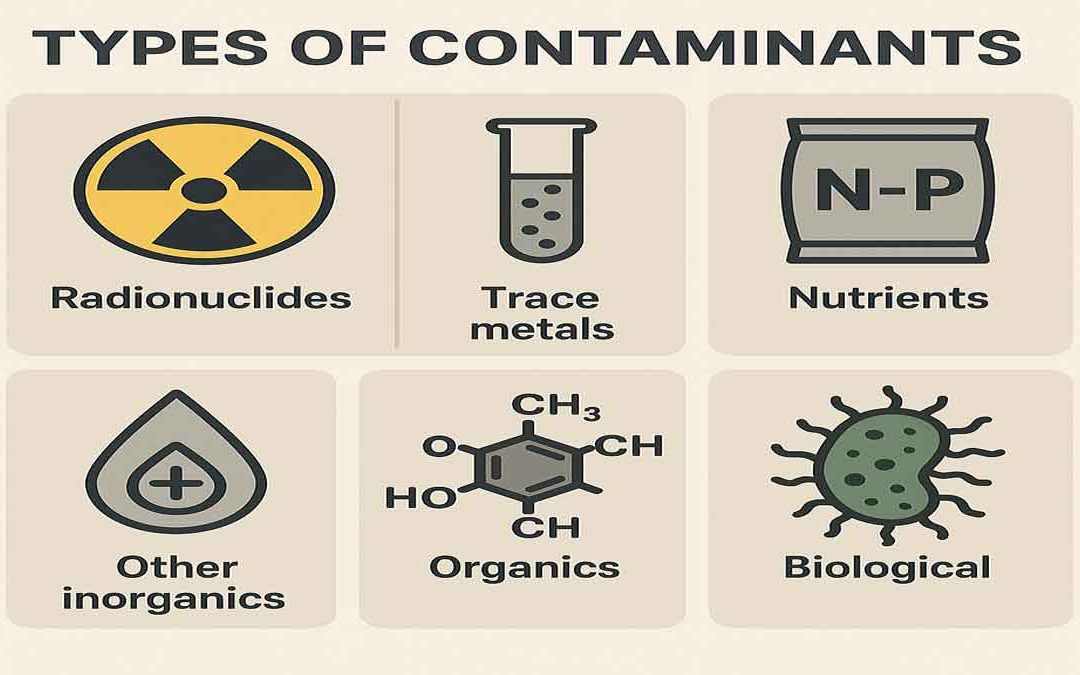
Types of Contaminants:
Six major categories are,
- Radionuclides
- Trace metals
- Nutrients
- Other inorganics
- Organics and
- Biological.
Radionuclides:
- The nuclear fuel industry is the main source of radioactive contaminants.
- Potential sources occur throughout the nuclear fuel cycle.
- During mining when raw ore is processed 238U, 229Th, 226Ra, and 222Rn are potential contaminants.
- Fuel fabrication, fuel reprocessing and power-generating facilities are other potential sources.
- Colorado, New Mexico, Utah, Wyoming, Saskatchewan and Ontario are the U producing regions of North America.
- The nuclear industry is very closely controlled and monitored by federal, state and provincial authorities.
Trace metals:
- Trace metals are a natural component of all groundwaters and represent the largest group of elements in the periodic table.
- Additional sources include (1) mining effluents, (2) industrial wastewaters, (3) urban runoff, (4) agricultural wastes and fertilizers, and (5) fossil fuels.
- Some trace metals (B, Cu, Fe, Zn) are essential for health but others have a tendency to accumulate in the body (or bioaccumulate in organisms low in the food chain) from sources at relatively low concentrations.
- The 13 trace metals that make the EPA list of 129 priority pollutants are: Ag, As, Be, Cd, Cr, Cu, Hg, Ni, Pb, Sb, Se, Tl, Zn.
Nutrients:
- Nutrients are ions and compounds containing nitrogen and phosphorus.
- The dominant nitrogen species in groundwater in NO3- and to a lesser extent NH4+.
- Phosphorus is less important as a contaminant because of its low solubility and tendency to readily sorb onto solids.
- Sources of N and P are largely agricultural including the use of fertilizers and the cultivation of virgin soils (when large quantities of N are released.)
- Sewage (N) and municipal wastewaters (P) are also sources of nutrients.
Other inorganics:
- This group of “contaminants” includes the major ions usually present in groundwater.
- Extremely high concentrations render water unsuitable for human consumption, animal watering and many industrial uses.
- Health related concerns are low for this group of contaminants but high concentrations of Na+ can disrupt blood chemistry and lower Na+ concentrations may lead to hypertension.
- Fluoride a good example of a trace non-metal contaminant. At low concentrations F- has the beneficial effect of reducing tooth decay. At higher concentrations (only x5 higher) F- can lead to serious health problems including goitre and fluoridosis.
Organics:
- Contamination of groundwater by organic compounds is a consequence of the large number of petroleum products and man-made organics in common use.
- The EPA list of 131 priority pollutants contains 116 organic compounds, 13 trace metals, asbestos and cyanide. Over 90% are organics.
- The EPA divides the organics into four groups based on the methods used for analysis but ultimately the analytical tool is gas chromatography-mass spectrometry (GC-MS):
- Base-neutral extractables (47)
- Acid extractables (12)
- Volatiles (32)
- Pesticides and PCBs (25)
Biological:
- The important biological contaminants are:
- Pathogenic bacteria (Fecal streptococci, Fecal colliforms, Escherichia coli, Shigella dysenteriae, Salmonella typhi, Vibrio cholerae)
- Viruses (enteroviruses, hepatitis A virus, polio virus and rotavirus )
- Parasites (Giardia, Entamoeba, Cryptosporidium )
- The main sources are (1) land disposal of sewage and septic tanks, (2) leachates from sanitary landfills and (3) agricultural wastes.
- The contaminants are particulate rather than dissolved, transport distances are limited and problems tend to be related to localized sources.