
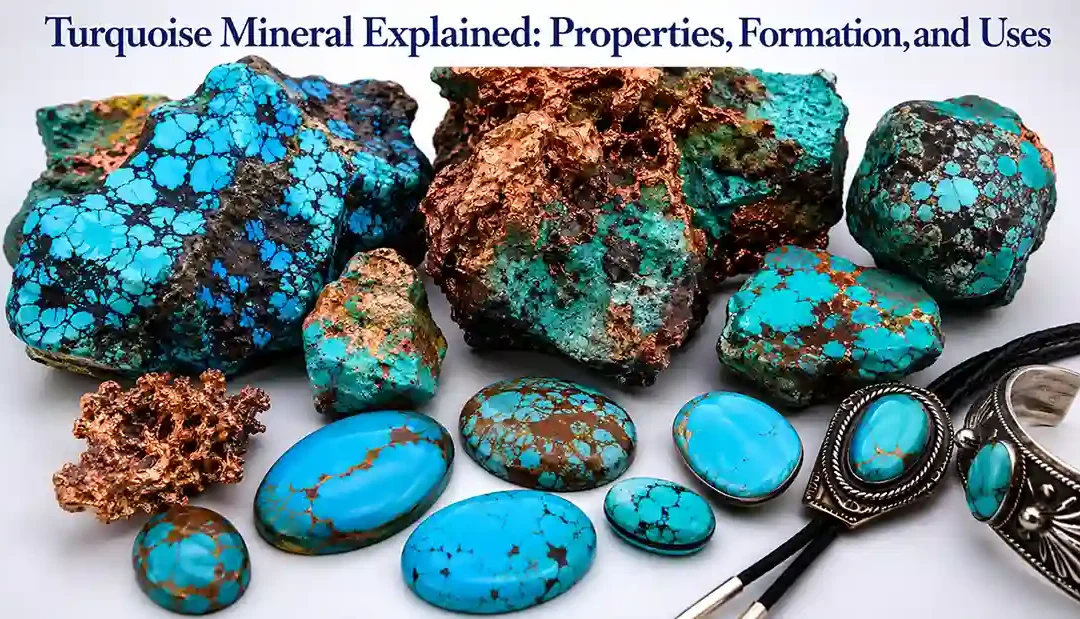
Turquoise is one of the oldest known gemstones and has been treasured for thousands of years because of its distinctive blue-to-green color. Ancient civilizations used turquoise for jewelry, ceremonial objects, carvings, and decorative art long before the discovery of many other gemstones.
Unlike transparent gemstones such as diamond or sapphire, turquoise is valued for its unique opaque appearance, vibrant color, and attractive matrix patterns.
Today, turquoise remains one of the world's most recognizable ornamental stones.
What Is Turquoise?
Turquoise is a hydrated copper-aluminum phosphate mineral.
It is prized for:
- sky-blue color
- blue-green shades
- attractive matrix patterns
- historical significance
- jewelry applications
Turquoise forms through weathering and groundwater processes in arid environments.
Turquoise Mineral Profile
| Property | Value |
|---|---|
| Mineral Group | Phosphate |
| Chemical Formula | CuAl₆(PO₄)₄(OH)₈·4H₂O |
| Color | Blue to Green |
| Hardness | 5–6 |
| Crystal System | Triclinic |
| Luster | Waxy to Subvitreous |
| Streak | White to Bluish White |
| Specific Gravity | 2.6–2.9 |
What Causes Turquoise's Color?
Turquoise obtains its color primarily from:
Copper
Produces blue coloration.
Iron
Creates greener shades.
Zinc
May contribute to unique color variations.
The finest turquoise often displays an intense sky-blue color.
Matrix Patterns
Many turquoise specimens contain dark matrix patterns.
These patterns are formed by:
- host rock remnants
- limonite veins
- iron oxides
- manganese oxides
Matrix patterns can greatly influence a gemstone's appearance and value.
Formation of Turquoise
Turquoise forms through:
Weathering Processes
Surface waters dissolve minerals.
Copper-Rich Environments
Copper-bearing rocks provide essential elements.
Arid Climates
Dry conditions promote mineral precipitation.
Groundwater Activity
Mineral-rich water deposits turquoise in fractures and cavities.
Because these conditions are relatively uncommon, high-quality turquoise deposits are limited.
Physical Properties
Luster
Waxy to subvitreous.
Transparency
Opaque.
Cleavage
Poor.
Fracture
Conchoidal to uneven.
Turquoise is softer than many gemstones and requires careful handling.
Crystal Structure
Turquoise crystallizes in the:
Triclinic Crystal System
Characteristics include:
- microscopic crystals
- compact masses
- nodular growth forms
- vein fillings
Well-formed turquoise crystals are extremely rare.
Learn more → triclinic-crystal-system
Major Sources of Turquoise
Important turquoise deposits occur in:
- Iran
- United States
- China
- Egypt
- Mexico
- Chile
The most famous deposits occur near Neyshabur, which has produced high-quality turquoise for centuries.
Historical Importance
Turquoise has a long cultural history.
Ancient Egypt
Used in jewelry and burial treasures.
Persia (Iran)
Highly prized royal gemstone.
Native American Cultures
Used in jewelry and ceremonial objects.
Tibet
Important decorative and spiritual stone.
Turquoise has been valued for more than 5,000 years.
Turquoise in Ancient Egypt
Turquoise was extensively mined in the Sinai Peninsula.
Ancient Egyptians used it for:
- jewelry
- amulets
- ceremonial objects
- royal decorations
Many famous archaeological discoveries contain turquoise artifacts.
Turquoise vs Chrysocolla
| Property | Turquoise | Chrysocolla |
|---|---|---|
| Hardness | 5–6 | 2–4 |
| Mineral Group | Phosphate | Silicate |
| Color | Blue-Green | Blue-Green |
| Durability | Higher | Lower |
Turquoise is generally harder and more durable.
Turquoise vs Amazonite
| Property | Turquoise | Amazonite |
|---|---|---|
| Mineral Group | Phosphate | Feldspar |
| Hardness | 5–6 | 6–6.5 |
| Transparency | Opaque | Translucent to Opaque |
| Color | Sky Blue | Greenish Blue |
Turquoise in Jewelry
Turquoise is widely used in:
- rings
- pendants
- necklaces
- earrings
- bracelets
- beads
It is especially associated with Southwestern and Native American jewelry styles.
Turquoise Treatments
Many commercial turquoise gemstones are:
Stabilized
Resin strengthens porous material.
Waxed
Improves appearance.
Dyed
Enhances color.
Natural untreated turquoise is generally more valuable.
Factors Affecting Value
Color
Sky-blue color is most desirable.
Matrix
Attractive patterns can increase value.
Hardness
Dense material is preferred.
Treatment Status
Natural stones command premiums.
Origin
Certain mines are highly prized.
Turquoise Mining and Specimens
Turquoise is commonly recovered from:
- near-surface deposits
- copper mining districts
- weathered rock zones
- arid environments
Most gem-quality material is cut into cabochons rather than faceted stones.
Turquoise as a Birthstone
Turquoise is one of the traditional birthstones for december.
It shares this designation with:
- tanzanite
- zircon
Why Turquoise Is Valuable
Turquoise remains popular because of:
- unique blue color
- historical significance
- cultural importance
- attractive matrix patterns
- rarity of high-quality natural material
Its popularity spans thousands of years and many cultures.
Turquoise Identification Summary
| Property | Turquoise |
|---|---|
| Formula | CuAl₆(PO₄)₄(OH)₈·4H₂O |
| Mineral Group | Phosphate |
| Hardness | 5–6 |
| Crystal System | Triclinic |
| Color | Blue-Green |
| Streak | White |
| Transparency | Opaque |
Turquoise is a hydrated copper-aluminum phosphate mineral.
Copper within the mineral structure produces its characteristic blue color.
Major sources include Iran, the United States, China, Egypt, Mexico, and Chile.
The dark matrix consists of remnants of host rock and mineral impurities such as iron and manganese oxides.
Turquoise has a Mohs hardness of approximately 5–6.
Final Thoughts
Turquoise is one of the most historically important and visually distinctive gemstones in the world. Its vibrant blue color, unique matrix patterns, and thousands of years of cultural significance have made it a favorite decorative stone across civilizations.
From ancient Egyptian treasures and Persian royal jewelry to modern artisan creations, turquoise continues to captivate collectors, gemologists, and jewelry lovers alike. Its remarkable combination of geology, beauty, and history ensures its enduring place among the world's most treasured ornamental stones.