
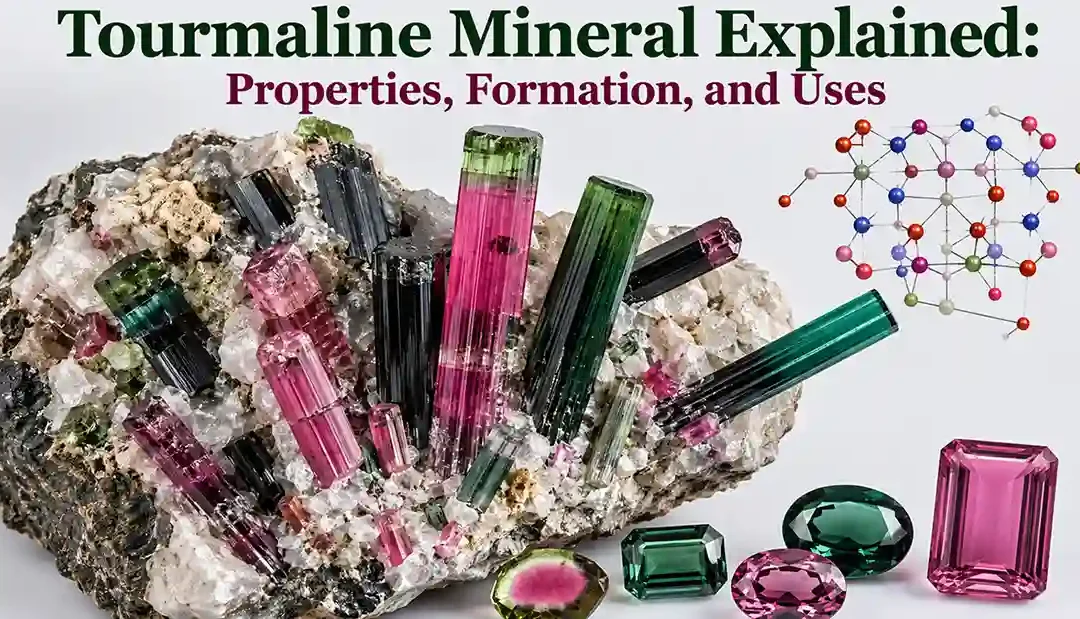
Tourmaline is one of the most diverse and colorful mineral groups on Earth. It occurs in nearly every color imaginable and is highly prized by both mineral collectors and gemstone enthusiasts.
Tourmaline is famous for its:
- extraordinary color variety
- gemstone quality crystals
- piezoelectric properties
- large pegmatite crystals
Unlike many minerals that occur in only one or two colors, tourmaline can display multiple colors within a single crystal, making it one of the most fascinating gemstones in mineralogy.
Learn more → topaz mineral explained
What Is Tourmaline?
Tourmaline is a complex boron silicate mineral group. A simplified tourmaline formula is:
Tourmaline contains varying amounts of:
- boron
- aluminum
- silicon
- iron
- magnesium
- lithium
- sodium
This chemical complexity is responsible for its remarkable range of colors.
Basic Properties of Tourmaline
| Property | Value |
|---|---|
| Mineral Group | Cyclosilicate |
| Chemical Class | Boron Silicate |
| Crystal System | Trigonal |
| Hardness | 7–7.5 |
| Streak | White |
| Luster | Vitreous |
Why Does Tourmaline Have So Many Colors?
Different elements produce different colors.
| Element | Common Color |
|---|---|
| Iron | Black, Blue, Green |
| Manganese | Pink, Red |
| Chromium | Green |
| Vanadium | Green |
| Copper | Neon Blue |
This variety makes tourmaline one of the most colorful mineral groups known.
Crystal Structure of Tourmaline
Tourmaline contains:
- silicate rings
- boron groups
- aluminum-rich zones
- various metal ions
Its crystal structure creates:
- elongated crystals
- vertical striations
- strong crystal growth patterns
Learn more → crystal structure in minerals
Crystal System of Tourmaline
Tourmaline belongs to the trigonal crystal system. Its symmetry is characterized by Threefold Rotational Symmetry.
Common crystal habits include:
- elongated prisms
- columnar crystals
- striated crystal faces
These crystal shapes are among the easiest ways to recognize tourmaline.
Learn more → trigonal crystal system
Physical Properties of Tourmaline
| Property | Description |
|---|---|
| Color | Almost every color |
| Streak | White |
| Luster | Vitreous |
| Hardness | 7–7.5 |
| Cleavage | Poor |
| Transparency | Transparent to opaque |
| Specific Gravity | 3.0–3.3 |
Major Varieties of Tourmaline
Schorl
Black tourmaline and the most common variety.
Elbaite
Gem-quality colorful tourmaline.
Rubellite
Pink to red tourmaline.
Verdelite
Green tourmaline.
Indicolite
Blue tourmaline.
Watermelon Tourmaline
Pink center surrounded by green outer zones.
Popular Tourmaline Varieties
| Variety | Color |
|---|---|
| Schorl | Black |
| Rubellite | Pink-Red |
| Verdelite | Green |
| Indicolite | Blue |
| Watermelon | Pink & Green |
Watermelon Tourmaline
Watermelon tourmaline displays:
- pink interiors
- green outer rims
The color zoning forms during crystal growth as chemical conditions change. It is one of the most recognizable gemstone varieties in the world.
How Tourmaline Forms
Granite Pegmatites
The most important formation environment.
Hydrothermal Veins
Mineral-rich fluids deposit crystals.
Metamorphic Rocks
Occurs in some schists and gneisses.
Boron-Rich Environments
Requires boron-rich fluids for crystal growth.
Tourmaline in Pegmatites
Tourmaline commonly occurs with:
- quartz
- feldspar
- mica
- beryl
- topaz
Pegmatites provide ideal conditions for growing exceptionally large crystals.
Piezoelectric Properties of Tourmaline
Tourmaline is famous for being piezoelectric. When pressure is applied, electrical charges develop within the crystal. This property has scientific and industrial applications.
Major Tourmaline-Producing Countries
Important sources include:
- Brazil
- Afghanistan
- Pakistan
- Madagascar
- Nigeria
- Mozambique
Brazil is especially famous for producing colorful gem-quality tourmalines.
Uses of Tourmaline
Jewelry
Most important commercial use.
Mineral Collections
Highly valued by collectors.
Scientific Instruments
Used because of its electrical properties.
Decorative Displays
Popular museum specimens.
Major Uses of Tourmaline
| Industry | Application |
|---|---|
| Jewelry | Gemstones |
| Collecting | Mineral specimens |
| Science | Electrical applications |
| Museums | Displays |
Tourmaline in Mineral Identification
Geologists identify tourmaline using:
- elongated prismatic crystals
- vertical striations
- hardness of 7–7.5
- wide color variety
- trigonal crystal symmetry
The combination of striations and crystal shape is especially diagnostic.
Learn more → mineral identification guide
Tourmaline Identification Summary
| Property | Tourmaline |
|---|---|
| Hardness | 7–7.5 |
| Crystal System | Trigonal |
| Color | Nearly all colors |
| Luster | Vitreous |
| Streak | White |
| Mineral Group | Cyclosilicate |
Different chemical elements such as iron, manganese, chromium, vanadium, and copper create different colors.
Black tourmaline, called schorl, is the most common variety of tourmaline.
Watermelon tourmaline is a crystal with a pink center and green outer layer.
Tourmaline belongs to the trigonal crystal system.
Tourmaline commonly forms in granite pegmatites, hydrothermal veins, and some metamorphic rocks.
Final Thoughts
Tourmaline is one of the most extraordinary mineral groups in geology due to its incredible color diversity, complex chemistry, and unique crystal forms. From black schorl and blue indicolite to the famous watermelon tourmaline, few minerals can match its visual variety.
Its occurrence in pegmatites, gemstone deposits, and scientific applications makes tourmaline both geologically important and highly prized in the gemstone world.