
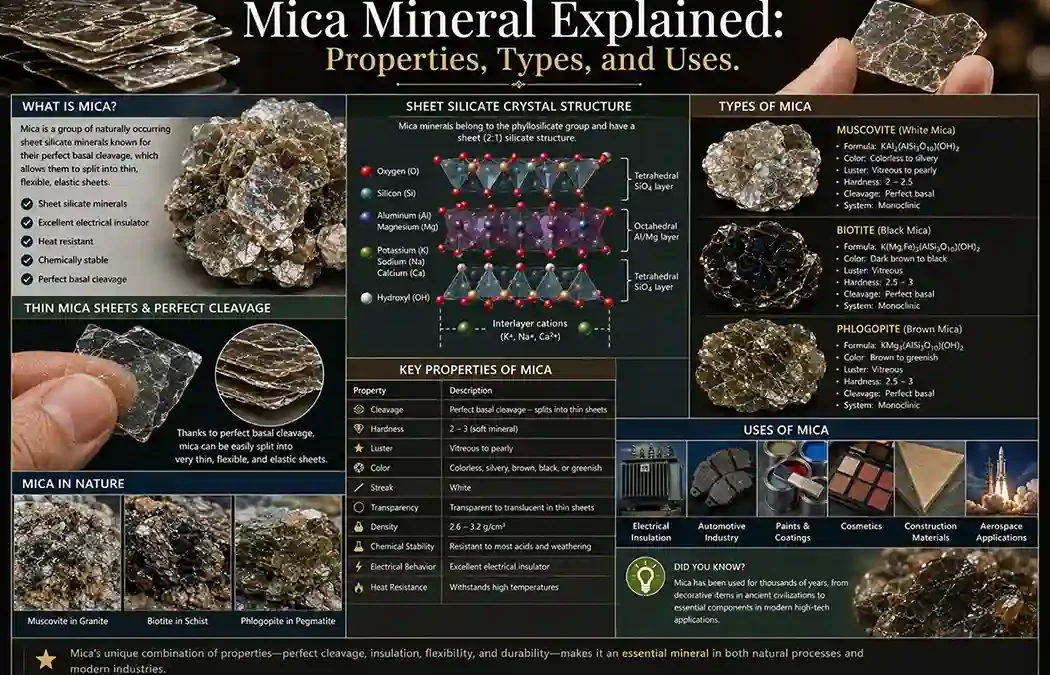
Mica is a group of important rock-forming silicate minerals known for their perfect basal cleavage and ability to split into extremely thin, flexible sheets.
Mica minerals are common in:
- igneous rocks
- metamorphic rocks
- sedimentary rocks
Because of their distinctive sheet-like structure, mica minerals are among the easiest minerals to identify.
The two most common mica minerals are:
- Muscovite
- Biotite
Micas play a major role in geology, industry, and mineral identification.
Learn more → mineral classification system
What Is Mica?
Mica is a group of sheet silicate minerals. Mica minerals belong to the phyllosilicate group. Their crystal structure consists of stacked layers of silicon-oxygen tetrahedra. This layered structure allows mica to split into thin sheets.
Basic Properties of Mica
| Property | Typical Value |
|---|---|
| Mineral Group | Silicate |
| Subgroup | Phyllosilicate |
| Crystal System | Monoclinic |
| Cleavage | Perfect Basal |
| Luster | Vitreous to Pearly |
| Transparency | Transparent to Opaque |
Why Mica Splits Into Thin Sheets
The unique property of mica comes from its crystal structure.
Layered Atomic Structure
Strong bonds exist within each layer, while weaker bonds connect the layers.
This causes mica to split easily along flat planes.
The result is:
- flexible sheets
- smooth surfaces
- perfect cleavage
Learn more → crystal structure in minerals
Major Types of Mica
The mica group contains many minerals, but two dominate most rocks.
Muscovite
Light-colored mica.
Biotite
Dark-colored mica.
These two varieties are the most common in geology.
Muscovite Mica
Muscovite
Muscovite is the most common light-colored mica.
Characteristics
- Colorless to silvery
- Transparent to translucent
- Excellent cleavage
- Flexible sheets
Common Occurrence
- Granite
- Pegmatite
- Schist
- Gneiss
Muscovite is often called white mica.
Biotite Mica
Biotite
Biotite is the most common dark mica.
Characteristics
- Dark brown to black
- Iron-rich composition
- Flexible sheets
- Strong cleavage
Common Occurrence
- Granite
- Diorite
- Schist
- Gneiss
Biotite is often called black mica.
Muscovite vs Biotite
| Property | Muscovite | Biotite |
|---|---|---|
| Color | Light | Dark |
| Transparency | Transparent | Mostly opaque |
| Iron Content | Low | High |
| Common Name | White Mica | Black Mica |
Crystal System of Mica
Most mica minerals belong to the monoclinic crystal system. Their crystallographic relationship is: . Despite belonging to the monoclinic system, their layered structure dominates their appearance.
Learn more → monoclinic crystal system
Mica Cleavage
Mica exhibits perfect basal cleavage
This allows mica to split into:
- paper-thin sheets
- flexible layers
- transparent flakes
This property is one of the most diagnostic features in mineral identification.
Learn more → mineral cleavage vs fracture
Physical Properties of Mica
| Property | Description |
|---|---|
| Color | White, silver, brown, black |
| Streak | White |
| Luster | Vitreous to pearly |
| Hardness | 2.5–3 |
| Cleavage | Perfect basal |
| Transparency | Transparent to opaque |
Mica in Rocks
Mica commonly occurs in:
Igneous Rocks
- Granite
- Pegmatite
Metamorphic Rocks
- Schist
- Gneiss
Sedimentary Rocks
- Some sandstones
- Clay-rich sediments
Mica contributes to the shiny appearance of many metamorphic rocks.
Industrial Uses of Mica
Mica has many industrial applications.
Electronics
Excellent electrical insulator.
Paints
Improves durability and shine.
Cosmetics
Used in makeup and shimmer products.
Construction
Added to roofing and insulation products.
Plastics
Improves heat resistance.
Major Uses of Mica
| Industry | Application |
|---|---|
| Electronics | Insulators |
| Cosmetics | Makeup products |
| Paints | Surface coatings |
| Construction | Roofing materials |
| Plastics | Heat-resistant fillers |
Mica and Metamorphic Rocks
Mica is especially important in metamorphic geology.
Large mica crystals commonly form during:
- regional metamorphism
- contact metamorphism
Their alignment often creates foliation. This texture is characteristic of rocks such as schist.
Learn more → mineral texture guide
Mica in Mineral Identification
Geologists identify mica using:
- perfect basal cleavage
- sheet-like habit
- low hardness
- pearly luster
- flexible flakes
Few minerals display these features as clearly as mica.
Learn more → mineral identification guide
Mica Identification Summary
| Property | Mica |
|---|---|
| Mineral Group | Phyllosilicate |
| Hardness | 2.5–3 |
| Cleavage | Perfect |
| Crystal System | Monoclinic |
| Habit | Sheet-like |
| Luster | Vitreous to Pearly |
Mica is a group of sheet silicate minerals known for perfect cleavage and thin flexible sheets.
Muscovite (white mica) and biotite (black mica).
Its layered crystal structure contains weak bonds between atomic layers.
Most mica minerals have a hardness between 2.5 and 3.
Mica occurs in granite, pegmatite, schist, gneiss, and other rocks.
Final Thoughts
Mica is one of the most recognizable mineral groups because of its sheet-like crystal structure and perfect cleavage. Whether in granite, schist, or industrial products, mica plays an important role in geology and modern technology.
Understanding mica helps geologists identify rocks, interpret metamorphic processes, and appreciate the relationship between crystal structure and mineral properties.
Continue learning with → monoclinic crystal system and crystal structure in minerals.