
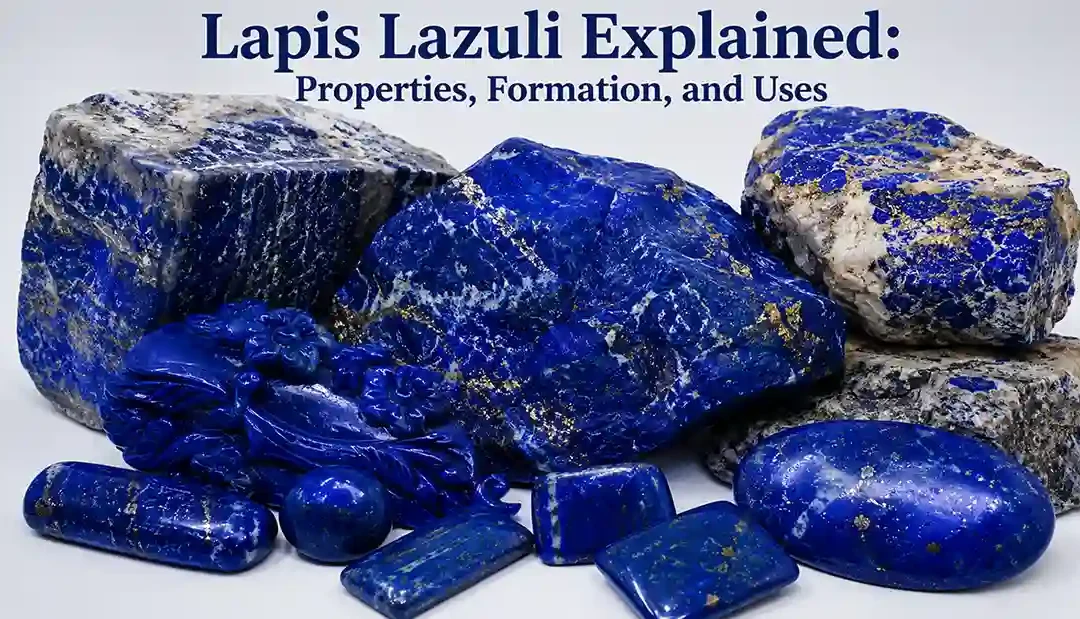
Lapis lazuli is one of the most famous ornamental stones in human history. Revered for its intense royal-blue color and sparkling golden pyrite inclusions, lapis lazuli has been prized for thousands of years by civilizations ranging from ancient Egypt to Renaissance Europe.
Unlike most gemstones, lapis lazuli is not a single mineral. Instead, it is a rock composed of several minerals, with lazurite being the primary blue-colored component.
Its beauty, rarity, and historical significance have made lapis lazuli one of the world's most recognizable decorative stones.
What Is Lapis Lazuli?
Lapis lazuli is a metamorphic rock composed mainly of:
- lazurite
- calcite
- pyrite
- sodalite
The rich blue color comes primarily from lazurite.
Lapis lazuli is valued for:
- intense blue color
- golden pyrite flecks
- historical significance
- decorative uses
- gemstone applications
Lapis Lazuli Profile
| Property | Value |
|---|---|
| Rock Type | Metamorphic Rock |
| Main Mineral | Lazurite |
| Color | Deep Blue |
| Hardness | 5–5.5 |
| Luster | Dull to Vitreous |
| Streak | Light Blue |
| Specific Gravity | 2.7–2.9 |
| Transparency | Opaque |
What Gives Lapis Lazuli Its Blue Color?
The characteristic blue color results from sulfur-containing compounds within lazurite.
Higher lazurite content generally produces:
- deeper blue color
- higher gemstone quality
- greater value
The finest specimens display a rich ultramarine blue color.
Pyrite Inclusions
Many lapis lazuli specimens contain Pyrite (FeS₂).
Pyrite appears as:
- golden flecks
- metallic sparkles
- scattered inclusions
These inclusions are often considered desirable because they resemble stars in a night sky.
Calcite Veins
White calcite commonly occurs within lapis lazuli.
High-Quality Lapis
- deep blue
- minimal calcite
Lower-Quality Lapis
- abundant white calcite
- lighter appearance
Excessive calcite generally lowers gemstone value.
Formation of Lapis Lazuli
Lapis lazuli forms through:
Contact Metamorphism
Heat from intruding magma alters limestone.
Metasomatism
Chemical fluids introduce new elements.
Metamorphic Reactions
Lazurite develops under specific pressure and temperature conditions.
This process creates lapis lazuli-bearing rock bodies.
Major Sources of Lapis Lazuli
Important lapis lazuli deposits occur in:
- Afghanistan
- Chile
- Russia
- Pakistan
- Myanmar
The most famous source is Badakhshan, where lapis lazuli has been mined for over 6,000 years.
Historical Importance
Ancient civilizations highly valued lapis lazuli.
Ancient Egypt
Used in jewelry, scarabs, and burial artifacts.
Mesopotamia
Used for seals and ornaments.
Greece and Rome
Popular decorative stone.
Renaissance Europe
Source of ultramarine pigment.
Lapis lazuli was once more valuable than gold in some regions.
Ultramarine Pigment
For centuries, artists ground lapis lazuli into powder to produce:
Ultramarine
A brilliant blue pigment used in:
- paintings
- manuscripts
- religious artwork
Famous Renaissance artists used ultramarine extensively because of its exceptional color quality.
Physical Properties
Luster
Dull to vitreous.
Transparency
Opaque.
Cleavage
Variable due to mixed mineral composition.
Fracture
Uneven.
Because of its moderate hardness, lapis lazuli requires some care in jewelry.
Lapis Lazuli vs Sodalite
| Property | Lapis Lazuli | Sodalite |
|---|---|---|
| Main Blue Mineral | Lazurite | Sodalite |
| Pyrite Flecks | Common | Rare |
| Historical Value | Very High | Moderate |
| Color | Deep Royal Blue | Blue-Violet |
Pyrite inclusions often help distinguish lapis lazuli from sodalite.
Lapis Lazuli in Jewelry
Lapis lazuli is commonly used in:
- rings
- pendants
- necklaces
- earrings
- beads
- carvings
It is especially popular in artisan and historical-style jewelry.
Factors Affecting Value
Color
Deep royal blue is most valuable.
Lazurite Content
Higher content increases value.
Calcite Amount
Less calcite is preferred.
Pyrite Distribution
Fine golden flecks are desirable.
Size
Large high-quality pieces are rare.
Mining and Specimens
Most lapis lazuli is recovered from:
- metamorphic rock quarries
- mountain deposits
- contact metamorphic zones
Large blocks are cut into gemstones, carvings, and decorative objects.
Why Lapis Lazuli Is Famous
Lapis lazuli remains popular because of:
- rich blue color
- historical significance
- decorative appeal
- gemstone applications
- artistic heritage
Few ornamental stones have influenced human culture as much as lapis lazuli.
Lapis Lazuli Identification Summary
| Property | Lapis Lazuli |
|---|---|
| Rock Type | Metamorphic |
| Main Mineral | Lazurite |
| Hardness | 5–5.5 |
| Color | Deep Blue |
| Streak | Light Blue |
| Transparency | Opaque |
| Key Feature | Blue Color with Pyrite Flecks |
No. Lapis lazuli is a rock composed mainly of the mineral lazurite along with calcite and pyrite.
The blue color comes from lazurite, which contains sulfur-bearing compounds.
The most famous deposits occur in Afghanistan, particularly in the Badakhshan region.
Ultramarine is a blue pigment historically produced by grinding lapis lazuli into a fine powder.
Lapis lazuli has a hardness of approximately 5–5.5 on the Mohs scale.
Final Thoughts
Lapis lazuli is one of the most historically significant ornamental stones ever discovered. Its deep blue color, sparkling pyrite inclusions, and thousands of years of cultural importance have made it a symbol of luxury, artistry, and prestige.
From ancient Egyptian treasures and Renaissance masterpieces to modern jewelry and decorative objects, lapis lazuli continues to captivate people around the world. Its unique combination of geology, history, and beauty ensures its enduring place among Earth's most celebrated gemstone materials.
Continue learning with → pyrite-mineral-explained