
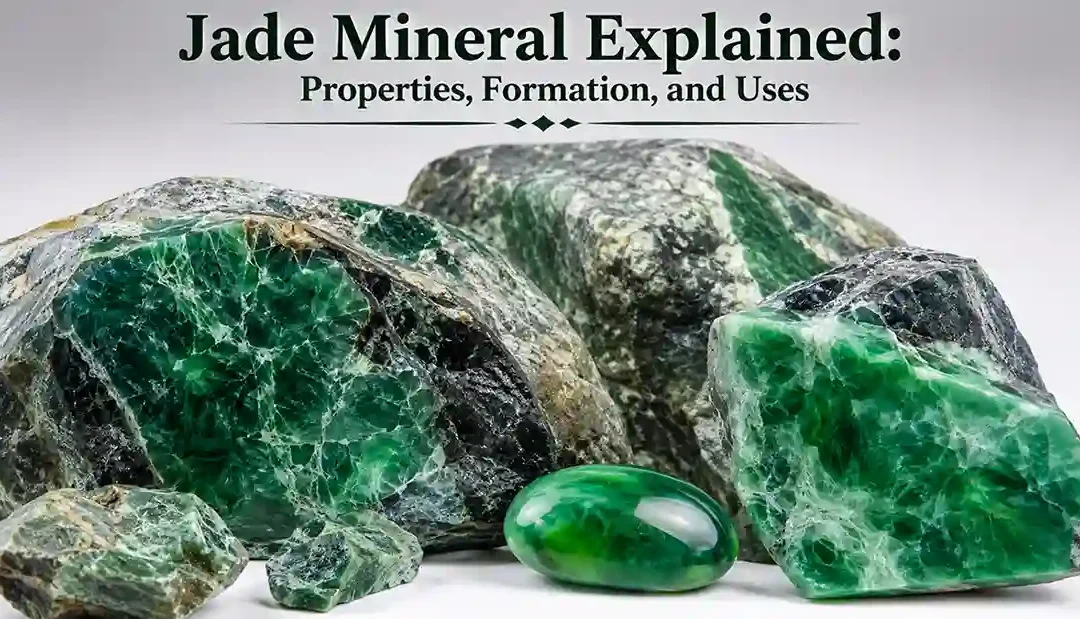
Jade is one of the most treasured ornamental stones in human history. For thousands of years, civilizations across Asia, Central America, and other regions have valued jade for its beauty, durability, and cultural significance.
Unlike many gemstones, jade refers to two distinct minerals:
- Jadeite
- Nephrite
Both minerals are exceptionally tough and can be carved into intricate artworks, jewelry, and ceremonial objects.
Learn more → what is a mineral
What Is Jade?
Jade is a gemstone name applied to two different minerals
These minerals are:
Jadeite
A pyroxene mineral.
Nephrite
An amphibole mineral.
Although they look similar, they differ in composition and crystal structure.
Types of Jade
| Type | Mineral Group |
|---|---|
| Jadeite | Pyroxene |
| Nephrite | Amphibole |
Jadeite vs Nephrite
Jadeite
Chemical formula:
Nephrite
Generalized formula:
Jadeite is generally:
- rarer
- more valuable
- brighter colored
Nephrite is generally:
- more common
- softer in appearance
- extremely tough
Why Is Jade So Valuable?
Beauty and Toughness
Jade is prized because of its:
- attractive colors
- smooth polish
- toughness
- rarity
Unlike many gemstones valued for hardness, jade is valued primarily for exceptional toughness. Its interlocking crystal structure makes it resistant to breaking.
Colors of Jade
Jade occurs in many colors.
Green
Most famous and valuable.
White
Often called "mutton fat jade."
Lavender
Popular jadeite variety.
Yellow
Less common decorative jade.
Black
Iron-rich varieties.
Common Jade Colors
| Color | Occurrence |
|---|---|
| Green | Most Valuable |
| White | Common |
| Lavender | Jadeite |
| Yellow | Less Common |
| Black | Iron-Rich |
Imperial Jade
The highest-quality jade is known as imperial jade
Characteristics include:
- vivid emerald-green color
- exceptional transparency
- fine texture
- high rarity
Imperial jade is usually jadeite rather than nephrite.
Crystal Structure of Jade
The value and toughness of jade result from Interlocking Crystal Networks
Jadeite forms:
- granular crystal textures
Nephrite forms:
- fibrous crystal textures
These structures create remarkable resistance to breaking.
Learn more → crystal structure in minerals
Physical Properties of Jade
| Property | Jadeite | Nephrite |
|---|---|---|
| Hardness | 6.5–7 | 6–6.5 |
| Luster | Waxy-Vitreous | Waxy |
| Toughness | Very High | Extremely High |
| Transparency | Opaque to Translucent | Opaque to Translucent |
How Jade Forms
Metamorphism
Most jade forms under metamorphic conditions.
Subduction Zones
High-pressure environments favor jade formation.
Fluid-Rich Systems
Hydrothermal fluids contribute to crystal growth.
Tectonic Activity
Plate convergence often creates jade-bearing rocks.
Jade and Plate Tectonics
Many jade deposits form where:
- oceanic plates subduct
- pressure increases
- metamorphism occurs
These environments produce the specialized conditions required for jade formation.
Learn more → subduction zones explained
Major Jade-Producing Countries
Important jade sources include:
- Myanmar
- China
- Guatemala
- Russia
- Canada
- New Zealand
Myanmar is the world's most important source of high-quality jadeite.
Jade in Ancient Civilizations
China
Used for over 7,000 years.
Maya Civilization
Highly valued ceremonial stone.
Maori Culture
Used in tools and ornaments.
Ancient Asia
Associated with power and status.
Jade has played a significant role in human culture for thousands of years.
Industrial and Gemstone Uses
Jewelry
The most important use.
Carvings
Popular ornamental stone.
Sculptures
Used in artistic works.
Cultural Artifacts
Important ceremonial material.
Major Uses of Jade
| Industry | Application |
|---|---|
| Jewelry | Gemstones |
| Art | Carvings |
| Museums | Historical artifacts |
| Collecting | Mineral specimens |
Jade in Mineral Identification
Geologists identify jade using:
- exceptional toughness
- waxy luster
- green coloration
- fibrous or granular texture
- metamorphic occurrence
Its toughness is one of the most distinctive identification features.
Learn more → mineral identification guide
Jade Identification Summary
| Property | Jade |
|---|---|
| Mineral Types | Jadeite & Nephrite |
| Hardness | 6–7 |
| Luster | Waxy |
| Toughness | Extremely High |
| Color | Green and Others |
| Formation | Metamorphic |
Jade is a gemstone term that refers to two minerals: jadeite and nephrite.
Jadeite, especially imperial jade, is generally more valuable than nephrite.
Its interlocking crystal structure makes it highly resistant to breaking.
Most jade forms in metamorphic environments associated with subduction zones.
Myanmar is famous for producing some of the world's finest jadeite.
Final Thoughts
Jade is one of the most culturally significant and geologically fascinating gemstone materials in the world. Its exceptional toughness, beautiful colors, and association with high-pressure metamorphic environments make it unique among gemstones.
From ancient Chinese artifacts and Mayan ceremonial objects to modern jewelry and carvings, jade continues to be valued for both its beauty and remarkable geological history.