
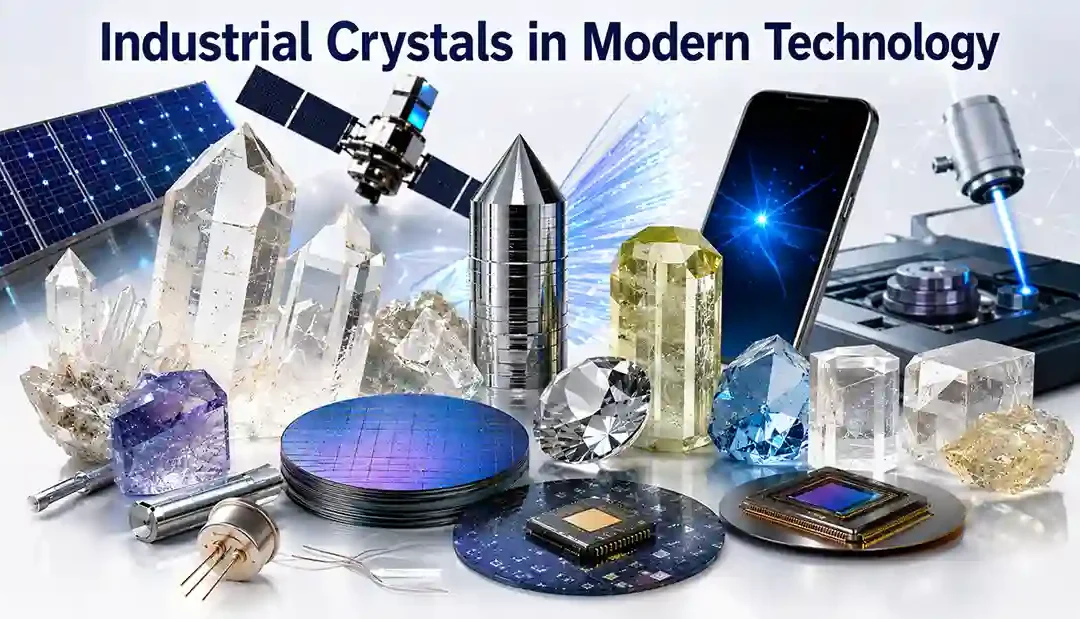
Industrial crystals are naturally occurring or laboratory-grown crystals that are used in manufacturing, electronics, construction, medicine, optics, energy production, and many other industries. Unlike gemstones, which are valued primarily for their beauty, industrial crystals are prized for their physical, chemical, electrical, optical, magnetic, and mechanical properties.
Modern technology depends heavily on industrial crystals. Quartz controls the timing of watches and smartphones, silicon crystals power computer processors, synthetic sapphire protects electronic devices, and industrial diamonds are used for cutting, drilling, and polishing. Many renewable energy technologies, communication systems, and medical instruments also rely on high-quality crystals.
Understanding industrial crystals is essential in mineralogy, materials science, crystallography, engineering geology, electronics, and manufacturing.
This topic should be studied together with Mineralogy Explained, Natural vs Synthetic Minerals Explained, and Crystal Chemistry Explained.
What Are Industrial Crystals?
Industrial crystals are crystals used for practical industrial applications rather than decorative purposes.
They may be:
- Natural crystals
- Synthetic crystals
- Single crystals
- Polycrystalline materials
Their usefulness depends on specific crystal properties.
Why Industrial Crystals Are Important
Industries use crystals because of their unique properties, including:
- High hardness
- Optical transparency
- Piezoelectricity
- Electrical conductivity
- Heat resistance
- Chemical stability
- Precision crystal structure
These characteristics make crystals essential for modern technology.
Natural vs Synthetic Industrial Crystals
Industrial crystals may originate from nature or be manufactured in laboratories.
Natural crystals include:
- Quartz
- Calcite
- Diamond
- Fluorite
Synthetic crystals include:
- Synthetic sapphire
- Silicon wafers
- YAG crystals
- Synthetic diamond
Many industries prefer synthetic crystals because they have fewer impurities and more consistent quality.
Common Industrial Crystals
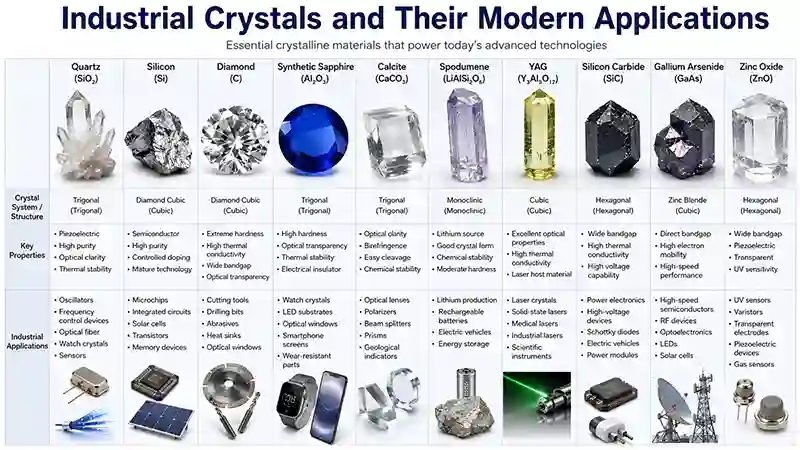
Quartz
Quartz is one of the world's most important industrial crystals.
Applications include:
- Electronic oscillators
- Watches
- Smartphones
- Radio transmitters
- Pressure sensors
Its piezoelectric property makes it extremely valuable.
Silicon
Silicon crystals are the foundation of modern electronics.
Uses include:
- Computer processors
- Microchips
- Solar cells
- Integrated circuits
Nearly every electronic device depends on single-crystal silicon.
Diamond
Industrial diamonds are valued for:
- Extreme hardness
- Wear resistance
- Heat conductivity
Applications:
- Cutting tools
- Drilling equipment
- Polishing wheels
Most industrial diamonds are synthetic.
Synthetic Sapphire
Synthetic sapphire provides:
- High scratch resistance
- Excellent optical clarity
- Heat resistance
Used in:
- Smartphone camera lenses
- LED substrates
- Watch crystals
- Scientific instruments
Calcite
Optical-grade calcite is used in:
- Polarizing microscopes
- Optical instruments
- Scientific equipment
Lithium Crystals
Lithium-bearing crystals contribute to:
- Battery production
- Electric vehicles
- Energy storage
Common minerals include:
- Spodumene
- Lepidolite
YAG (Yttrium Aluminum Garnet)
YAG crystals are synthetic crystals used in:
- Industrial lasers
- Medical lasers
- Scientific instruments
Piezoelectric Crystals
Common piezoelectric crystals include:
- Quartz
- Tourmaline
Applications include:
- Sensors
- Oscillators
- Pressure gauges
- Ultrasonic devices
Accessory Industrial Crystals
Other important industrial crystals include:
- Gallium arsenide
- Silicon carbide
- Zinc oxide
- Rutile
- Fluorite
- Corundum
- Germanium
- Perovskite crystals
These materials are widely used in semiconductors, LEDs, photovoltaics, and high-performance electronics.
How Industrial Crystals Are Manufactured
Synthetic industrial crystals are commonly produced using:
- Czochralski crystal growth
- Hydrothermal growth
- Chemical vapor deposition (CVD)
- High-pressure high-temperature (HPHT)
- Flux growth
- Bridgman method
These techniques produce crystals with high purity and controlled structures.
Crystal Properties Used in Industry
Industries select crystals based on:
- Hardness
- Transparency
- Piezoelectricity
- Thermal conductivity
- Electrical conductivity
- Optical properties
- Chemical stability
- Crystal perfection
Different industries require different combinations of these properties.
Industrial Applications
Industrial crystals are used in:
Electronics
- Computer chips
- Smartphones
- Sensors
- Oscillators
Renewable Energy
- Solar panels
- Battery materials
- Power electronics
Medical Technology
- Surgical lasers
- Medical imaging
- Dental tools
Aerospace
- Satellites
- Navigation systems
- Optical sensors
Manufacturing
- Cutting
- Drilling
- Grinding
- Precision machining
Geological Importance
Industrial crystals help geologists:
- Identify valuable mineral resources
- Evaluate ore deposits
- Understand crystal growth
- Study mineral stability
- Support economic geology
Many industrial minerals originate from specific geological environments.
Laboratory Investigation
Industrial crystals are analyzed using:
- X-Ray Diffraction (XRD)
- Electron Microprobe Analysis (EPMA)
- Scanning Electron Microscopy (SEM)
- Transmission Electron Microscopy (TEM)
- Raman Spectroscopy
- X-Ray Fluorescence (XRF)
- Optical Microscopy
These methods evaluate crystal quality, purity, and defects.
Applications
Industrial crystals are essential in:
- Electronics
- Materials Science
- Aerospace Engineering
- Renewable Energy
- Telecommunications
- Medical Technology
- Manufacturing
- Mineral Processing
Advantages of Industrial Crystals
Industrial crystals provide:
- High durability
- Precise electrical properties
- Excellent optical performance
- Chemical stability
- Reliable performance
- Long service life
Limitations
Industrial crystals also present challenges:
- High-purity crystals can be expensive to produce.
- Large single crystals require specialized manufacturing equipment.
- Some crystals are brittle and difficult to machine.
- Production often requires precise control of temperature, pressure, and chemical composition.
For comprehensive understanding, combine this topic with:
- Natural vs Synthetic Minerals Explained
- Crystal Growth in Minerals Explained
- Crystal Chemistry Explained
- Experimental Mineralogy Explained
- Mineralogy Explained
- X-Ray Diffraction in Mineralogy
- Electron Microprobe Analysis
- Optical Mineralogy Explained
Comparison Table
| Industrial Crystal | Main Property | Major Applications |
|---|---|---|
| Quartz | Piezoelectricity | Electronics, Sensors |
| Silicon | Semiconductor | Computer Chips, Solar Panels |
| Diamond | Hardness | Cutting and Drilling |
| Synthetic Sapphire | Scratch Resistance | Electronics, Optics |
| Calcite | Optical Properties | Polarizers, Microscopes |
| YAG | Laser Medium | Medical and Industrial Lasers |
| Silicon Carbide | Heat Resistance | Power Electronics |
Summary Table
| Feature | Industrial Crystals |
| Definition | Crystals Used in Industrial Applications |
| Sources | Natural and Synthetic |
| Major Industries | Electronics, Energy, Medicine, Aerospace |
| Common Study Methods | XRD, SEM, EPMA, Raman |
| Geological Importance | Economic Minerals and Crystal Technology |
Industrial crystals are natural or synthetic crystals used for practical applications in electronics, manufacturing, medicine, optics, aerospace, energy, and other industries.
Quartz and silicon are among the most important industrial crystals because they are essential for electronics, communication systems, and semiconductor technology.
Both. Some industrial crystals are mined from natural deposits, while others are grown in laboratories to achieve higher purity and more consistent quality.
Synthetic crystals can be produced with controlled size, purity, and crystal structure, making them ideal for high-performance industrial applications.
Scientists analyze industrial crystals using X-ray diffraction (XRD), scanning electron microscopy (SEM), electron microprobe analysis (EPMA), Raman spectroscopy, transmission electron microscopy (TEM), and optical microscopy.
Final Thoughts
Industrial crystals are the hidden foundation of modern technology. From quartz oscillators and silicon microchips to synthetic diamonds, sapphire windows, and laser crystals, these materials power the devices, machines, and infrastructure used every day. Their unique crystal structures give them exceptional electrical, optical, thermal, and mechanical properties that cannot easily be replaced by other materials.
By combining mineralogy, crystal chemistry, experimental mineralogy, and advanced manufacturing techniques, scientists and engineers continue to develop new crystal materials that support innovation in electronics, renewable energy, medicine, aerospace, and communications. Industrial crystals remain one of the most important links between Earth science and modern technology.
Continue Learning
Explore more topics related to crystal science and industrial minerals: