
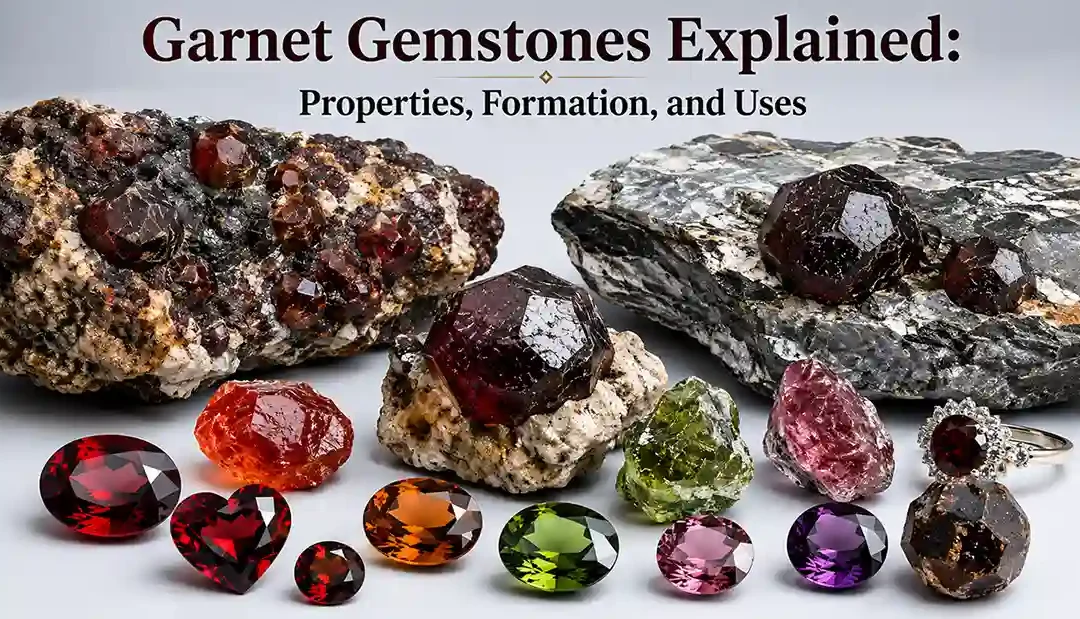
Garnet is one of the most diverse and widely recognized gemstone groups in the world. Although many people associate garnet with deep red gemstones, garnets actually occur in a remarkable range of colors including green, orange, pink, yellow, purple, and even nearly colorless varieties.
Garnets have been used in jewelry and decorative objects for thousands of years and remain popular because of their beauty, durability, and affordability.
They are also important minerals in geology because they help scientists understand metamorphic processes and rock formation.
What Are Garnet Gemstones?
Garnet refers to a group of closely related silicate minerals that share a similar crystal structure but vary in chemical composition.
Garnets are valued for:
- brilliant colors
- excellent durability
- gemstone clarity
- natural beauty
- geological significance
Unlike many gemstones, most garnets are untreated and display their natural colors.
Garnet Chemical Formula
Garnets form a mineral group with varying compositions.
The generalized garnet formula is: X₃Y₂(SiO₄)₃
Where:
- X = Mg, Fe, Mn, or Ca
- Y = Al, Fe, or Cr
Different combinations create different garnet varieties.
Garnet Mineral Profile
| Property | Value |
|---|---|
| Mineral Group | Garnet |
| Chemical Formula | X₃Y₂(SiO₄)₃ |
| Color | Red, Green, Orange, Yellow, Pink, Purple |
| Hardness | 6.5–7.5 |
| Crystal System | Isometric (Cubic) |
| Luster | Vitreous |
| Streak | White |
| Specific Gravity | 3.5–4.3 |
Major Garnet Varieties
Garnet is not a single mineral but a group of minerals.
Almandine
Most common garnet.
Color:
- dark red
- reddish brown
Formula: Fe₃Al₂(SiO₄)₃
Pyrope
Classic deep-red gemstone garnet.
Formula: Mg₃Al₂(SiO₄)₃
Spessartine
Bright orange garnet.
Formula: Mn₃Al₂(SiO₄)₃
Grossular
Occurs in many colors including green.
Formula: Ca₃Al₂(SiO₄)₃
Andradite
Includes the famous green demantoid garnet.
Formula: Ca₃Fe₂(SiO₄)₃
Major Garnet Species
| Garnet Type | Common Color |
|---|---|
| Almandine | Dark Red |
| Pyrope | Deep Red |
| Spessartine | Orange |
| Grossular | Green, Yellow |
| Andradite | Green, Yellow |
| Uvarovite | Emerald Green |
Crystal Structure
Garnets crystallize in the:
Isometric (Cubic) Crystal System
Characteristics include:
- dodecahedral crystals
- trapezohedral crystals
- highly symmetrical shapes
- excellent crystal development
Learn more → isometric-cubic-crystal-system
Physical Properties
Luster
Vitreous.
Transparency
Transparent to opaque.
Cleavage
None.
Fracture
Conchoidal to uneven.
The absence of cleavage contributes to garnet's durability.
Formation of Garnet
Garnets form in several geological environments.
Regional Metamorphism
Most common source.
Contact Metamorphism
Heat alters surrounding rocks.
Igneous Rocks
Some garnets crystallize from magma.
Alluvial Deposits
Weathered garnets accumulate in river sediments.
Garnets are especially important indicator minerals in metamorphic rocks.
Why Garnets Are Important in Geology
Garnets help geologists determine:
- metamorphic temperature
- pressure conditions
- rock history
- tectonic processes
Because garnets grow during metamorphism, they preserve valuable geological information.
Major Garnet-Producing Countries
Important sources include:
- India
- Sri Lanka
- Madagascar
- Tanzania
- Mozambique
- Namibia
- United States
Garnet Colors
Garnets occur in:
- red
- orange
- yellow
- green
- pink
- purple
- brown
- black
Blue garnet is extremely rare but does exist. Nearly every color occurs except pure blue in most commercial deposits.
Famous Green Garnets
Demantoid Garnet
One of the most valuable garnets.
Known for:
- brilliant green color
- exceptional dispersion
Tsavorite Garnet
Bright green grossular garnet. Often compared with emerald.
Garnet vs Ruby
| Property | Garnet | Ruby |
|---|---|---|
| Mineral Group | Garnet | Corundum |
| Hardness | 6.5–7.5 | 9 |
| Crystal System | Cubic | Trigonal |
| Cleavage | None | None |
Garnets are generally less expensive but still highly attractive gemstones.
Garnet in Jewelry
Garnets are commonly used in:
- rings
- pendants
- earrings
- bracelets
- necklaces
Their durability makes them suitable for everyday wear.
Industrial Uses of Garnet
Besides gemstones, garnet is used for:
Abrasives
Sandblasting and cutting.
Waterjet Cutting
Industrial precision cutting.
Filtration
Water treatment systems.
Polishing
Surface finishing applications.
Few gemstones have as many industrial applications as garnet.
Factors Affecting Garnet Value
Color
Most important factor.
Clarity
Transparent stones are preferred.
Size
Large gems are more valuable.
Variety
Demantoid and tsavorite command premium prices.
Cut
Enhances brilliance and color.
Garnet Mining and Gemstones
Gem-quality garnets are commonly recovered from:
- metamorphic rocks
- alluvial deposits
- pegmatites
- skarns
Many specimens are cut into brilliant gemstones because of their excellent optical properties.
Garnet as a Birthstone
Garnet is the traditional birthstone for January. It has been associated with protection, strength, and friendship for centuries.
Garnet Identification Summary
| Property | Garnet |
|---|---|
| Mineral Group | Garnet |
| Formula | X₃Y₂(SiO₄)₃ |
| Hardness | 6.5–7.5 |
| Crystal System | Isometric |
| Cleavage | None |
| Streak | White |
| Common Colors | Red, Green, Orange |
Garnet is both a mineral group and a popular gemstone.
No. Garnets occur in red, green, orange, yellow, pink, purple, and other colors.
Most garnets have a Mohs hardness between 6.5 and 7.5.
Demantoid and tsavorite garnets are among the most valuable varieties.
Garnet is the traditional birthstone for January.
Final Thoughts
Garnet gemstones are among the most versatile and fascinating members of the mineral kingdom. Their remarkable range of colors, geological importance, and widespread use in jewelry and industry make them unique among gemstones.
From deep red almandine and pyrope to brilliant green tsavorite and demantoid, garnets showcase the incredible diversity that can exist within a single mineral group. Their beauty, durability, and scientific significance ensure their continued popularity among collectors, gemologists, and jewelry enthusiasts worldwide.
Continue learning with → garnet-mineral-explained.