
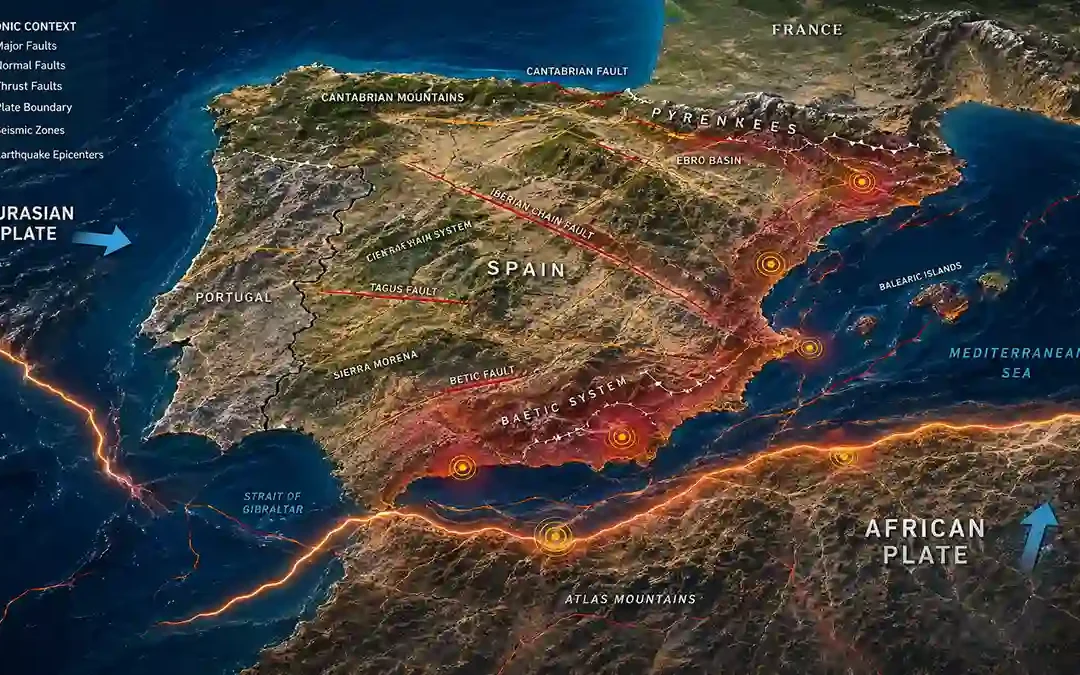
Spain is not usually considered one of Europe’s most earthquake-prone countries. But seismic activity here is far from uniform.
Some regions rarely experience earthquakes, while others — especially near the Mediterranean — sit under ongoing tectonic pressure. That contrast is what makes Spain geologically interesting.
If you’re new to earthquakes, start here → what is an earthquake
Spain’s Main Seismic Regions
| Region | Risk Level | Main Cause |
|---|---|---|
| Southern Spain | Very High | African–Eurasian plate interaction |
| Southeastern Mediterranean Coast | High | Active fault systems |
| Pyrenees Region | Moderate | Mountain compression |
| Central Spain | Low–Moderate | Older fault reactivation |
| Northwestern Spain | Low | Stable crust |
Spain’s strongest earthquakes are usually concentrated in the south and southeast.
To understand how tectonic stress forms → fault lines
Why Do Earthquakes Happen in Spain?
Spain’s earthquakes are mainly connected to the slow interaction between the African Plate and the Eurasian Plate.
Here’s the simplified process:
- The African Plate moves northward
- Pressure builds near the Mediterranean region
- Faults across southern Spain accumulate stress
- Earthquakes occur when rocks suddenly shift
This tectonic interaction also affects nearby North African countries like Morocco and Algeria.
Learn more → causes of earthquakes
Spain’s Four Distinct Earthquake Zones
Southern Spain & Andalusia (Highest Risk Area)
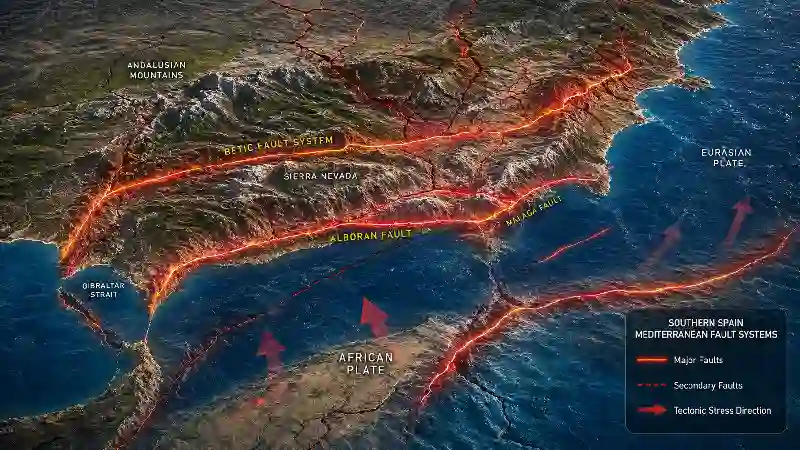
Southern Spain experiences the country’s strongest seismic activity.
- Active crustal faults
- Mediterranean tectonic pressure
- Moderate to strong earthquakes possible
This region is closest to the African–Eurasian interaction zone.
Explore earthquake types
Southeastern Mediterranean Coast
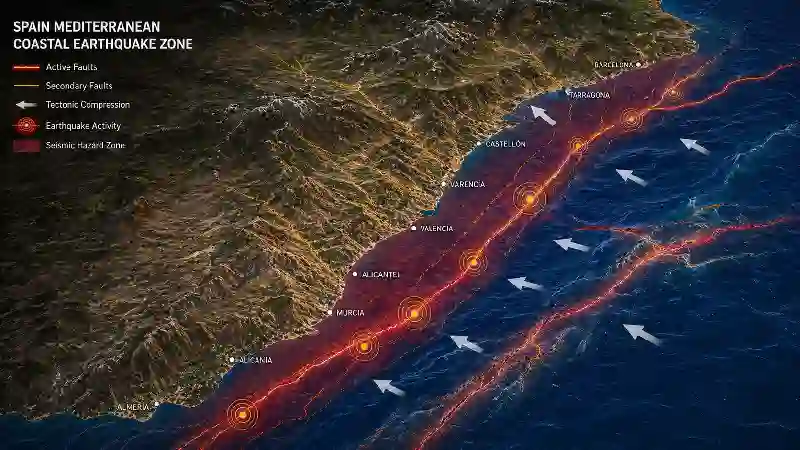
Spain’s southeastern coast contains several active fault systems.
- Shallow earthquakes occur here
- Coastal cities can feel strong shaking
- Stress is distributed across multiple faults
Pyrenees Mountains (Compression Zone)
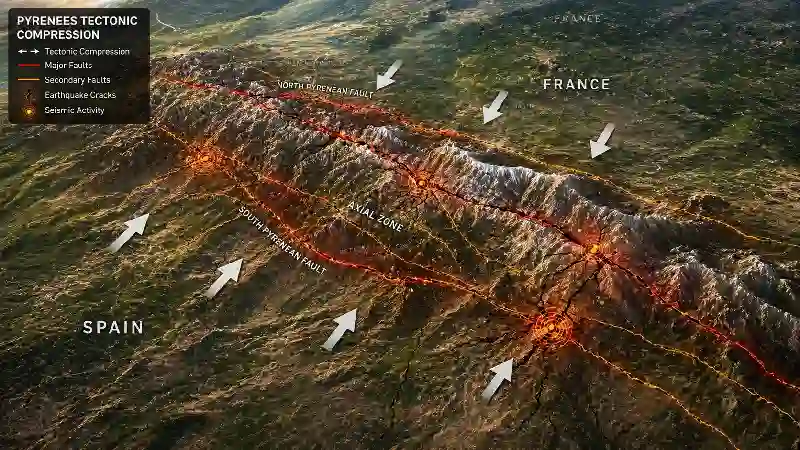
Northern Spain near the Pyrenees experiences moderate seismic activity.
- Mountain-building pressure
- Compression-related faults
- Less active than southern Spain
This region behaves differently from Mediterranean zones.
Central Spain (Hidden Fault Activity)
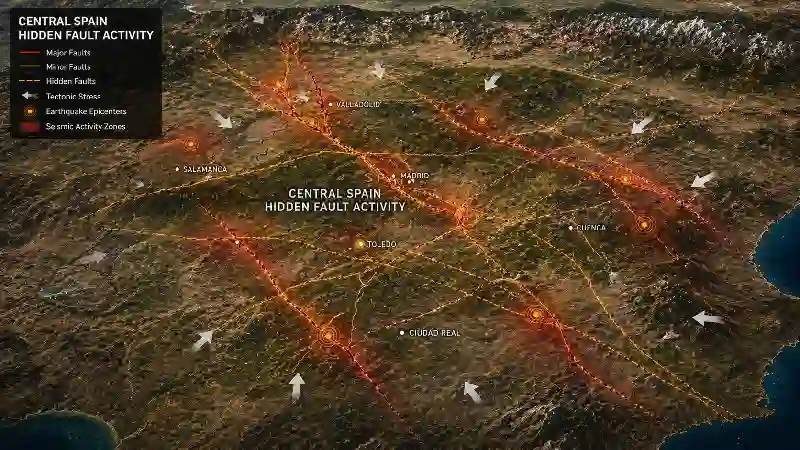
Central Spain is relatively stable, but not completely inactive.
- Older faults can reactivate
- Small earthquakes still occur
- Seismic risk is lower overall
This shows how earthquakes can happen even away from major boundaries.
Recent Earthquake Activity in Spain
Spain experiences earthquakes regularly, although most are small.
Recent patterns show:
- Increased activity near the Mediterranean coast
- Small offshore earthquakes
- Occasional moderate inland events
Most earthquakes are minor, but stronger events remain possible in southern regions.
Notable Earthquakes in Spain
Past earthquakes reveal Spain’s seismic history.
- 2011 Lorca Earthquake (M5.1)
A shallow earthquake causing significant damage. - 1884 Andalusia Earthquake
One of Spain’s strongest historical earthquakes. - 1755 Lisbon Earthquake Effects
Although centered offshore Portugal, the earthquake strongly affected Spain.
Understand magnitude vs impact
Spain vs Other Earthquake Regions
Spain’s seismic activity differs from major global earthquake zones.
- Spain → moderate Mediterranean tectonic activity
- Italy → more active shallow fault systems
- Morocco → Atlas Mountain compression
- California → transform faults like the San Andreas Fault
Spain’s earthquakes are generally less frequent, but still capable of causing damage.
Can Earthquakes in Spain Be Predicted?
No — earthquakes cannot be predicted precisely.
Scientists can:
- monitor seismic zones
- study fault systems
- estimate long-term risk
But exact timing remains uncertain.
Learn more → Can earthquakes be predicted
Southern and southeastern Spain.
Most are small, but moderate earthquakes do occur.
Because it is closer to the African–Eurasian tectonic interaction zone.
Yes — especially shallow earthquakes near populated areas.
Final Thoughts
Spain’s earthquakes may not happen as often as in Japan or Chile, but the country still sits within an active tectonic environment. From Mediterranean coastal faults to mountain compression zones, Spain shows how seismic activity can vary greatly across a single country.
Understanding these regional differences helps explain why some areas remain relatively quiet while others continue to experience tectonic stress beneath the surface.