
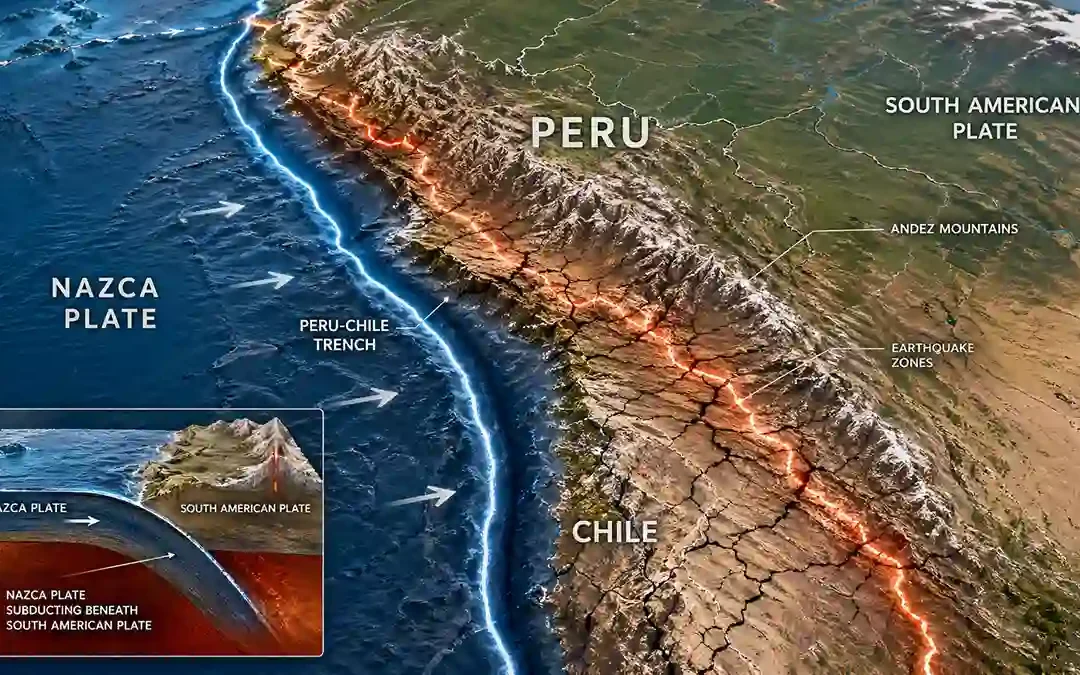
Peru experiences earthquakes because it sits directly above one of the most active subduction zones on Earth.
What makes Peru especially interesting is how closely its earthquakes are connected to the formation of the Andes Mountains. The same tectonic forces that create mountains also generate powerful earthquakes beneath the region.
If you’re new to earthquakes, start here → what is an earthquake
Peru’s Seismic Pattern (A Coastal-Mountain System)
| Region | Risk Level | What’s Happening |
|---|---|---|
| Pacific Coast | Very High | Subduction zone earthquakes |
| Central Andes | High | Crust compression |
| Southern Peru | Very High | Major tectonic stress |
| Northern Peru | Moderate | Lower seismic concentration |
| Amazon Basin | Low | Stable interior region |
Peru’s earthquakes are strongest near the coast, but their effects often extend into the mountains
To understand how these zones form → fault lines
Why Does Peru Have So Many Earthquakes?
Earthquakes in Peru primarily occur because the Nazca Plate is subducting beneath the South American Plate.
Here’s the process in simple terms:
- The Nazca Plate moves eastward
- It dives beneath South America
- Pressure builds along the boundary
- The crust deforms and uplifts
- Earthquakes occur when stress is released
This process is also responsible for the growth of the Andes Mountains.
Learn more → causes of earthquakes
Peru’s Three Main Earthquake Behaviors (Unique Insight)
Peru-Chile Trench (Primary Earthquake Source)
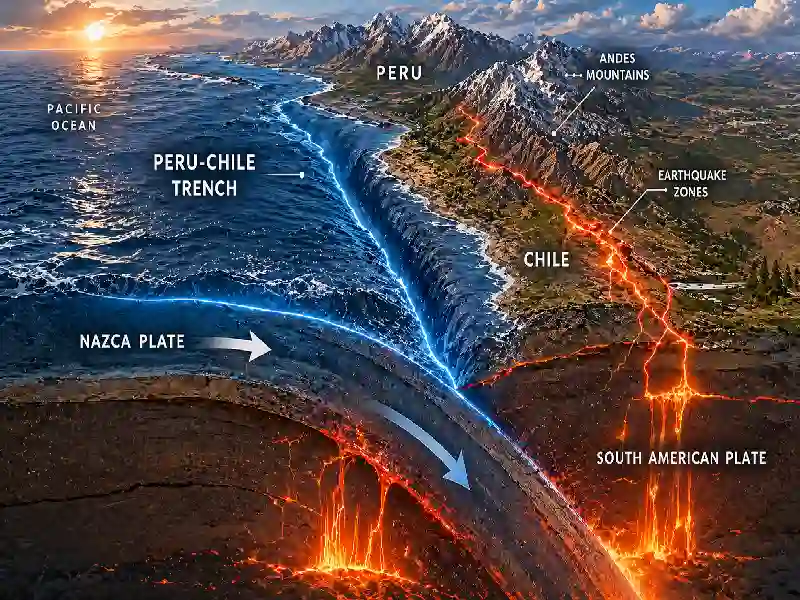
Off Peru’s coast lies the Peru-Chile Trench.
- Major subduction boundary
- Source of powerful earthquakes
- Potential for tsunamis
This trench is one of the most active seismic zones in South America.
Explore earthquake types
Andes Compression Zone
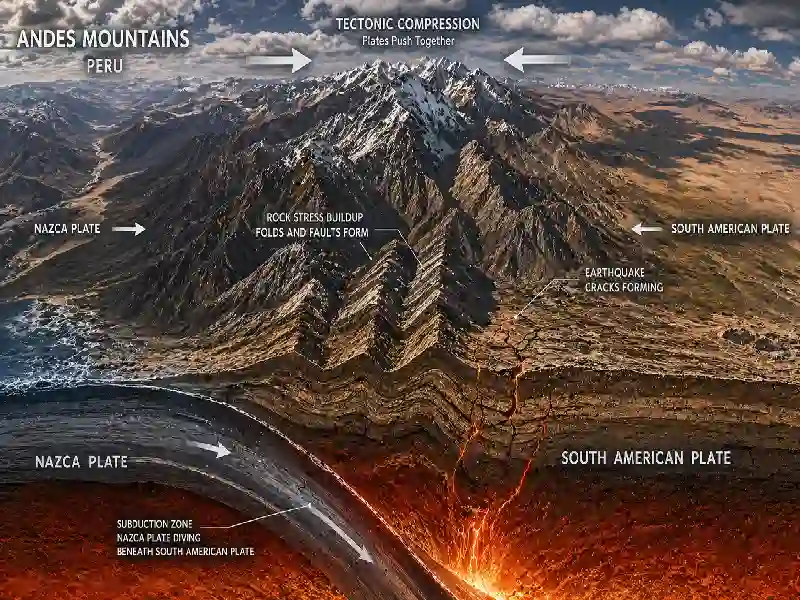
The Andes are not just mountains — they are evidence of ongoing tectonic pressure.
- Crust compression
- Active fault systems
- Frequent moderate earthquakes
This shows how mountain-building and earthquakes are connected.
Deep Earthquakes Beneath Peru
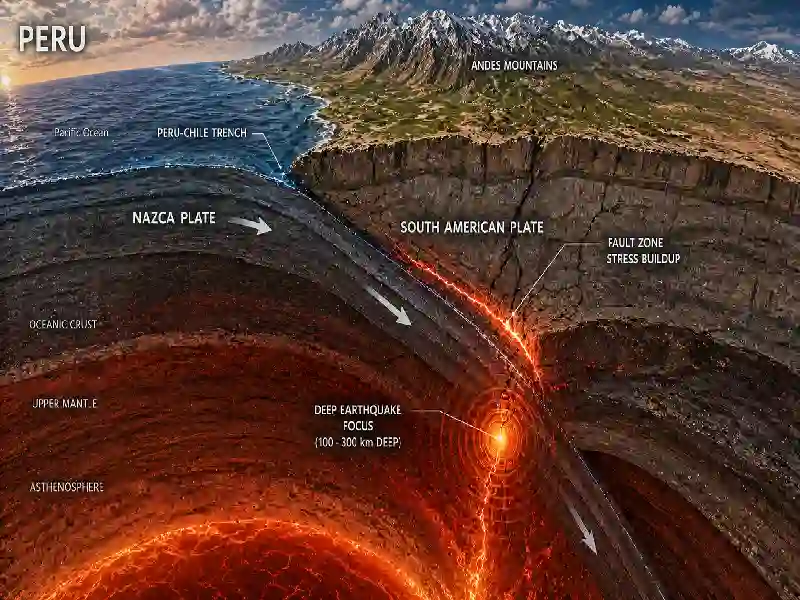
Peru also experiences deep earthquakes.
- Occur far below the surface
- Felt across large distances
- Usually linked to the descending Nazca Plate
These earthquakes behave differently from shallow coastal events.
Recent Earthquake Activity in Peru
Peru has earthquakes regularly throughout the year.
Recent patterns show:
- Frequent offshore earthquakes
- Ongoing activity along the Andes
- Aftershock sequences following larger events
This reflects continuous tectonic movement beneath the country.
Notable Earthquakes in Peru
Past events reveal the scale of Peru’s seismic risk.
- 1970 Ancash Earthquake (M7.9)
Triggered landslides and caused major destruction. - 2007 Pisco Earthquake (M8.0)
A powerful coastal earthquake affecting central Peru. - 1746 Lima–Callao Earthquake
One of the most destructive earthquakes in Peru’s history.
Understand magnitude vs impact
Peru vs Other Earthquake Regions
Peru shares similarities with some regions, but also has distinct patterns.
- Peru → coastal subduction + mountain compression
- Chile → stronger subduction dominance
- Nepal → continental collision earthquakes
- California → transform faults like the San Andreas Fault
Peru combines coastal and mountain seismic behavior
Can Earthquakes in Peru Be Predicted?
No — earthquakes cannot be predicted precisely.
Scientists can:
- monitor seismic activity
- study plate movement
- estimate long-term risk
But exact timing remains unknown.
Learn more → Can earthquakes be predicted
Because of subduction between the Nazca and South American plates.
The Pacific coast and Andes regions.
Yes — especially large offshore earthquakes.
Yes — they occur beneath the subducting Nazca Plate.
Final Thoughts
Earthquakes in Peru are tied directly to the powerful tectonic forces that continue shaping western South America. From the deep offshore subduction zone to the rising Andes Mountains, constant geological pressure has transformed the region over millions of years.
Studying Peru’s seismic activity reveals how earthquakes are closely connected to some of the planet’s most massive and dynamic geological systems.