
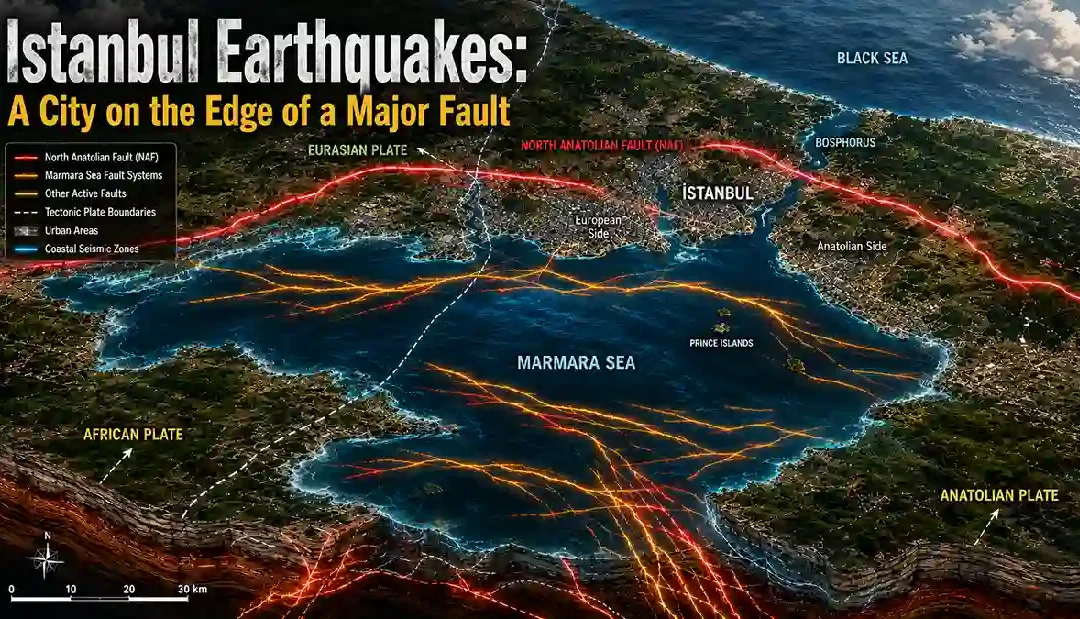
Istanbul is one of the most earthquake-risk cities in the world. The reason lies just south of the city: the North Anatolian Fault, one of the most active fault systems on Earth. This fault runs beneath the nearby Marmara Sea, placing Istanbul extremely close to a major seismic threat.
If you’re new to earthquakes, begin here → what is an earthquake
Istanbul Seismic Zones
| Zone | Risk Level | Main Cause |
|---|---|---|
| Marmara Sea Fault Zone | Extremely High | Transform fault movement |
| North Anatolian Fault | Extremely High | Plate sliding |
| Istanbul Urban Faults | High | Local crustal stress |
| Eastern Marmara Region | Very High | Fault interaction |
| Western Turkey | High | Regional tectonic movement |
Istanbul sits next to a major active fault system. To understand how faults work → fault lines
Why Do Earthquakes Happen in Istanbul?
Istanbul lies along a transform fault boundary.
Here’s the simple explanation:
- The Anatolian Plate moves westward
- The Eurasian Plate remains relatively stable
- The plates slide past each other
- Stress builds along the fault
- Earthquakes occur when the fault suddenly slips
This creates frequent earthquakes and the potential for very large ones.
Learn more → causes of earthquakes
Four Major Earthquake Systems Affecting Istanbul
North Anatolian Fault (Main Threat)
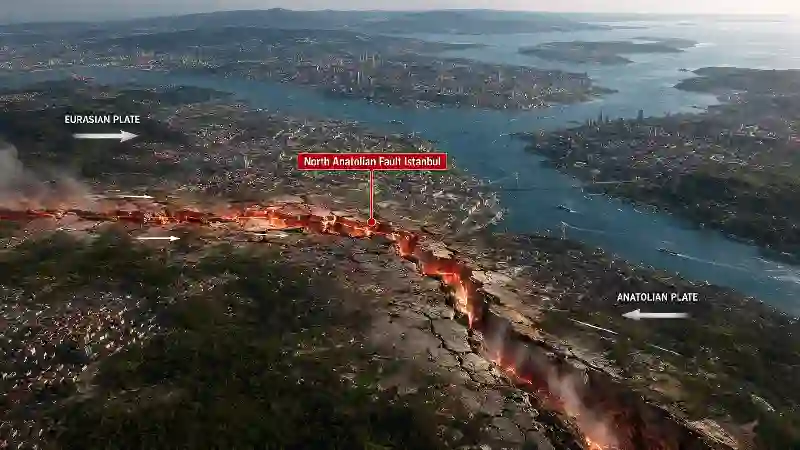
The North Anatolian Fault is the primary source of earthquake risk.
- Major transform fault
- Similar to California’s San Andreas Fault
- Capable of large earthquakes (M7+)
Explore earthquake types
Marmara Sea Seismic Gap (Most Dangerous Zone)
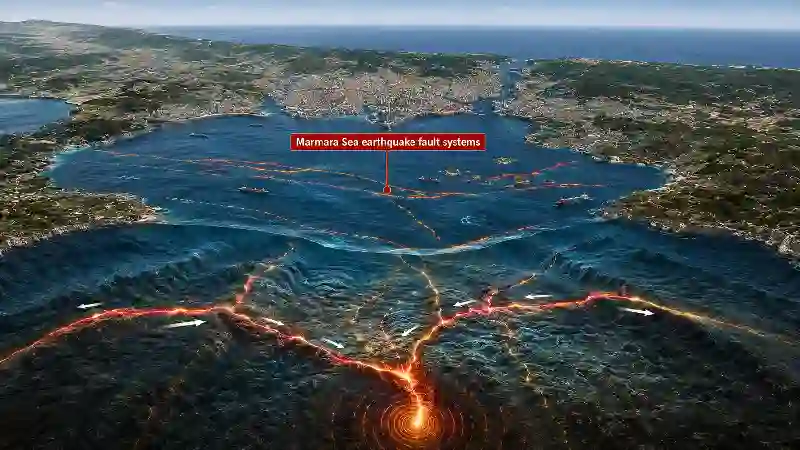
The Marmara Sea contains a seismic gap near Istanbul.
- Section of the fault has not ruptured recently
- Stress continues to build
- Scientists expect a future large earthquake
Regional Fault Interaction
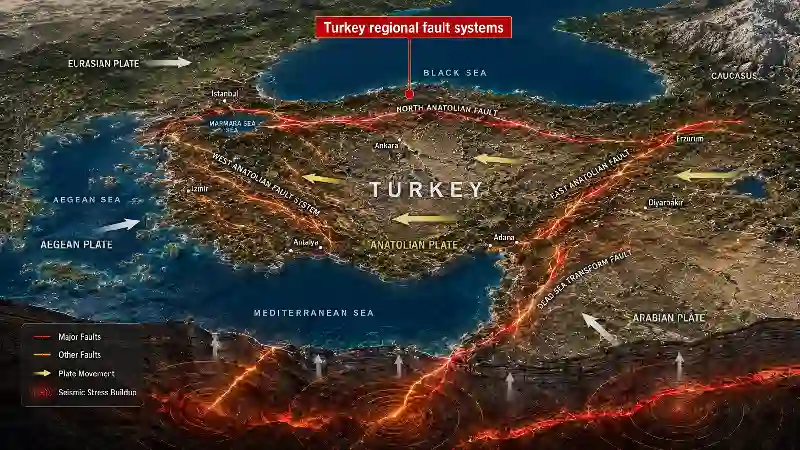
Istanbul is affected by multiple interacting faults.
- Stress transfers between fault segments
- Earthquakes can trigger nearby activity
- Complex seismic behavior
Urban Amplification Effects
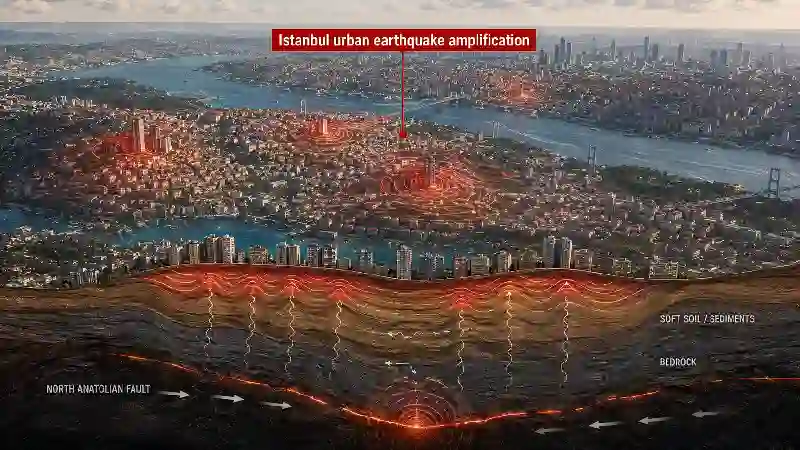
Parts of Istanbul can experience amplified shaking.
- Soft soil and sediment layers
- Stronger shaking during earthquakes
- Increased damage risk
Recent Earthquake Activity in Istanbul
The Istanbul region experiences frequent seismic activity.
Recent patterns show:
- Small earthquakes near the Marmara Sea
- Regional fault movement
- Ongoing stress buildup
Scientists closely monitor the area due to the high risk of a future large earthquake.
Notable Earthquakes Affecting Istanbul
Istanbul has experienced major earthquakes in history.
- 1999 Izmit Earthquake (M7.6)
A devastating earthquake along the North Anatolian Fault. - 1766 Istanbul Earthquake
A major historical event affecting the city. - Series of Westward-Migrating Earthquakes
Earthquakes have progressively moved toward Istanbul over time.
Understand magnitude vs impact
Istanbul vs Other Earthquake Regions
Istanbul shares similarities with other transform fault regions.
- Istanbul → transform fault (plate sliding)
- California → similar system like San Andreas Fault
- Japan → subduction zone earthquakes
- Chile → plate collision earthquakes
Istanbul’s risk comes from horizontal plate movement along a major fault.
Can Earthquakes in Istanbul Be Predicted?
No — earthquakes cannot be predicted precisely.
Scientists can:
- monitor fault movement
- measure stress buildup
- identify seismic gaps
But exact timing remains uncertain.
Learn more → Can earthquakes be predicted
Because it sits next to the North Anatolian Fault.
A major earthquake along the Marmara Sea segment.
Small earthquakes occur occasionally, but large ones are less frequent.
A section of a fault that hasn’t ruptured recently but may in the future.
Final Thoughts
Istanbul is one of the most closely watched earthquake regions in the world. With a major fault system running just offshore, the city faces significant seismic risk from future earthquakes.
Understanding Istanbul’s tectonic setting helps explain why scientists consider it one of the most likely locations for a major earthquake in the coming decades.