
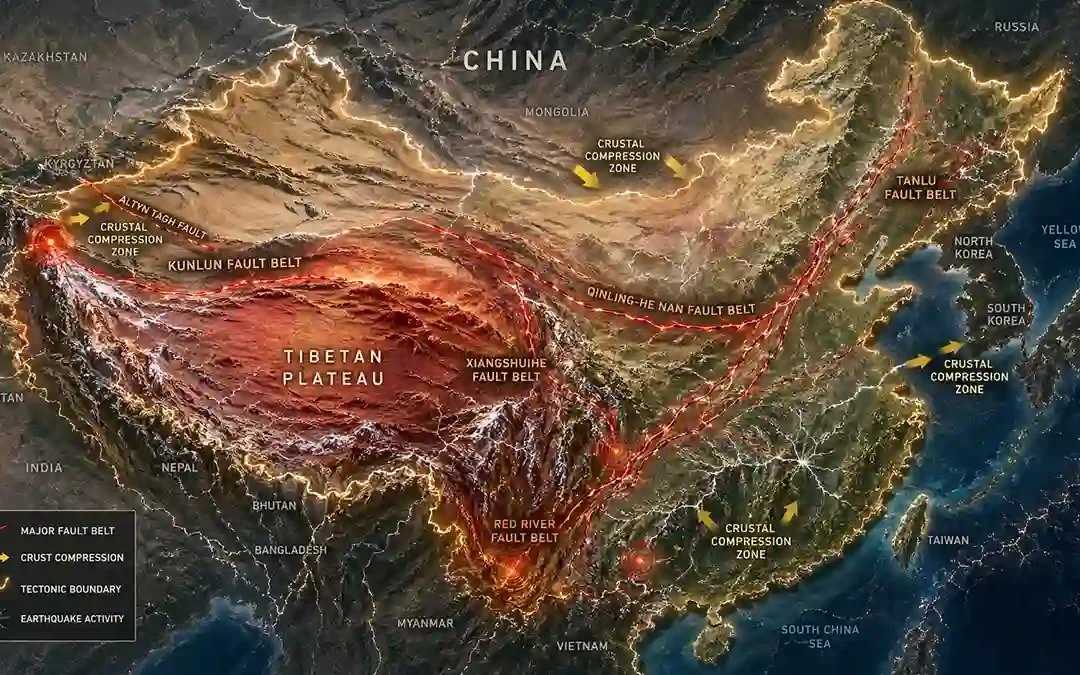
China’s earthquakes are different from what most people expect.
They don’t all occur along obvious plate edges like in Chile or Indonesia. Instead, many of them happen deep within the continent, far from the ocean.
That’s because China sits on a vast region where tectonic pressure spreads across large areas rather than staying concentrated in one place.
If you’re new to earthquakes, start here → what is an earthquake
China’s Seismic Pattern (Wide and Uneven)
| Region | Risk Level | What’s Happening |
|---|---|---|
| Western China (Tibetan Plateau) | Very High | Crust compression + uplift |
| Sichuan Basin Edge | Very High | Active fault belts |
| Northern China | Moderate | Intraplate stress |
| Eastern China | Low–Moderate | Distant tectonic influence |
| Coastal Regions | Moderate | Plate boundary proximity |
China’s earthquakes are spread across multiple fault belts, not one single zone
To understand how stress builds → fault lines
The Core Driver: Continental Stress (A Different Mechanism)
China’s earthquakes are mainly linked to the effects of the Indian Plate pushing into the Eurasian Plate.
Here’s the key idea:
- The Indian Plate moves north
- It collides with Eurasia
- The Tibetan Plateau rises
- Stress spreads across China’s interior
This creates continental earthquakes, which behave differently from subduction zone quakes.
Learn more → causes of earthquakes
China’s Three Distinct Earthquake Behaviors (Unique Insight)
Tibetan Plateau (Pressure Zone)

The Tibetan Plateau is one of the most geologically active regions on Earth.
- Ongoing crust uplift
- Strong compression forces
- Frequent large earthquakes
This region is directly affected by the India–Eurasia collision.
Explore earthquake types
Sichuan Fault Belt (High-Impact Zone)
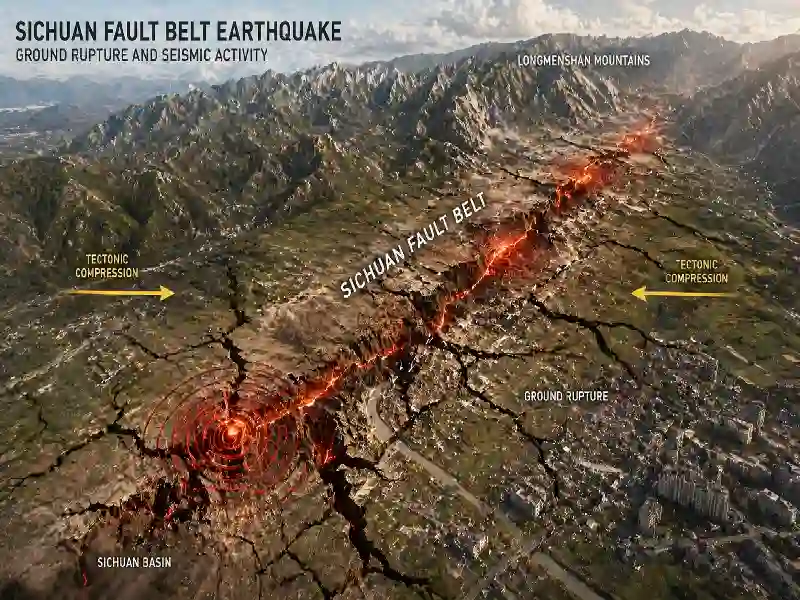
The Sichuan region sits at the edge of the plateau.
- Active fault systems
- Sudden stress release
- Potential for destructive earthquakes
This is where large earthquakes can have major human impact.
Northern & Eastern China (Hidden Stress Zones)

These areas are less active — but not inactive.
- Intraplate earthquakes
- Lower frequency
- Sometimes unexpected events
This shows how stress can travel far from its origin.
Recent Earthquake Activity in China
China continues to experience earthquakes across multiple regions.
Recent patterns show:
- Frequent activity in western China
- Occasional moderate earthquakes inland
- Aftershock sequences in major fault zones
What’s notable is how activity is distributed rather than concentrated.
Notable Earthquakes in China
Historical events highlight the risks.
- 2008 Sichuan Earthquake (M7.9)
One of the most devastating earthquakes in modern China. - 1976 Tangshan Earthquake (M7.5)
A major intraplate earthquake causing widespread destruction. - 1920 Haiyuan Earthquake (M8.3)
One of the deadliest earthquakes in history.
Understand magnitude vs impact
China vs Other Earthquake Regions
China’s seismic behavior stands out globally.
- China → widespread continental earthquakes
- Nepal → compression from plate collision
- Chile → strong subduction earthquakes
- California → transform faults like the San Andreas Fault
China’s earthquakes are shaped by distributed stress across a large landmass
Can Earthquakes in China Be Predicted?
No — earthquakes cannot be predicted precisely.
Scientists can:
- monitor seismic zones
- map fault systems
- estimate long-term risk
But exact timing remains uncertain.
Learn more about can earthquakes be predicted
Because tectonic stress spreads across the continental interior.
Western China, especially the Tibetan Plateau and Sichuan region.
Yes — especially in western regions.
Yes — both boundary and intraplate earthquakes can be strong.
Final Thoughts
China’s earthquakes tell a different story from many other regions. Instead of one clear boundary, the country experiences wide, distributed tectonic stress, making earthquakes more complex and less predictable.
Understanding China helps you see how Earth’s forces don’t always follow simple lines — sometimes they spread across entire continents.