
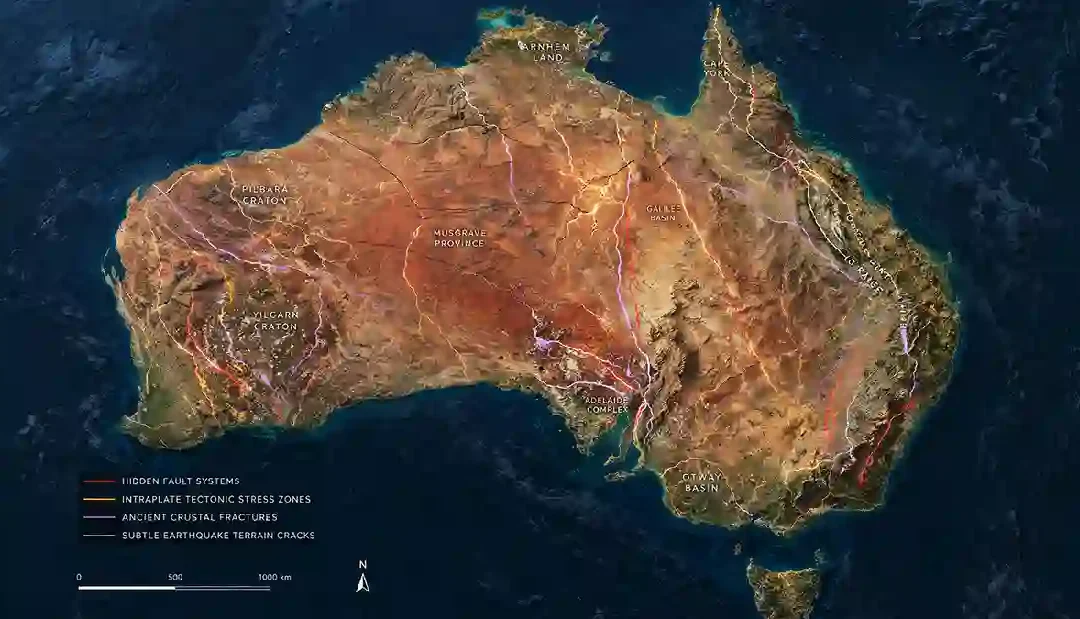
Australia is often considered a geologically stable continent. It sits far from major tectonic plate boundaries and has no giant subduction zones like Japan or Chile. Yet earthquakes still happen here.
In fact, Australia experiences thousands of small earthquakes every year because tectonic stress can still build deep inside continental plates. That makes Australia one of the world’s most interesting examples of intraplate earthquakes.
If you’re new to earthquakes, begin here → what is an earthquake
Australia’s Main Seismic Regions
| Region | Risk Level | Main Cause |
|---|---|---|
| Southeastern Australia | High | Hidden fault reactivation |
| Western Australia | Moderate–High | Ancient crustal stress |
| Central Australia | Moderate | Intraplate stress |
| Northern Australia | Low–Moderate | Distributed tectonic forces |
| Eastern Coastal Areas | Moderate | Fault systems beneath the crust |
Australia’s earthquakes happen mostly because of stress inside the Australian Plate.
To understand how tectonic stress builds → fault lines
Why Do Earthquakes Happen in Australia?
Australia’s earthquakes occur because tectonic forces still affect the continent even far from plate boundaries.
Here’s the simple explanation:
- The Australian Plate slowly moves northward
- Stress spreads across the continent
- Ancient faults remain weak zones underground
- Pressure builds over long periods
- Earthquakes occur when old faults reactivate
This creates earthquakes deep inside the plate itself.
Learn more → causes of earthquakes
Australia’s Four Distinct Earthquake Systems
Southeastern Australia (Most Active Region)
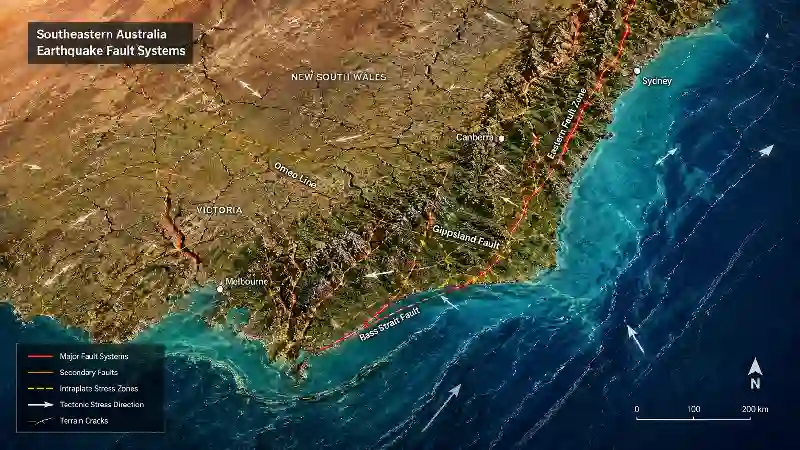
Southeastern Australia experiences many of the country’s noticeable earthquakes.
- Ancient faults remain active
- Moderate earthquakes can occur
- Some earthquakes are felt across cities and towns
This is one of Australia’s most monitored seismic regions.
Explore earthquake types
Western Australia’s Ancient Crust
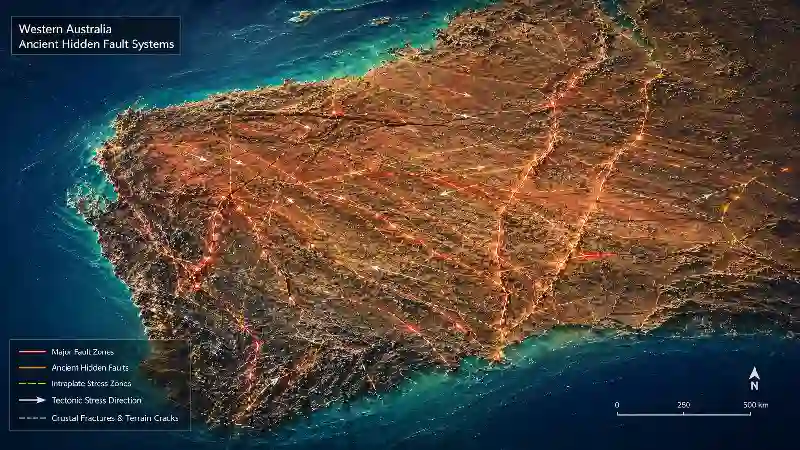
Western Australia contains some of Earth’s oldest continental crust.
- Ancient geological structures
- Reactivated faults under stress
- Occasional strong intraplate earthquakes
Central Australia Earthquakes
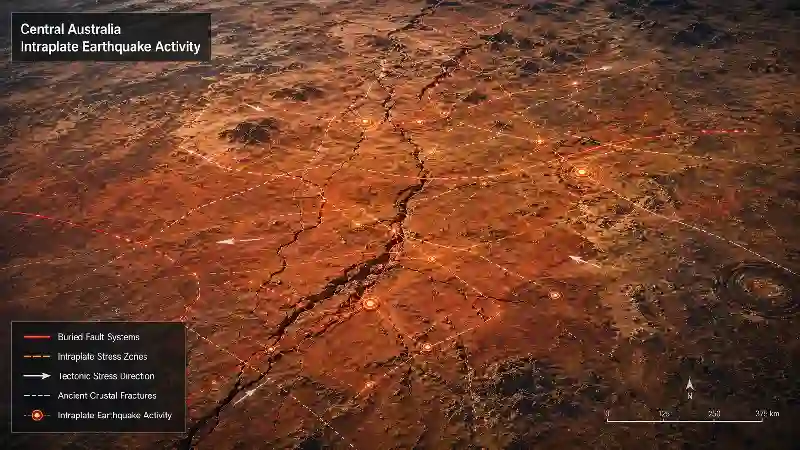
Central Australia also experiences seismic activity despite its remote location.
- Deep crustal stress
- Ancient buried fault systems
- Rare but measurable earthquakes
Stable Coastal Regions
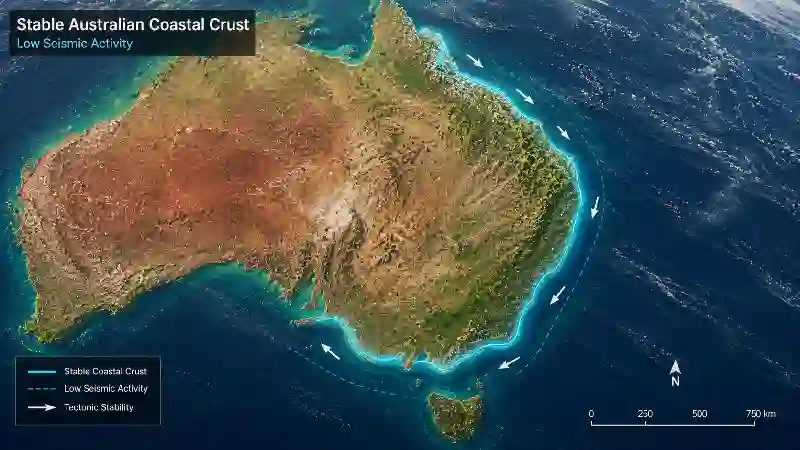
Some coastal areas remain relatively stable.
- Lower seismic activity
- Fewer active fault systems
- Earthquakes are generally weak
Recent Earthquake Activity in Australia
Australia experiences small earthquakes regularly.
Recent patterns show:
- Minor earthquakes in southeastern regions
- Occasional moderate intraplate earthquakes
- Seismic activity across remote inland areas
Most earthquakes are small, but stronger earthquakes can still occur unexpectedly.
Notable Earthquakes in Australia
Australia has experienced several important earthquakes historically.
- 1989 Newcastle Earthquake (M5.6)
One of Australia’s most damaging modern earthquakes. - 2016 Petermann Ranges Earthquake (M6.1)
A strong intraplate earthquake in central Australia. - 1968 Meckering Earthquake (M6.5)
Significant ground rupture in Western Australia.
Understand magnitude vs impact
Australia vs Other Earthquake Regions
Australia’s earthquakes are very different from plate-boundary regions.
- Australia → intraplate fault reactivation
- South Africa → similar ancient crust earthquakes
- Indonesia → subduction zone earthquakes
- California → transform faults like the San Andreas Fault
Australia proves earthquakes can happen far from major tectonic boundaries.
Can Earthquakes in Australia Be Predicted?
No — earthquakes cannot be predicted precisely.
Scientists can:
- monitor seismic zones
- study ancient fault systems
- track crustal stress patterns
But exact timing remains uncertain.
Learn more → Can earthquakes be predicted
Because tectonic stress still affects ancient faults inside the Australian Plate.
Southeastern Australia.
Most are small, but moderate damaging earthquakes can still occur.
No — most earthquakes are intraplate events.
Final Thoughts
Australia’s earthquakes show that even “stable” continents are never completely motionless. Deep beneath the surface, ancient faults continue responding to tectonic stress spreading across the Australian Plate.
That hidden movement creates one of the world’s most fascinating examples of intraplate seismic activity.