
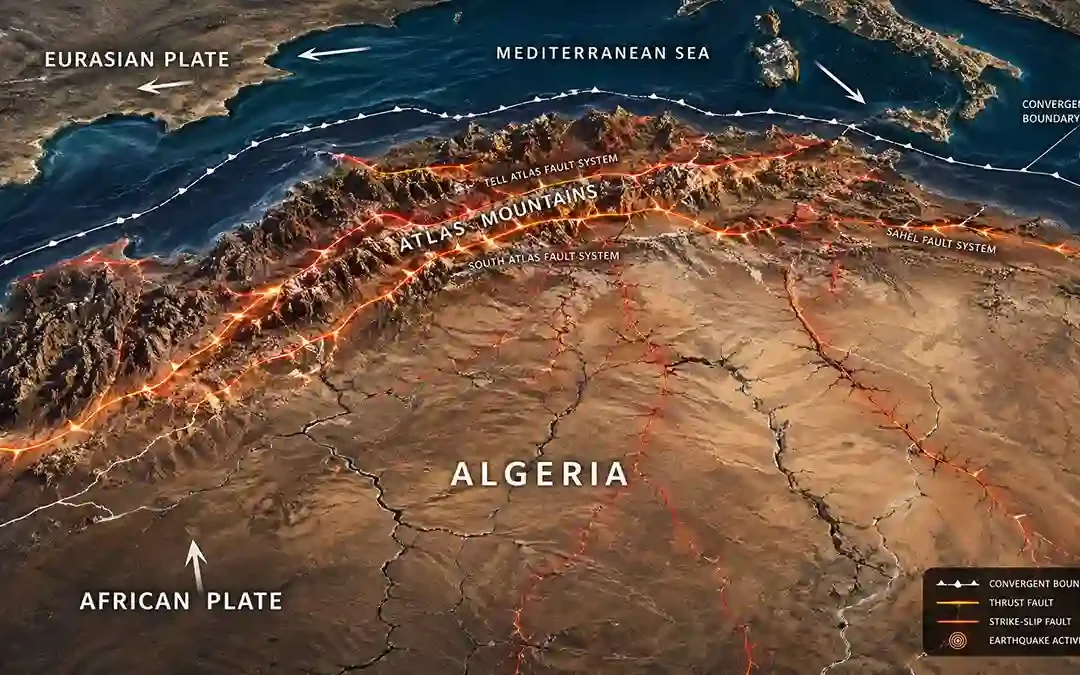
Algeria is one of the most earthquake-prone countries in North Africa. Most of the country’s seismic activity happens in the northern regions near the Mediterranean coast, where tectonic pressure continues to shape mountain ranges and fault systems.
Although earthquakes are less frequent than in countries along the Pacific Ring of Fire, Algeria can still experience strong and damaging events.
If you’re new to earthquakes, begin here → what is an earthquake
Algeria’s Main Earthquake Zones
| Region | Risk Level | Main Cause |
|---|---|---|
| Northern Algeria | Very High | Plate compression |
| Atlas Mountains | High | Mountain fault systems |
| Mediterranean Coast | High | Active tectonic faults |
| Central Algeria | Low–Moderate | Distributed crust stress |
| Southern Sahara Region | Low | Stable crust |
Algeria’s earthquake activity is concentrated mostly in the north. To understand how tectonic stress forms → fault lines
Why Do Earthquakes Happen in Algeria?
Algeria’s earthquakes are mainly caused by the movement of the African Plate toward the Eurasian Plate.
Here’s the basic process:
- The African Plate moves northward
- It pushes against Eurasia
- The crust compresses and deforms
- Faults store tectonic stress
- Earthquakes occur when the stress is released
This tectonic interaction affects much of the Mediterranean region.
Learn more → causes of earthquakes
Algeria’s Three Main Earthquake Behaviors
Atlas Mountain Earthquakes
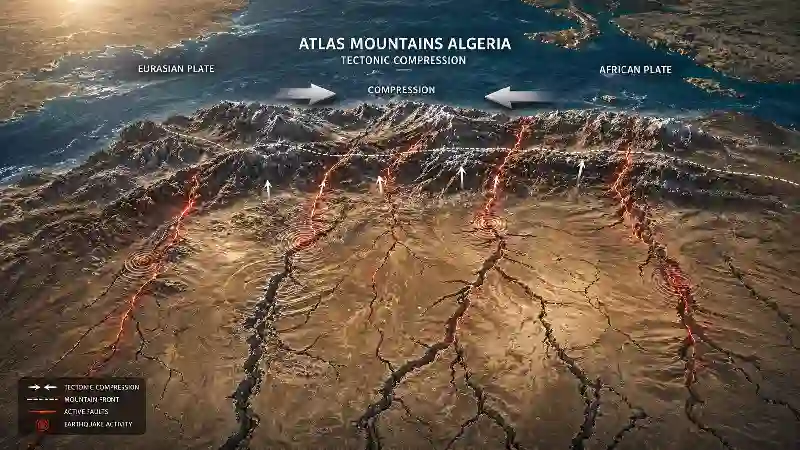
The Atlas Mountains contain active fault systems.
- Crust compression continues
- Mountain-building processes remain active
- Moderate to strong earthquakes are possible
This region experiences much of Algeria’s inland seismic activity.
Explore earthquake types
Mediterranean Coastal Faults
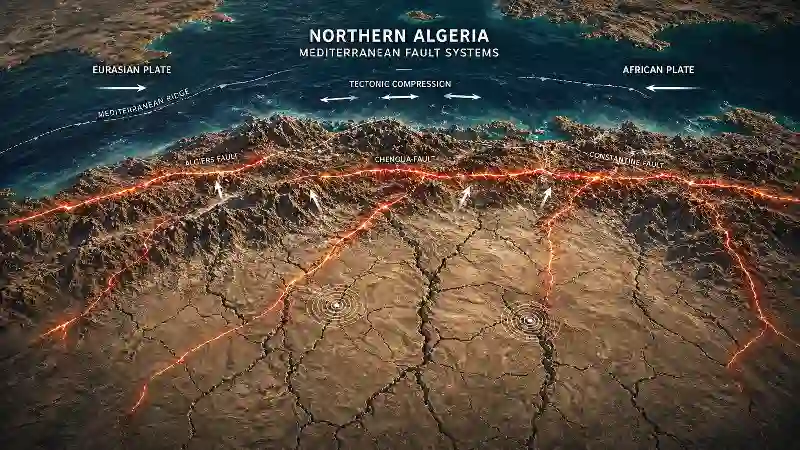
Northern Algeria near the Mediterranean is highly active.
- Dense fault networks
- Shallow earthquakes
- Potential for significant damage near cities
Many historical earthquakes have occurred close to the coast.
Hidden Inland Stress Zones
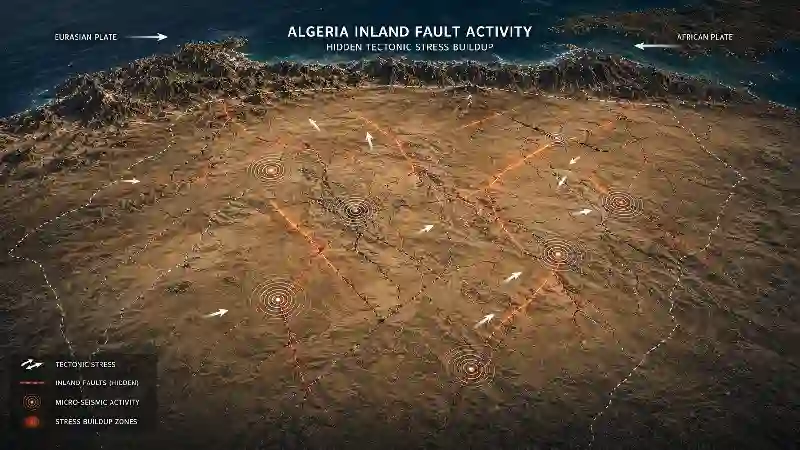
Some earthquakes occur away from major visible faults.
- Older faults can reactivate
- Stress spreads inland
- Earthquake locations can vary unexpectedly
Recent Earthquake Activity in Algeria
Algeria experiences regular seismic activity.
Recent patterns show:
- Frequent small earthquakes in northern regions
- Moderate earthquakes near coastal fault zones
- Aftershocks following stronger events
Most activity remains concentrated near the Mediterranean side of the country.
Notable Earthquakes in Algeria
Past earthquakes reveal Algeria’s seismic history.
- 2003 Boumerdès Earthquake (M6.8)
A destructive coastal earthquake near Algiers. - 1980 El Asnam Earthquake (M7.1)
One of Algeria’s strongest recorded earthquakes. - 1716 Algiers Earthquake
A major historical earthquake affecting northern Algeria.
Understand magnitude vs impact
Algeria vs Other Earthquake Regions
Algeria’s seismic activity differs from major Pacific regions.
- Algeria → Mediterranean compression + mountain faults
- Morocco → Atlas Mountain seismic activity
- Italy → shallow Mediterranean fault systems
- California → transform faults like the San Andreas Fault
Algeria’s earthquakes are shaped by slow but powerful tectonic compression.
Can Earthquakes in Algeria Be Predicted?
No — earthquakes cannot be predicted precisely.
Scientists can:
- monitor seismic activity
- map active faults
- estimate long-term risk
But exact timing remains uncertain.
Learn more → Can earthquakes be predicted
Because the African Plate pushes against the Eurasian Plate.
Northern Algeria and the Mediterranean coastal region.
Moderate earthquakes occur regularly in the north.
Yes — especially near coastal fault systems.
Final Thoughts
Algeria’s earthquakes are part of the larger tectonic system shaping the Mediterranean region. Although the country is not located on the Pacific Ring of Fire, ongoing tectonic compression still creates active faults and seismic risk.
Understanding Algeria’s earthquake zones helps explain how mountain-building and plate movement continue to shape North Africa today.