
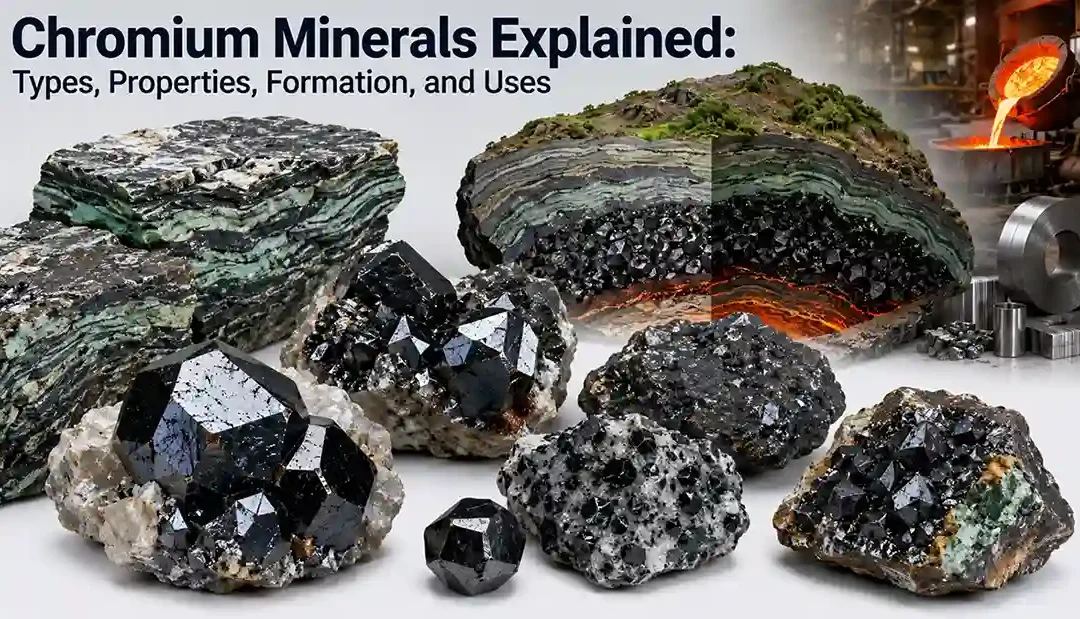
Chromium is a critical industrial metal best known for its role in stainless steel production. It provides corrosion resistance, hardness, and durability to many modern materials.
Chromium minerals are important because they supply the chromium used in:
- stainless steel
- ferrochrome alloys
- aerospace materials
- refractory products
- chemical manufacturing
- metal coatings
Nearly all commercial chromium comes from a single mineral: chromite.
Learn more → mineral classification system
What Are Chromium Minerals?
Chromium minerals are naturally occurring minerals that contain significant concentrations of chromium.
These minerals occur mainly in:
- ultramafic rocks
- layered mafic intrusions
- ophiolite complexes
- magmatic ore deposits
The most important chromium-bearing mineral is chromite.
Chemical Formula of Chromium
Chromium is a metallic chemical element represented by:
Basic Properties
| Property | Value |
|---|---|
| Element Name | Chromium |
| Symbol | Cr |
| Atomic Number | 24 |
| Atomic Weight | 51.996 |
| Classification | Transition Metal |
| Density | 7.19 g/cm³ |
Major Chromium Minerals
Chromite – The Most Important Chromium Mineral
Chromite is the world's only major commercial source of chromium.
Its formula is: FeCr₂O₄
Characteristics include:
- black color
- metallic to submetallic luster
- very high density
- magnetic properties
Virtually all chromium metal originates from chromite deposits.
Magnesiochromite
Magnesiochromite is a magnesium-rich chromium spinel.
Its formula is: MgCr₂O₄
Features include:
- dark coloration
- spinel crystal structure
- ultramafic rock association
It commonly occurs alongside chromite.
Zinc Chromite
Zinc chromite is a zinc-rich chromium spinel.
Its formula is: ZnCr₂O₄
Characteristics include:
- spinel structure
- chromium enrichment
- rarity compared with chromite
Chromian Spinel
Chromian spinel represents chromium-rich members of the spinel group.
Its generalized formula is: (Mg,Fe)(Cr,Al)₂O₄
These minerals help geologists understand:
- mantle composition
- tectonic environments
- magma evolution
Formation of Chromium Deposits
Magmatic Segregation
The most important process for chromium concentration.
Layered Mafic Intrusions
Major chromite ore bodies form here.
Ultramafic Rocks
Rich source of chromium-bearing minerals.
Ophiolite Complexes
Important chromite-hosting environments.
Layered Intrusion Chromite Deposits
Many major chromium deposits occur within:
- layered mafic intrusions
- ultramafic complexes
- mantle-derived rocks
These environments allow dense chromite crystals to settle and concentrate during magma cooling.
Chromium and Stainless Steel
Chromium is critical for:
Stainless Steel
Corrosion resistance.
Ferrochrome Production
Industrial alloy manufacturing.
Aerospace Materials
High-strength components.
Industrial Machinery
Wear-resistant surfaces.
Major Uses of Chromium
| Industry | Application |
|---|---|
| Steel Industry | Stainless Steel |
| Metallurgy | Ferrochrome |
| Aerospace | High-Performance Alloys |
| Construction | Corrosion-Resistant Materials |
| Manufacturing | Industrial Components |
Ferrochrome Production
Most chromium is converted into ferrochrome before being used in steel production. The process combines chromium with iron to produce an alloy essential for stainless steel manufacturing.
Major Chromium-Producing Countries
Important chromium producers include:
- South Africa
- Kazakhstan
- India
- Turkey
- Finland
- Zimbabwe
South Africa hosts the largest known chromite reserves in the world.
How Geologists Identify Chromium Minerals
Chromite
- black color
- high density
- spinel structure
- association with ultramafic rocks
Magnesiochromite
- chromium-rich spinel
- dark coloration
Chromian Spinel
- spinel crystal habit
- chromium enrichment
Chromite's density and occurrence in ultramafic rocks are among its most important identification features.
Learn more → mineral identification guide
Chromium Minerals Summary
| Mineral | Formula | Main Use |
|---|---|---|
| Chromite | FeCr₂O₄ | Chromium Ore |
| Magnesiochromite | MgCr₂O₄ | Chromium Source |
| Zinc Chromite | ZnCr₂O₄ | Minor Ore |
| Chromian Spinel | (Mg,Fe)(Cr,Al)₂O₄ | Chromium-Bearing Mineral |
| Coulsonite | FeV₂O₄ | Associated Mineral |
Chromite (FeCr₂O₄) is the world's primary chromium ore mineral.
The chemical symbol for chromium is Cr.
Most chromium deposits form in ultramafic rocks and layered mafic intrusions through magmatic processes.
Chromium is primarily used in stainless steel production, ferrochrome alloys, and corrosion-resistant materials.
South Africa hosts the world's largest chromite reserves and is a leading chromium producer.
Final Thoughts
Chromium minerals are among the most economically important metallic mineral resources because they supply the chromium needed for stainless steel and modern industrial alloys. Chromite dominates global chromium production and forms in some of the most fascinating magmatic environments on Earth.
From ultramafic mantle-derived rocks to massive layered intrusions, chromium minerals provide valuable insights into ore formation processes while supporting industries that rely on strong, corrosion-resistant materials.