
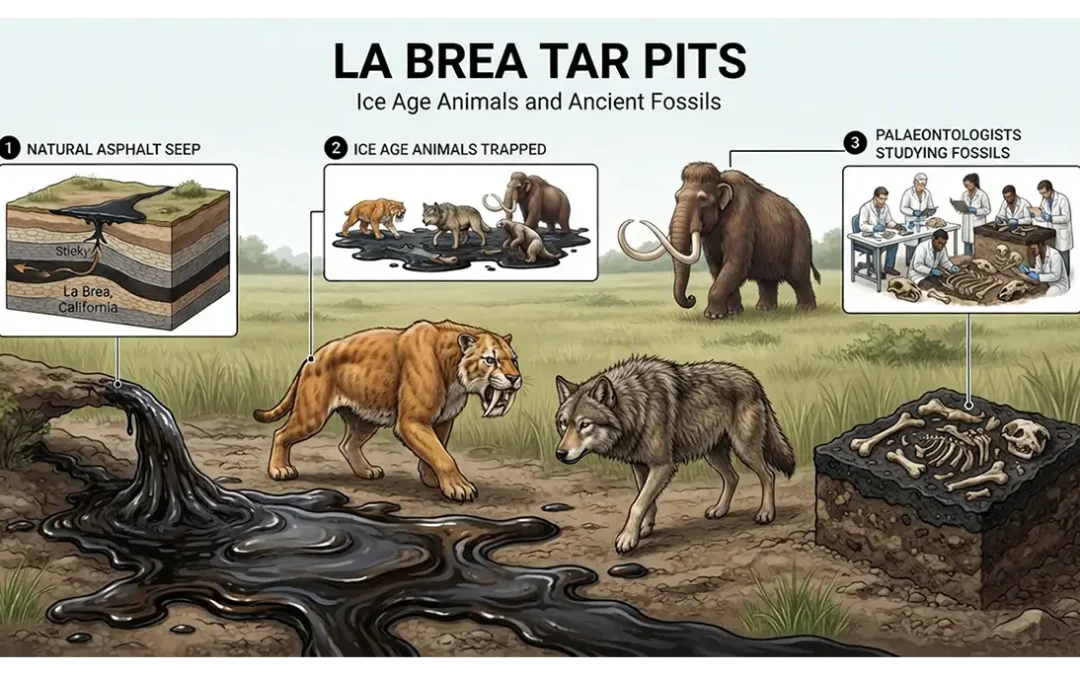
The La Brea Tar Pits in Los Angeles, California, offer a remarkable glimpse into life during the last Ice Age. Beneath their dark, sticky asphalt lie the remains of ancient animals, including saber-toothed cats, dire wolves, mammoths, and giant ground sloths. These fossils reveal how diverse wildlife lived, interacted, and adapted to environmental changes thousands of years ago.
Unlike ordinary fossil sites, La Brea preserves an extensive collection of animal remains trapped in naturally occurring asphalt over a long period. The deposits formed as petroleum seeped through the ground and accumulated at the surface, creating conditions that captured animals and preserved their bones.
Today, scientists study these discoveries to reconstruct prehistoric ecosystems, investigate the disappearance of large mammals, and understand the geological processes behind the site. The La Brea Tar Pits remain one of the most valuable windows into the ancient natural history of Southern California.
What Are the La Brea Tar Pits?
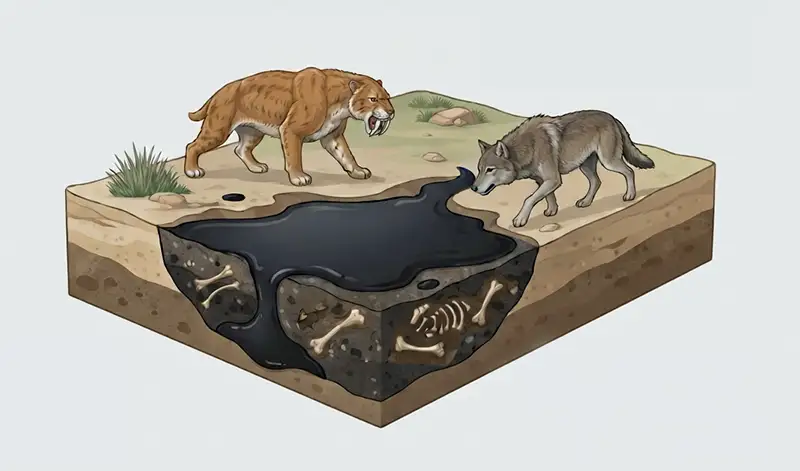
The La Brea Tar Pits are a collection of natural asphalt seeps where petroleum-derived material reaches the surface and forms sticky pools. The site is internationally recognized for its abundant fossils, particularly those of animals that lived during the late Pleistocene Epoch.
Although commonly called tar pits, these formations are not ordinary containers of manufactured tar. They consist mainly of natural asphalt, a dense mixture of petroleum-derived hydrocarbons that can trap animals when exposed at the ground surface.
The deposits formed over many thousands of years. As animals became caught in the sticky material, their remains accumulated alongside sediment, plant fragments, and other biological material. Repeated episodes of trapping created fossil-bearing layers that now preserve evidence of ancient life.
The site is especially famous for its large collection of carnivore remains. Saber-toothed cats and dire wolves are among its best-known discoveries, while numerous herbivores, birds, insects, and smaller vertebrates provide a broader picture of the region's former biodiversity.
The La Brea Tar Pits are important for more than their impressive animal fossils. Their deposits also help scientists investigate ancient vegetation, climate, food webs, and ecological relationships. Together, these records make the site a valuable natural archive of Southern California's prehistoric environments.
Where Are the La Brea Tar Pits Located?
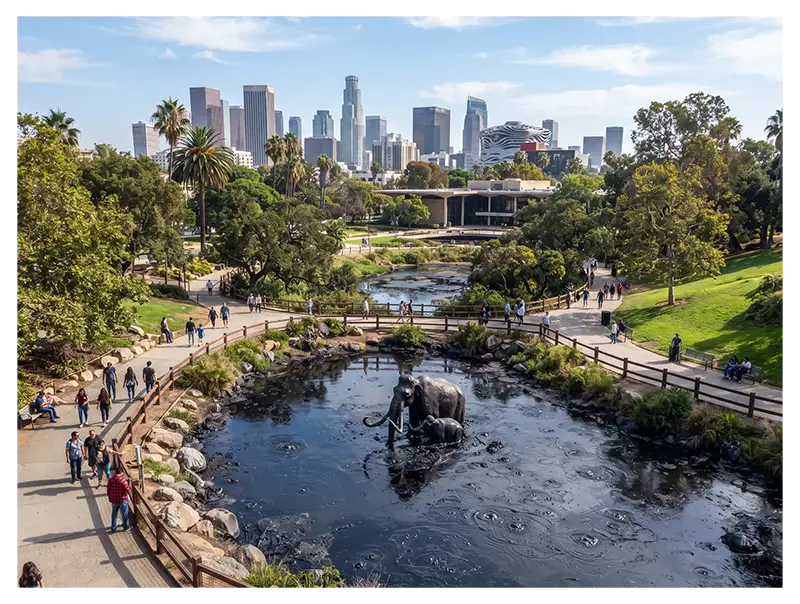
The La Brea Tar Pits lie in the Hancock Park area of Los Angeles, California, in the western United States. The site occupies a heavily developed urban landscape, making it an unusual place to encounter an active geological feature and a major paleontological locality.
The surrounding region forms part of the Los Angeles Basin, which has a complex geological history shaped by sediment accumulation, tectonic activity, and petroleum formation. These geological processes helped create the underground petroleum system that produces the natural asphalt seeps.
The La Brea Tar Pits and Museum welcomes visitors who want to learn about the area's geology, examine fossil specimens, and explore scientific interpretations of Ice Age life. The museum and park connect discoveries from underground with the scientific research that helps explain them.
One of the site's most distinctive features is the contrast between its prehistoric contents and its modern surroundings. Asphalt still rises to the surface in certain areas, even though streets, buildings, and landscaped public spaces surround the site.
The La Brea Tar Pits' location in Los Angeles also makes it an accessible destination for public education. Visitors can explore paleontology without traveling to a remote desert or mountainous region, while researchers continue to study a fossil record that scientists have investigated for generations.
How Did the La Brea Tar Pits Form?
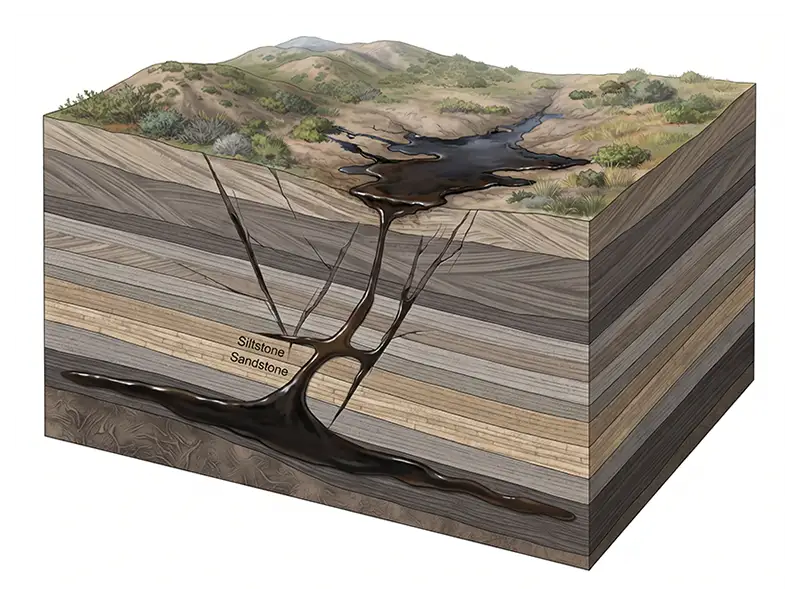
The formation of the La Brea Tar Pits began with petroleum that organic-rich sediments generated deep beneath the Earth's surface. Over geological time, heat and pressure transformed buried organic matter into hydrocarbons. These petroleum compounds then migrated through permeable rocks and fractures toward shallower geological layers.
When the petroleum reached the surface, exposure to air and environmental processes caused lighter components to evaporate or break down. The remaining material became thicker and more viscous, forming natural asphalt. This substance accumulated in depressions or spread across the ground, creating patches that could appear deceptively solid.
The process did not occur in a single event. Petroleum seeped to the surface repeatedly, producing deposits of different ages and thicknesses. Over time, animals, plants, sediment, and other materials became incorporated into these deposits, building the fossil-rich layers that made the site famous.
Natural asphalt differs from ordinary tar in its origin and composition. Manufacturers commonly produce tar by heating organic materials, whereas petroleum deposits beneath the ground naturally produce the material found at La Brea. Scientists use the broad term bitumen to describe heavy petroleum components, and they use asphalt for mixtures rich in these materials.
Temperature, weathering, sediment content, and petroleum composition can change the appearance and stickiness of a seep. Some exposed areas may look like dark, relatively firm ground, while others contain softer material that can trap animals.
These geological processes explain why the site remains scientifically valuable. The asphalt does more than surround the fossils; a long-running natural process created the conditions that allowed the site to preserve an exceptional fossil record.
How Did Animals Become Trapped in the Tar Pits?
Animals became trapped when they stepped onto exposed asphalt while moving through the landscape or searching for resources such as water. The dark asphalt often resembled ordinary wet ground, making it difficult for animals to recognize the danger. Once an animal stepped into a sufficiently sticky patch, its movements could push its limbs deeper into the asphalt.
The dense asphalt resisted movement, making escape difficult. As animals struggled, they often brought more of their bodies into contact with the sticky material. Fatigue gradually weakened them and reduced their ability to break free. However, not every animal that encountered an asphalt seep became trapped. Local conditions, the animal's size, its behavior, and its movements all influenced the outcome.
Trapped animals also attracted predators and scavengers. Carnivores often approached immobilized animals to hunt or feed, but some became trapped themselves. These encounters sometimes triggered a chain of trapping events. This process helps explain why the fossil deposits contain abundant remains of meat-eating mammals alongside the herbivores that served as their prey.
Over time, repeated trapping events accumulated the remains of many individuals from different species. Asphalt and surrounding sediment preserved these remains, allowing scientists to recover bones, teeth, and other evidence of prehistoric life.
However, the resulting fossil record has an important limitation: it does not provide a perfectly balanced census of the ancient ecosystem. Different animals had different chances of becoming trapped, and preservation conditions varied across the site. Therefore, scientists cannot automatically use a species' abundance in the fossil deposits to determine its exact population size in the surrounding landscape.
Despite this bias, the site offers scientists an unusually detailed opportunity to investigate predator-prey relationships, animal anatomy, and changes in biodiversity over time. Scientists account for the trapping process when interpreting the evidence instead of assuming that the deposits represent every species equally.
What Ice Age Animals and Fossils Have Been Found at La Brea?
The La Brea fossil deposits contain an extraordinary variety of organisms from the late Pleistocene. Many discoveries date to the period commonly associated with the last Ice Age, although the deposits formed at different times and do not all represent a single moment in history.
Saber-toothed cats
The saber-toothed cat Smilodon fatalis is one of the most iconic animals discovered at La Brea. It had powerful forelimbs, a robust body, and long, flattened upper canine teeth. Its anatomy suggests that it was adapted to subdue prey using strength and specialized killing behavior rather than relying solely on prolonged pursuit.
Large numbers of Smilodon remains have helped researchers investigate its anatomy, growth, injuries, and possible social behavior. Fossils showing healed damage can reveal that some individuals survived serious injuries, although such evidence does not by itself establish how they lived or interacted.
Dire wolves
The dire wolf, Aenocyon dirus, was a large carnivorous mammal that inhabited North America during the Pleistocene. Its remains are particularly abundant in La Brea's fossil collections.
Comparisons of dire wolf skulls, teeth, and limb bones help researchers understand its feeding adaptations and physical characteristics. Its relationship to living gray wolves has also been investigated using anatomical and genetic evidence, showing why fossil appearance alone cannot always establish evolutionary relationships.
Mammoths and mastodons
Mammoths and mastodons were large proboscideans that lived in North America during the Pleistocene. Mammoths generally had teeth suited to processing grasses and other vegetation, while mastodons possessed different molar structures adapted to a broader range of plant material, including woody vegetation.
Their remains provide evidence about ancient herbivores, habitat use, and the environmental conditions that supported large mammals. These animals should not be treated as interchangeable: they belonged to distinct evolutionary lineages and differed in anatomy and feeding adaptations.
Ground sloths
Several types of ground sloths lived in the Americas before the end of the Pleistocene. Unlike modern tree sloths, these extinct mammals included large, predominantly ground-dwelling species. Their robust skeletons and specialized claws reflected different ways of moving and obtaining food.
Ground sloth fossils help scientists investigate the diversity of ancient herbivores and the ecological roles they occupied. Their remains also contribute to understanding how the disappearance of large mammals altered prehistoric food webs.
Other mammals and vertebrates
The La Brea deposits have yielded remains of ancient horses, bison, camels, American lions, smaller carnivores, rodents, rabbits, and numerous bird species. Fish, reptiles, amphibians, and other organisms are also represented in the broader fossil record.
Bird fossils are particularly useful because they can provide evidence about ancient habitats and ecological relationships that mammal remains alone cannot reveal. Smaller organisms and plant material add further detail about the environment in which these animals lived.
Taken together, these discoveries show that Ice Age Los Angeles supported a diverse community of predators, herbivores, scavengers, and smaller organisms. The fossils are valuable not merely because they belong to famous prehistoric animals, but because they allow researchers to study an interconnected ecosystem.
How Are La Brea Fossils Excavated and Studied?
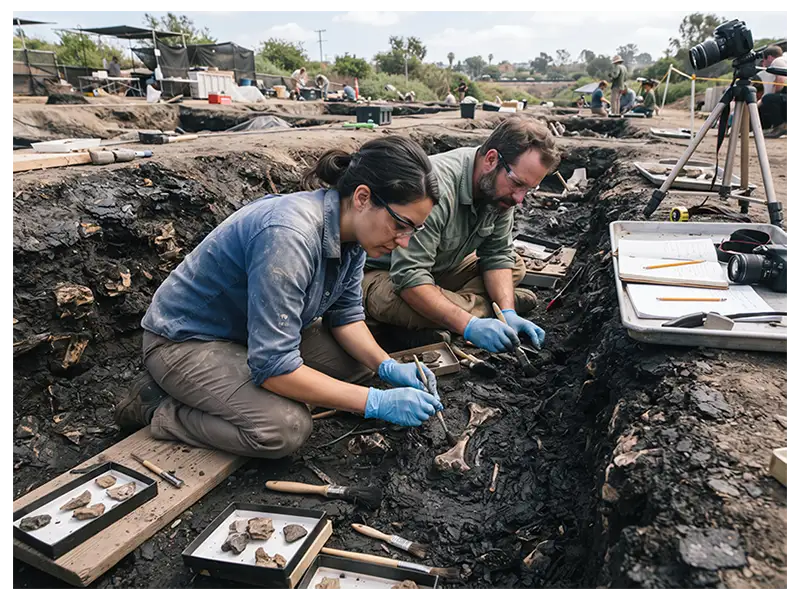
Recovering fossils from asphalt deposits requires careful excavation and specialized preparation. Unlike a skeleton exposed in loose sediment, a specimen from La Brea may be surrounded by sticky petroleum-derived material mixed with soil, fragments of bone, plant remains, and other debris.
Excavation and documentation
Researchers and trained excavation teams remove fossil-bearing material while recording where each specimen is found. The position of a bone, its relationship to nearby remains, and the geological layer surrounding it can all provide information needed for later interpretation.
Some research areas have become known for their long-running excavations and detailed documentation. Preserving the context of a discovery is essential because a fossil's scientific value depends not only on the specimen itself but also on reliable information about its origin.
Fossil preparation
Once recovered, specimens undergo preparation to separate bone from asphalt and other surrounding material. This work can require considerable time and care, especially when remains are fragile, fragmented, or densely packed together.
Technicians may use appropriate mechanical and chemical methods to remove unwanted material while protecting the fossil. The process must be tailored to the specimen because different bones, teeth, and other remains can respond differently to treatment.
Identification and dating
Scientists identify specimens by examining features such as bone shape, tooth structure, size, and anatomical proportions. Comparisons with other fossil material and modern animals help establish which species or broader group an organism belongs to.
The age of a fossil-bearing deposit may be investigated using geological relationships, radiometric dating where suitable materials are available, and other chronological techniques. Researchers may also examine the stratigraphic position of a specimen and compare it with dated deposits elsewhere.
No single method necessarily provides every answer. Different approaches have different limits, so reliable interpretations often depend on several lines of evidence.
Modern research methods
Researchers can use digital imaging, three-dimensional scanning, microscopic analysis, chemical studies, and ancient DNA methods where preservation permits. These techniques can reveal anatomical details, growth patterns, relationships between populations, and information about past environments.
Not every specimen preserves usable genetic material, and results depend on the condition of the remains and the method employed. Combining traditional fossil anatomy with newer analytical techniques helps scientists extract more information without treating any one method as conclusive on its own.
What Do La Brea Fossils Reveal About Ice Age Los Angeles?
The fossil record provides evidence of an environment very different from present-day urban Los Angeles. During the Pleistocene, Southern California supported a changing mixture of habitats, including grasslands, shrublands, woodland areas, and environments influenced by regional moisture and temperature patterns.
Ancient climate and vegetation
Plant remains, pollen where preserved, and the ecological requirements of fossil animals help researchers reconstruct past landscapes. These sources can indicate which kinds of vegetation were present and how environmental conditions changed over time.
Such reconstructions are not based on a single fossil or species. Scientists compare multiple forms of evidence because animals can occupy different habitats, migrate between regions, or adapt to changing conditions.
Food webs and predator-prey relationships
The presence of large carnivores alongside herbivores provides opportunities to investigate ancient food webs. Teeth, skulls, limb structures, and patterns of injury help researchers infer what animals ate and how they obtained food.
The abundance of carnivore remains at La Brea must be interpreted in light of the trapping mechanism. Predators could be attracted to vulnerable animals, increasing their likelihood of becoming trapped. Consequently, fossil counts cannot be used as a direct measurement of the original proportions of predators and prey.
Extinction and ecological change
Many large mammals that once lived in North America disappeared near the end of the Pleistocene. The La Brea record contributes to research on these extinctions, but it cannot independently establish a single cause.
Scientists investigate several possible influences, including climatic shifts, habitat transformation, ecological disruption, and human activity. The importance of each factor may have differed among species and regions.
By comparing fossils from different time periods, researchers can investigate which organisms persisted, which declined, and how ecosystems changed. The deposits therefore help connect the story of individual animals with the broader history of environmental change.
Why Are the La Brea Tar Pits Important to Science?
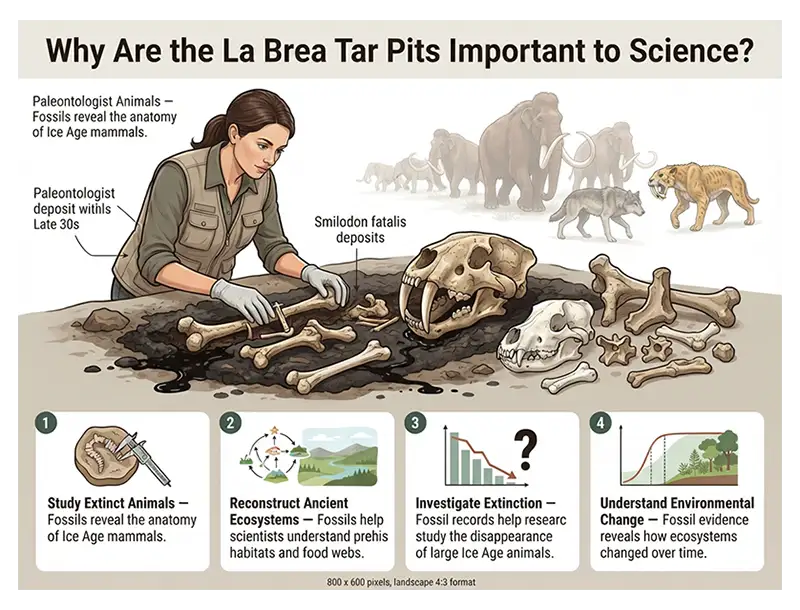
The La Brea Tar Pits are significant because they preserve a large and diverse record of life from the late Pleistocene. Their fossils include many individuals from numerous species, allowing scientists to examine differences in anatomy, age, growth, and physical condition within ancient animal populations.
One important contribution involves the study of extinct carnivores. Large collections of saber-toothed cats and dire wolves give researchers the material they need to examine skeletal adaptations, injuries, and physical variations. Researchers can compare these findings with evidence from other fossil sites to build a more complete picture of prehistoric North American wildlife.
The site also helps scientists reconstruct ancient ecosystems. Mammal remains, birds, smaller vertebrates, and plant evidence each provide different information about habitat conditions and ecological relationships. By analyzing these records together, scientists can identify patterns that a single type of fossil might not reveal.
Another major contribution involves the study of extinction. Researchers use the fossil record to investigate how animal communities changed over time and compare those changes with independent evidence of climate and human presence. This approach matters because extinction rarely results from a single factor or one universal cause.
The La Brea collections also support education and public engagement. Museum exhibits, research projects, and excavation activities help educators and scientists explain how researchers use physical evidence to reconstruct events that occurred thousands of years ago.
Continued preservation remains essential because fossil deposits contain information that no one can recover once destruction eliminates it. Through careful documentation, responsible excavation, conservation, and long-term research, scientists can ensure that future investigators have access to these specimens and can examine them using methods that may not yet exist.
Are the La Brea Tar Pits Still Active Today?
Yes. Natural asphalt continues to seep to the surface in parts of the La Brea area. These seeps are evidence that the geological process responsible for the deposits has not completely stopped, although the visible activity varies by location and over time.
The material originates from petroleum moving through underground geological pathways. When it reaches the surface, lighter components may escape or weather away, leaving a thick residue rich in heavy hydrocarbons. This residue can form dark patches, sticky pools, or asphalt-coated ground.
Not every exposed patch behaves like a deep pool of liquid. Natural asphalt can be relatively firm, and its physical properties depend on temperature, composition, sediment, and weathering. Therefore, the modern appearance of a seep may differ from the conditions under which many prehistoric animals became trapped.
The present-day seeps also provide a useful connection between geology and paleontology. They demonstrate the continuing natural processes that created the fossil deposits, while the older layers preserve evidence of previous trapping events.
However, modern activity should not be confused with the ancient fossil record. A currently visible seep does not necessarily contain the same density of fossils as a well-known fossil-bearing deposit, and scientists must evaluate each location according to its geological context.
The combination of active asphalt seepage, protected fossil resources, and ongoing research makes the area a distinctive place to study how geological processes can shape the preservation of ancient life.
Can You Visit the La Brea Tar Pits?
The La Brea Tar Pits and Museum offer visitors an opportunity to explore paleontology, natural asphalt seepage, and the history of Ice Age Los Angeles. Located in Hancock Park, the site combines outdoor geological features with museum exhibits and educational displays.
Explore the park
Visitors can observe the landscape around the seeps and learn how petroleum-derived material reaches the surface. Some areas provide visible examples of asphalt activity, illustrating that the site is a real geological feature rather than simply a collection of preserved fossils.
Because exposed asphalt may be sticky or unstable, visitors should follow posted safety instructions and remain within designated public areas.
Discover the fossil collections
Museum displays introduce visitors to prehistoric animals and the scientific work used to understand them. Fossil skeletons, bones, teeth, and explanatory exhibits help illustrate the diversity of organisms that inhabited the region during the Ice Age.
These collections also show how researchers reconstruct ancient ecosystems by comparing different species and examining the physical evidence preserved in fossil deposits.
Learn about paleontological research
Depending on current operations, visitors may have opportunities to observe or learn about excavation and fossil preparation. These activities demonstrate why paleontology requires careful documentation, technical skill, and patience.
Before planning a visit, check the official La Brea Tar Pits and Museum website for current opening hours, admission arrangements, exhibitions, tour availability, and any temporary closures. Visitor services and public access can change, so current information is more reliable than assuming that every feature is available year-round.
A visit can be valuable for students, families, and anyone interested in geology or prehistoric life. It connects the scientific explanations in books and articles with a real place where natural processes and fossil discoveries can be explored together.
Conclusion
The La Brea Tar Pits reveal how a natural geological process can preserve an unusually detailed record of ancient life. Petroleum seepage created asphalt deposits that trapped animals over thousands of years, leaving fossils that now help scientists reconstruct the ecosystems of Ice Age Los Angeles.
From saber-toothed cats and dire wolves to mammoths, birds, and smaller organisms, the discoveries provide insight into prehistoric biodiversity and ecological relationships. Continued excavation, conservation, and scientific analysis ensure that this remarkable site will remain an important resource for understanding Earth's past.
The La Brea Tar Pits preserve fossil deposits formed over tens of thousands of years, with many famous discoveries dating to the late Pleistocene Epoch. The deposits represent different periods rather than a single event.
Predators were sometimes attracted to animals already trapped in sticky asphalt. When they approached to feed, they could become trapped themselves, contributing to the large number of carnivore remains in the fossil record.
Yes. Fossil-bearing deposits continue to be studied, and excavation and research can reveal additional specimens. New discoveries depend on the locations investigated and the scientific work being conducted.
The famous La Brea fossil deposits primarily preserve Ice Age animals, not non-avian dinosaurs. Dinosaurs disappeared about 66 million years ago, long before the late Pleistocene mammals represented by the site's best-known fossils.
Their combination of naturally occurring asphalt, exceptionally abundant Ice Age fossils, and ongoing scientific research makes them distinctive. The deposits preserve many individuals from different species, allowing scientists to investigate ancient animal communities and environmental change.