
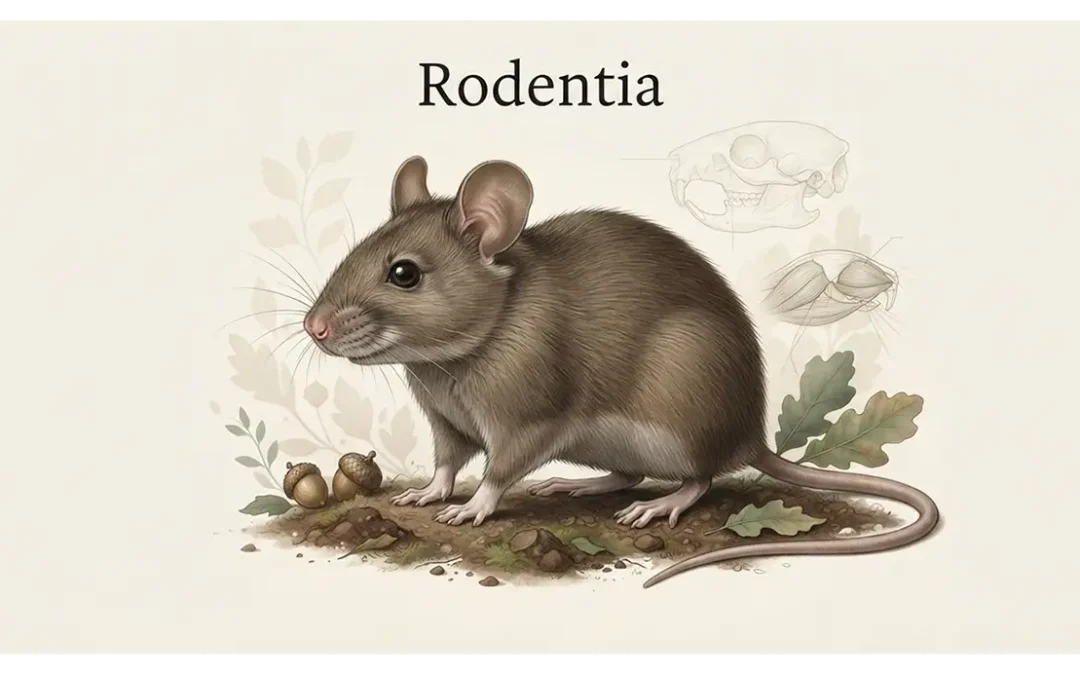
Rodentia is one of the largest and most diverse orders of mammals. It includes familiar animals such as mice, rats, squirrels, beavers, guinea pigs, porcupines, and capybaras. Rodents live in almost every major terrestrial environment, from tropical rainforests and grasslands to deserts, mountains, wetlands, and human settlements.
Although rodents differ greatly in size, appearance, diet, and behavior, they share a defining anatomical feature: a pair of continuously growing incisors in both the upper and lower jaws. These specialized front teeth help them gnaw food, open seeds, strip bark, and perform other tasks essential to survival.
Rodents play important roles in natural ecosystems. Some disperse seeds, others dig burrows that influence soil conditions, and many serve as food for predators. Certain species also live alongside humans and can affect agriculture, food storage, and public health.
Understanding Rodentia helps explain how mammals adapt to different environments and why this group has become so successful around the world.
What Is Rodentia?
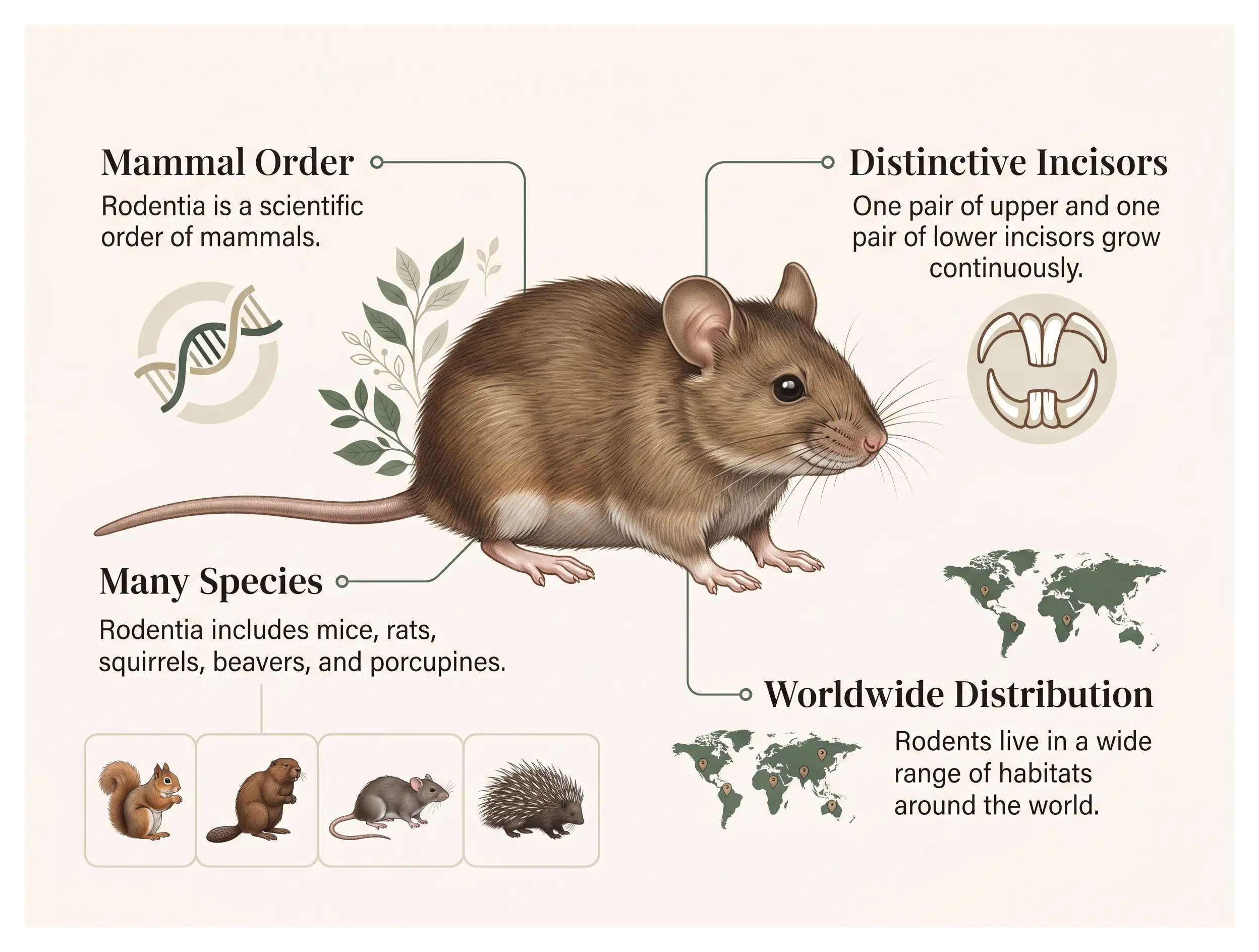
Rodentia is the scientific order of mammals commonly known as rodents. The name refers to their characteristic gnawing behavior, which is closely connected to the structure of their teeth.
Rodents belong to the class Mammalia. Like other mammals, they are warm-blooded vertebrates, have hair at some stage of life, and females produce milk to nourish their young. Most species have four limbs, although their bodies are adapted for different ways of moving, including running, climbing, swimming, and burrowing.
What distinguishes rodents from other mammals is their specialized dentition. They have one pair of upper incisors and one pair of lower incisors, with no canine teeth. A gap called a diastema separates the incisors from the cheek teeth. This arrangement allows the front teeth to cut and gnaw while the rear teeth grind food.
Rodents vary enormously in appearance. A tiny mouse can fit into a small shelter, while a capybara can weigh more than 50 kilograms. Some have long tails, others have short or nearly absent tails, and species such as porcupines possess protective quills.
Rodents are found naturally on every continent except Antarctica, although their distribution varies by species. Many have also spread beyond their original ranges through human transportation and settlement.
What Are the Main Characteristics of Rodents?
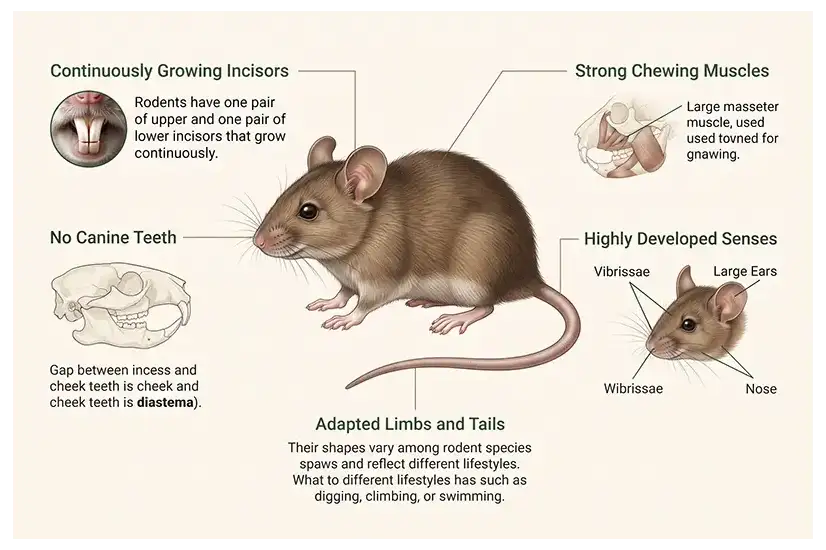
Rodents share several anatomical and biological features, but their bodies differ according to their lifestyles. The following characteristics help explain how members of Rodentia survive in different habitats.
- Body covering: Most rodents have fur that provides insulation and protection. Its thickness and color vary with climate, habitat, and species.
- Four limbs: Their limbs support walking, running, climbing, swimming, or digging. Some squirrels have long hind limbs for jumping, while burrowing rodents possess powerful forelimbs.
- Sensitive whiskers: Many rodents use whiskers, also called vibrissae, to sense nearby objects and navigate through narrow spaces or in darkness.
- Well-developed senses: Smell, hearing, and touch are important to many species. Vision also plays a significant role, particularly in active daytime animals such as squirrels.
- Variable tails: Tails help with balance, communication, heat regulation, or swimming, depending on the species. Some rodents have bushy tails, while others have short ones.
- Small to large body sizes: Many species are small and lightweight, but beavers, porcupines, and capybaras demonstrate the considerable size range within the order.
- Adaptable behavior: Rodents may be solitary or social, active during the day or night, and territorial or tolerant of nearby individuals.
These features are not identical across all rodents. Their anatomy and behavior reflect the different environmental challenges each species faces.
What Makes Rodent Teeth Unique?
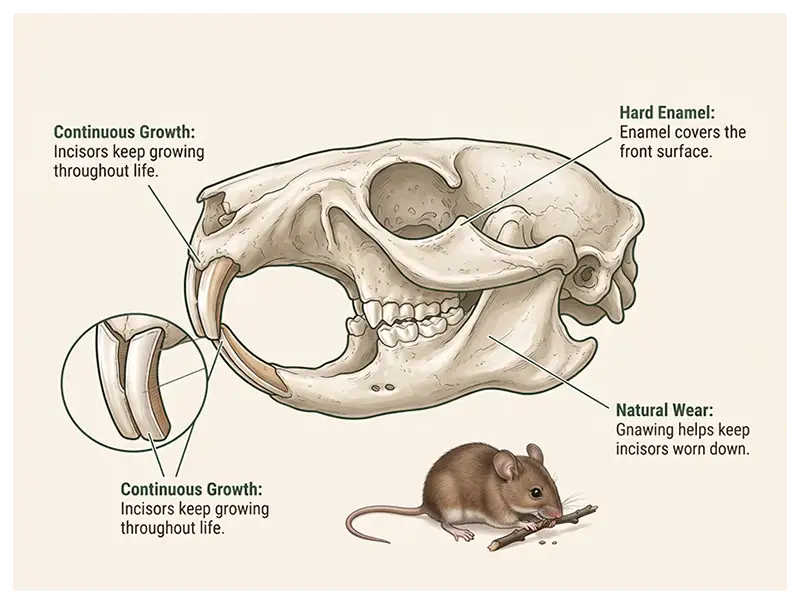
Rodent teeth are among the most distinctive features of the order. Their structure allows them to gnaw tough materials and process a wide range of foods. Rodents have one pair of upper incisors and one pair of lower incisors. These front teeth grow continuously throughout life, compensating for the wear caused by regular gnawing and chewing.
Several adaptations make these teeth effective:
- Chisel-shaped edges: The incisors have sharp front edges that help cut seeds, plant stems, wood, and other materials.
- Hard enamel at the front: The front surface contains hard enamel, while the softer dentine behind it wears away more quickly. This difference helps maintain a sharp cutting edge.
- Continuous growth: The incisors keep growing, so regular use is important for maintaining an appropriate tooth length.
- A diastema: A gap separates the incisors from the premolars and molars. This space allows rodents to position and manipulate food efficiently.
- Grinding cheek teeth: Premolars, when present, and molars help crush and grind food after the incisors cut it.
Rodents do not have canine teeth. This distinguishes their dental arrangement from that of many other mammals. Their incisors are useful for more than eating. Some rodents gnaw wood to gain access to food or shelter, while others use their teeth to open hard seeds or modify their surroundings.
However, the degree of wood gnawing varies considerably among species. Dental problems can develop if the teeth do not wear down normally. In some individuals, misaligned incisors continue growing without adequate contact and may interfere with feeding.
How Are Rodents Classified Scientifically?
Rodents belong to the animal kingdom and are classified within the mammalian order Rodentia. Scientists classify them using features such as skull structure, teeth, anatomy, fossils, and genetic evidence.
Their basic taxonomic position is:
| Taxonomic rank | Classification |
|---|---|
| Kingdom | Animalia |
| Phylum | Chordata |
| Class | Mammalia |
| Order | Rodentia |
Below the order level, rodents are divided into suborders, infraorders, superfamilies, families, and smaller groups. The exact classification depends on the taxonomic system used, and researchers continue to refine relationships as new evidence becomes available.
Living rodents are commonly organized into three major evolutionary branches:
- Sciuromorpha: Includes squirrels, marmots, chipmunks, and several related groups.
- Castorimorpha: Includes beavers, pocket gophers, and kangaroo rats and mice.
- Myomorpha: Includes mice, rats, hamsters, gerbils, voles, and many other species.
Another important group is the Ctenohystrica, which includes guinea pigs, chinchillas, porcupines, and several other lineages. Some classifications arrange these branches differently, reflecting ongoing research into rodent evolutionary relationships.
The names above describe broad evolutionary groupings rather than a simple ranking from primitive to advanced. All living rodents have undergone their own evolutionary histories, and no living group should be considered an unchanged ancestor of another.
Scientific classification is useful because common names can be misleading. Animals that look similar do not necessarily belong to the same family, while closely related rodents may have very different appearances.
What Are the Main Types of Rodents?
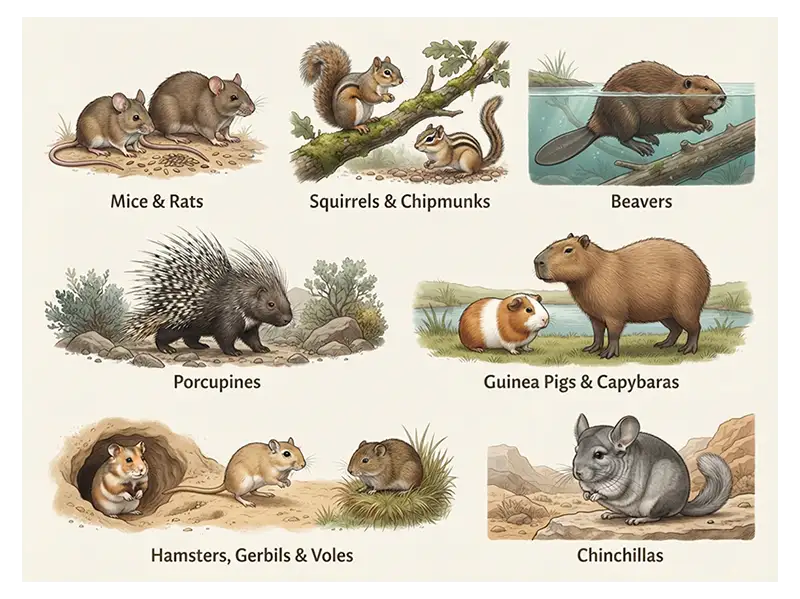
Rodentia contains thousands of living species, making it impossible to describe every species in a short overview. The following examples illustrate some of the best-known groups and their distinctive adaptations.
1. Mice and rats
Mice and rats are generally small to medium-sized rodents with pointed snouts, prominent incisors, and long tails in many species. They occupy habitats ranging from forests and grasslands to farms, cities, and buildings. Some species eat seeds, fruits, and other plant material, while others consume insects or a broader mixture of foods. House mice and brown rats have spread widely alongside human activity.
2. Squirrels and chipmunks
Squirrels include tree-dwelling, ground-dwelling, and flying forms. Many have strong hind limbs, sharp claws, and excellent climbing abilities. Their diets commonly include nuts, seeds, fruits, buds, and fungi. Chipmunks are generally small, ground-oriented squirrels, often recognized by stripes along their backs. Some squirrels store food for later use, and forgotten caches can contribute to seed dispersal.
3. Beavers
Beavers are large, semiaquatic rodents adapted to life in and around freshwater. They have strong jaws, continuously growing incisors, webbed hind feet, and broad, flattened tails. They feed mainly on bark, leaves, twigs, and aquatic vegetation. Many beavers build dams and lodges, although their behavior varies with local conditions. Their dams can create wetlands and change the flow of water through landscapes.
4. Porcupines
Porcupines are recognized by their sharp defensive quills, which are modified hairs. When threatened, they may raise their quills and turn toward a potential attacker. Different porcupine groups live in the Americas, Africa, Europe, and Asia. Depending on the species, they may climb trees or spend most of their time on the ground. Many feed on leaves, bark, stems, fruits, and other plant material.
5. Guinea pigs and capybaras
Guinea pigs and capybaras belong to the South American cavy-related rodent lineage. Guinea pigs are compact, mostly terrestrial animals that feed on grasses and other plant material. They are familiar as domesticated animals, although wild cavy species also exist.
Capybaras are the largest living rodents. They are semiaquatic animals native to South America and are strongly associated with rivers, lakes, marshes, and other wet habitats. Their diet consists mainly of grasses and aquatic plants.
6. Hamsters, gerbils, and voles
These rodents include many small-bodied species with different ecological adaptations. Hamsters often have cheek pouches for carrying food, while many gerbils are adapted to dry or sandy environments. Voles are generally compact rodents with relatively short tails and rounded bodies. They commonly inhabit grasslands, meadows, wetlands, and other places with abundant ground vegetation.
7. Chinchillas and related rodents
Chinchillas are South American rodents known for their exceptionally dense fur. Wild chinchillas are associated with rocky habitats in the Andes, where they use crevices for shelter. Their thick coats provide insulation in cool environments. Habitat loss and historical hunting have severely affected wild chinchilla populations, making conservation important for these animals.
These examples show how one mammalian order can contain animals with very different sizes, diets, habitats, and behaviors.
Where Do Rodents Live?
Rodents occupy an exceptionally wide range of environments. Their success is partly due to their varied diets, reproductive strategies, and ability to exploit different sources of shelter.
Forests: Squirrels, mice, dormice, and many other rodents live among trees, fallen logs, leaf litter, and underground burrows. Tree-dwelling species may use branches and cavities, while ground-dwelling species shelter beneath vegetation or in the soil.
Grasslands and savannas: Voles, ground squirrels, gerbils, and numerous other rodents inhabit open landscapes. Burrows can protect them from predators, extreme temperatures, and seasonal changes.
Deserts and dry regions: Some gerbils, kangaroo rats, and related species are adapted to limited water availability. They may obtain much of their moisture from food and conserve water through specialized physiology and behavior.
Wetlands and freshwater habitats: Beavers and capybaras depend strongly on water, while other rodents live along riverbanks and marshes. Aquatic or semiaquatic adaptations help certain species swim and forage in wet environments.
Mountains: Some rodents live at high elevations, where they must cope with cold temperatures, rocky terrain, and short growing seasons. Dense fur, shelter-seeking behavior, and seasonal changes in activity can help them survive.
Human-modified environments: House mice, brown rats, and some other adaptable species occupy farms, warehouses, gardens, and cities. Food waste, stored grain, and buildings can provide resources and shelter.
Although rodents are found on most continents, their diversity is not evenly distributed. Many groups originated and diversified in particular regions, and some species have restricted ranges. Rodents reached new areas through natural dispersal over geological time, while human transport has introduced certain species to places where they did not previously occur.
What Do Rodents Eat?
Rodent diets vary widely. Many species mainly eat plants, but others supplement plant foods with insects, eggs, or other animal material.
Common foods include:
- Seeds and nuts: Important food sources for mice, squirrels, and many other rodents. Hard coverings make gnawing especially useful.
- Leaves, stems, and grasses: These provide much of the diet for capybaras, guinea pigs, and various field-dwelling species.
- Fruits and berries: Available seasonally in forests, shrublands, and other habitats.
- Roots and underground plant parts: Some rodents dig for roots, tubers, and other food stored beneath the soil.
- Bark and woody material: Beavers and certain other rodents feed on bark, twigs, and related plant tissues.
- Fungi: Several rodents consume mushrooms and underground fungi, sometimes helping disperse fungal spores.
- Animal matter: Some mice, rats, and other rodents opportunistically eat insects, eggs, or small animals.
Many rodents are opportunistic feeders, meaning they adjust their diets to available resources. However, not all species are generalists; some rely on particular plants or food sources. Food storage is another useful adaptation. Squirrels may bury nuts, hamsters can transport food in cheek pouches, and some rodents maintain underground caches.
These behaviors help animals cope with periods when food is scarce. Diet also influences teeth and digestion. Plant-heavy diets often require extensive grinding, while seeds and hard food items require effective cutting and crushing. Different species have digestive adaptations suited to their usual foods.
How Do Rodents Reproduce and Develop?
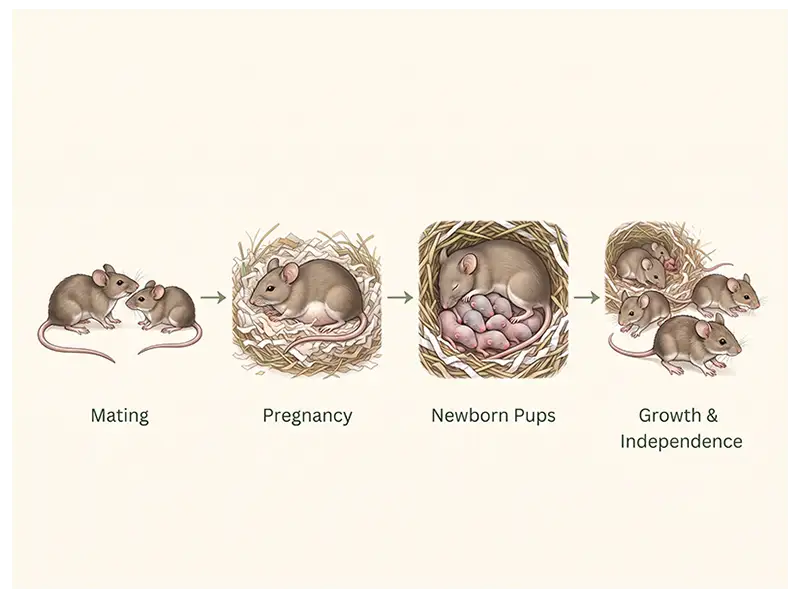
Rodent reproduction varies between species, but many rodents can produce multiple litters during favorable conditions. Their reproductive rates depend on food availability, climate, predation, body size, and other environmental factors.
Most rodents give birth to live young. The gestation period is often relatively short in small species, although it differs considerably among groups. Litter size can range from one or a few offspring to much larger numbers. Newborn development varies as well. In many mice and rats, young are born blind, hairless, and highly dependent on their mother.
They require warmth, milk, and protection before becoming more independent. By contrast, some rodents give birth to young that are more developed at birth. Guinea pigs, for example, typically have fur, open eyes, and greater mobility soon after birth. Parental care usually includes nursing and sheltering the young.
In some species, fathers or other group members may also contribute to care, but the level of social cooperation differs widely. Reproductive patterns can change with environmental conditions. A rodent population may increase rapidly when food is plentiful and shelter is available, while drought, disease, predation, or harsh weather can reduce survival and breeding success.
High reproductive potential helps explain why certain rodents adapt well to disturbed environments. However, it does not mean every rodent species breeds rapidly or has large litters.
How Did Rodents Evolve?
The evolutionary history of Rodentia extends back to the early part of the Cenozoic Era. Rodents emerged after the extinction of non-avian dinosaurs and later became one of the most diverse groups of mammals.
The earliest widely recognized rodents appeared during the Paleocene or early Eocene, depending on how the group and its earliest relatives are defined. Fossils show that early members already possessed important dental features associated with gnawing. Over time, rodents diversified into many lineages with different skull shapes, body sizes, diets, and lifestyles.
Several factors contributed to their evolutionary success.
Specialized incisors: Continuously growing incisors enabled rodents to process many kinds of food and gnaw through tough materials. This adaptation helped different lineages exploit seeds, vegetation, bark, and other resources.
Dietary diversification: Some groups developed adaptations for eating leaves and grasses, while others became specialized seed eaters or developed broader diets. Differences in cheek teeth and jaw structure reflect these feeding strategies.
Adaptation to different environments: Rodent lineages evolved for life in trees, underground burrows, open grasslands, rocky mountains, and freshwater habitats. These adaptations allowed them to occupy many ecological roles.
Geographic diversification: As continents, climates, and ecosystems changed, rodent groups spread and diversified in different regions. Isolation and environmental change contributed to the development of distinct species.
The fossil record also reveals that modern rodent diversity developed over a long period rather than in a single evolutionary event. Scientists use fossil teeth, skulls, other skeletal remains, and genetic comparisons to investigate how different rodent families are related.
Rodent evolution continues today. Living populations respond to changing environments through natural selection, migration, and other evolutionary processes, just as earlier rodent lineages did over millions of years.
Why Are Rodents Important to Ecosystems?
Rodents influence the ecosystems in which they live. Their effects extend beyond their own survival because they interact with plants, fungi, predators, and soil organisms.
Seed dispersal and plant growth
Squirrels and other rodents collect and bury seeds and nuts. Some stored seeds are never recovered, allowing them to germinate when conditions are suitable. This behavior can help plants spread and regenerate forests. The effects are not always beneficial to plants. Rodents also eat seeds and seedlings, which can reduce plant regeneration in some environments.
Soil disturbance
Burrowing rodents move soil as they dig tunnels and create underground chambers. Their activity can alter soil structure, redistribute nutrients, and create openings used by other animals. The importance of these effects depends on the species, the density of its population, and the local environment.
Food webs
Rodents are prey for many predators, including owls, hawks, snakes, foxes, and other carnivorous mammals. They transfer energy from seeds, plants, and other food sources to higher levels of the food web. Changes in rodent populations can therefore affect the animals that depend on them for food.
Habitat modification
Some rodents change their surroundings on a large scale. Beavers are a prominent example: their dams can slow streams, retain water, and create wetlands. These wetlands provide habitat for many aquatic and terrestrial organisms.
Fungi and nutrient cycling
Some rodents eat fungi and may disperse spores through their droppings. Others contribute to nutrient movement by feeding, digging, and moving organic material around their habitats.
Rodents can also have negative effects. Certain species damage crops, consume stored food, or become invasive when introduced beyond their natural ranges. Their ecological impact depends on context: the same type of activity may benefit a natural ecosystem while causing problems in an agricultural setting.
What Is the Difference Between Rodents and Rabbits?
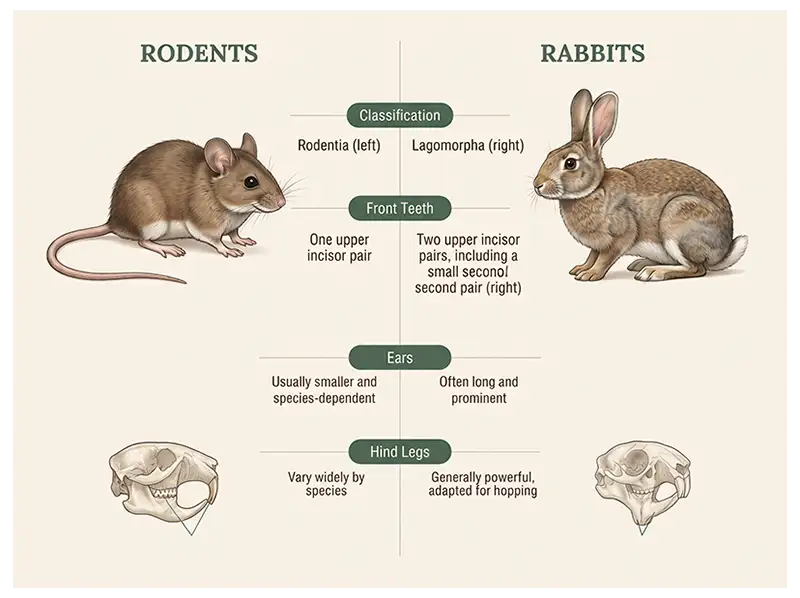
Rodents and rabbits may look similar in some ways, but they belong to different mammalian orders. Rodents belong to Rodentia, while rabbits and hares belong to Lagomorpha.
The most useful distinction is the arrangement of their incisors.
| Feature | Rodents | Rabbits and hares |
|---|---|---|
| Scientific order | Rodentia | Lagomorpha |
| Upper incisors | One main pair | Two pairs, including a smaller pair behind the main incisors |
| Lower incisors | One pair | One pair |
| Canine teeth | Absent | Absent |
| Examples | Mice, rats, squirrels, beavers | Rabbits, hares, pikas |
| Typical feeding adaptations | Vary widely among species | Many are adapted to feeding on grasses and other vegetation |
Both groups have continuously growing incisors, but their dental structures differ. Rabbits and hares possess a second, smaller pair of upper incisors behind the main pair, often called peg teeth.
Their digestive systems also have similarities and differences. Many rabbits rely on hindgut fermentation and re-ingest special soft fecal pellets, a process known as cecotrophy, to absorb additional nutrients. Some rodents use different digestive strategies, and certain rodents also practice forms of re-ingestion.
Despite their superficial similarities, rabbits are not rodents. Their separate evolutionary histories are supported by anatomical, fossil, and genetic evidence.
Conclusion
Rodentia is a highly diverse order of mammals distinguished by continuously growing incisors and specialized gnawing adaptations. Its members range from tiny mice to large capybaras, occupying environments as different as forests, deserts, mountains, wetlands, and cities.
Their varied diets, reproductive strategies, and body structures have helped them adapt to many ecological conditions. Rodents also influence ecosystems through seed dispersal, burrowing, feeding, and habitat modification, while some species interact closely with human agriculture and settlements.
Studying Rodentia provides insight into mammalian evolution, animal classification, and the relationships between organisms and their environments. Despite their differences, rodents share a distinctive dental foundation that connects this remarkable group of mammals.
Rodentia is the scientific name for the mammalian order commonly known as rodents. The name relates to gnawing, a behavior made possible by their specialized incisors.
Their defining dental feature is one pair of continuously growing incisors in the upper jaw and one pair in the lower jaw. These teeth are adapted for gnawing and cutting.
Mice, rats, squirrels, beavers, porcupines, hamsters, guinea pigs, chinchillas, and capybaras are examples of rodents.
No. Rabbits and hares belong to Lagomorpha. Unlike rodents, they have two pairs of upper incisors, including a smaller pair behind the main incisors.
The capybara is the largest living rodent. It is native to South America and is strongly associated with rivers, lakes, and wetlands.