
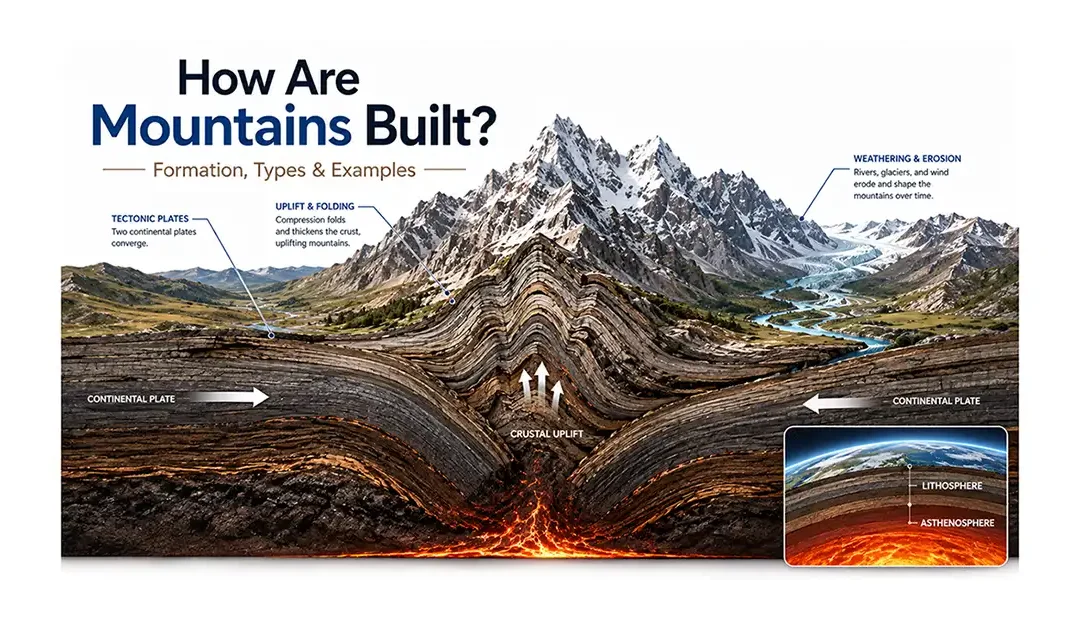
Mountains are among the most impressive natural features on Earth, rising high above the surrounding landscape and shaping the planet's climate, rivers, and ecosystems. From the towering Himalayas of Asia to the volcanic peaks of the Andes, every mountain has a unique geological story that began millions of years ago beneath Earth's surface.
But how are mountains built? Contrary to what many people imagine, mountains do not appear suddenly. They form through slow and powerful geological processes driven by the movement of tectonic plates, volcanic activity, and the gradual uplift of Earth's crust. Over millions of years, these forces push, fold, fracture, and elevate rocks, creating the mountain ranges we see today. Even after they form, mountains continue to change as weathering, erosion, glaciers, and rivers constantly reshape their slopes.
Understanding mountain building is essential for learning about plate tectonics, earthquakes, volcanoes, and the evolution of Earth's continents. It also helps scientists reconstruct ancient geological events and explains why mountain ranges are found in specific regions around the world.
What Does It Mean to Build a Mountain?
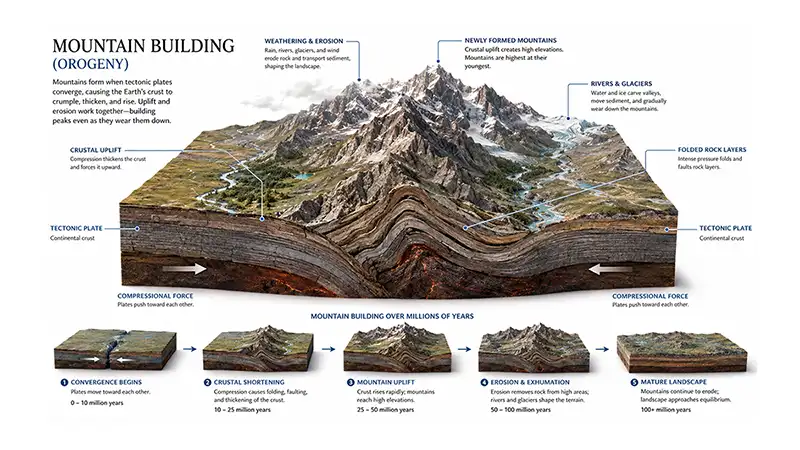
Mountain building, also known as orogeny, is the long-term geological process through which Earth's crust is uplifted and deformed to create mountains and mountain ranges. Rather than occurring over days or years, mountain building usually takes millions to tens of millions of years, driven by the movement of tectonic plates and the enormous forces generated within Earth's interior.
The word orogeny comes from the Greek words oros (mountain) and genesis (origin), meaning the formation of mountains. During an orogenic event, rocks may be folded, faulted, uplifted, or even melted by intense heat and pressure. These processes gradually transform relatively flat landscapes into towering mountain ranges.
Most mountains are formed at plate boundaries, where tectonic plates either collide, move apart, or slide past one another. When plates converge, the immense compressional forces can thicken Earth's crust and push it upward. In other regions, volcanic eruptions or fault movements create mountains through different geological mechanisms.
Mountain building is not a single event but a continuous cycle. While tectonic forces lift the land, natural processes such as weathering, erosion, glaciers, rivers, and landslides simultaneously wear mountains down. As a result, mountains are constantly evolving, with uplift and erosion occurring together over geological time.
Understanding mountain building helps geologists explain the origin of Earth's largest landforms and reveals how continents have changed throughout Earth's history. It also provides valuable insights into plate tectonics, earthquakes, volcanic activity, and the distribution of natural resources.
How Are Mountains Built?
Mountains are built through a combination of powerful geological processes that reshape Earth's crust over millions of years. The primary driving force behind mountain formation is plate tectonics—the continuous movement of Earth's lithospheric plates. As these plates interact, they generate enormous forces that compress, fracture, uplift, or melt sections of the crust, gradually forming mountain ranges.
Although different types of mountains form in different ways, the overall mountain-building process generally follows five major stages: tectonic plate movement, crustal compression, folding and faulting, crustal uplift, and long-term erosion and reshaping.
1. Movement of Tectonic Plates
The first stage of mountain building begins with the movement of tectonic plates. Earth's lithosphere is divided into several large and smaller plates that slowly move across the semi-fluid asthenosphere beneath them. These plates typically move at a rate of only a few centimeters per year, but over millions of years, this movement dramatically reshapes Earth's surface.
Mountains most commonly form where plates interact at their boundaries. Depending on how the plates move, they may collide, separate, or slide past one another. Among these interactions, plate collisions are responsible for creating most of the world's major mountain ranges.
2. Compression of Earth's Crust
When two tectonic plates move toward each other, they create intense compressional forces. Because rocks deep within Earth's crust are subjected to high temperatures and pressures, they often deform instead of breaking immediately.
As compression continues, the crust becomes thicker and shorter. The enormous pressure causes vast layers of sedimentary and metamorphic rocks to buckle, producing the foundation of future mountain ranges.
This process is especially important at convergent plate boundaries, where continental plates or oceanic and continental plates collide.
3. Folding and Faulting
As compressional forces increase, rocks respond in two main ways:
Folding occurs when rock layers bend without breaking. These folded layers gradually rise to form large mountain belts known as fold mountains, such as the Himalayas and the Alps.
When rocks can no longer withstand the stress, they fracture along faults. The movement of rock blocks along these faults creates fault-block mountains, where some sections of the crust are uplifted while others sink.
Together, folding and faulting reshape Earth's crust into rugged mountainous landscapes.
4. Crustal Uplift
As compression, folding, and faulting continue, Earth's crust is pushed upward in a process known as crustal uplift.
This uplift occurs because the crust becomes thicker and more buoyant during plate collisions. In volcanic regions, rising magma can also contribute to uplift by adding new material to Earth's surface.
Crustal uplift is responsible for the tremendous elevations reached by mountain ranges such as the Himalayas, where Mount Everest continues to rise slowly as the Indian Plate collides with the Eurasian Plate.
5. Continued Erosion and Reshaping
Mountain building does not stop once mountains rise above the surrounding landscape. From the moment they form, mountains are continuously modified by weathering and erosion.
Natural agents such as:
- Rivers
- Glaciers
- Wind
- Rain
- Freeze–thaw cycles
- Landslides
gradually wear away the rock, carving valleys, cliffs, and rugged peaks. At the same time, tectonic uplift may continue to raise the mountains, creating a dynamic balance between uplift and erosion.
Types of Mountain Formation
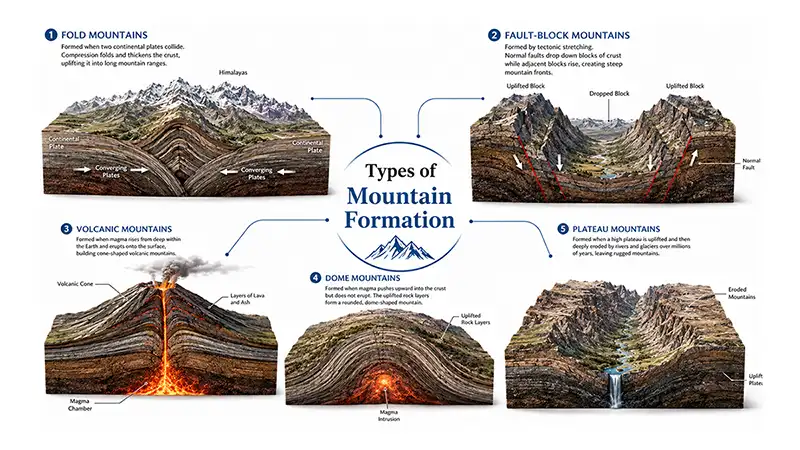
Not all mountains are formed in the same way. Although plate tectonics is the primary force behind mountain building, the geological processes involved can differ significantly depending on the movement of Earth's crust. As a result, geologists classify mountains into several types based on how they formed rather than simply how they look.
The five main types of mountains are fold mountains, fault-block mountains, volcanic mountains, dome mountains, and plateau mountains. Each type reflects a different geological process and provides important clues about Earth's tectonic history.
Fold Mountains
Fold mountains are the most common and highest mountain ranges on Earth. They form when two tectonic plates collide, generating immense compressional forces that fold and uplift layers of sedimentary and metamorphic rocks.
Over millions of years, repeated compression thickens the crust, producing vast mountain belts with long parallel ridges and deep valleys.
Fold mountains are typically associated with convergent plate boundaries and continue to grow as plate movements persist.
Examples include:
- Himalayas
- Alps
- Appalachian Mountains
- Zagros Mountains
Fault-Block
Mountains
Fault-block mountains form when Earth's crust fractures along faults due to tectonic stress. Large blocks of rock move vertically, with some blocks rising while adjacent blocks sink.
The uplifted blocks become mountains, whereas the down-dropped blocks often form valleys or basins.
Fault-block mountains commonly develop in regions where the crust is being stretched or compressed.
Examples include:
- Sierra Nevada (United States)
- Teton Range (United States)
- Harz Mountains (Germany)
Volcanic Mountains
Volcanic mountains are created when molten rock, known as magma, rises from Earth's mantle and erupts onto the surface as lava, volcanic ash, and other volcanic materials.
Successive eruptions gradually build cone-shaped mountains around the volcanic vent. Some volcanic mountains remain active today, while others have become dormant or extinct.
These mountains are commonly found near subduction zones, divergent plate boundaries, and hotspots.
Examples include:
- Mount Fuji (Japan)
- Mount Kilimanjaro (Tanzania)
- Mount St. Helens (United States)
- Mauna Loa (Hawaii)
Dome Mountains
Dome mountains form when molten magma rises beneath Earth's crust but does not erupt. Instead, the magma pushes the overlying rock layers upward, creating a broad, rounded dome.
Over millions of years, erosion removes the upper layers and exposes the uplifted rocks beneath.
Unlike volcanic mountains, dome mountains are not built by lava flows on the surface.
Examples include:
- Black Hills (United States)
- Henry Mountains (United States)
Plateau Mountains
Plateau mountains, also called erosional mountains, develop when large elevated plateaus are deeply eroded by rivers, glaciers, and weathering.
Instead of being uplifted into sharp peaks, these mountains originate from broad, relatively flat highlands that become dissected over time.
Although erosion shapes their rugged appearance, tectonic uplift often raises the original plateau before erosion begins.
Examples include:
- Catskill Mountains (United States)
- Cumberland Plateau (United States)
Role of Plate Tectonics in Mountain Building
The theory of plate tectonics provides the scientific explanation for how most mountains are built. Earth's outer shell, known as the lithosphere, is divided into several large and smaller tectonic plates that move slowly over the semi-molten asthenosphere beneath them. Although these plates move only a few centimeters each year, their continuous motion over millions of years reshapes Earth's surface and creates some of the planet's most spectacular mountain ranges.
Most mountain-building events occur along plate boundaries, where tectonic plates interact. Depending on how the plates move, mountains may form through continental collision, subduction, crustal uplift, or volcanic activity.
Continental–Continental Collision
One of the most dramatic examples of mountain building occurs when two continental plates collide.
Because continental crust is relatively thick and buoyant, neither plate easily sinks beneath the other. Instead, both plates crumple, fold, and thicken under immense compressional forces. This causes Earth's crust to rise, creating enormous fold mountain ranges.
The best-known example is the Himalayas, which continue to grow as the Indian Plate slowly moves northward and collides with the Eurasian Plate. This ongoing collision also contributes to frequent earthquakes across the region.
Oceanic–Continental Convergence
Mountains also form where an oceanic plate collides with a continental plate.
Because oceanic crust is denser, it sinks beneath the continental plate in a process called subduction. As the descending plate moves deeper into Earth's mantle, it partially melts, producing magma.
The rising magma feeds volcanoes while compressional forces uplift the continental crust, creating long volcanic mountain chains.
A classic example is the Andes Mountains in South America, formed as the Nazca Plate subducts beneath the South American Plate.
Oceanic–Oceanic Convergence
When two oceanic plates converge, one plate subducts beneath the other. The melting of the descending plate generates magma that rises to the surface, forming chains of volcanic islands known as island arcs.
Although these mountains initially form beneath the ocean, continued volcanic activity can eventually raise them above sea level.
Examples include:
- The Japanese Islands
- The Aleutian Islands (Alaska)
- The Mariana Islands
Divergent Plate Boundaries
Although less commonly associated with major mountain ranges, divergent plate boundaries can also create mountains.
As tectonic plates move apart, magma rises from the mantle to fill the gap, forming new crust. This process builds long underwater mountain chains known as mid-ocean ridges, such as the Mid-Atlantic Ridge.
On continents, divergence can produce rift valleys bordered by fault-block mountains, as seen in the East African Rift System.
Why Plate Tectonics Is Essential
Without plate tectonics, Earth would not have the towering mountain ranges that define many of its landscapes. The slow movement of tectonic plates drives the compression, uplift, volcanism, and crustal deformation responsible for mountain formation.
At the same time, plate tectonics also influences:
- Earthquakes
- Volcanic eruptions
- Continental drift
- Ocean basin formation
- The rock cycle
This makes plate tectonics one of the most important theories in modern geology and the primary mechanism behind mountain building.
Famous Mountain Ranges and How They Formed
Every mountain range has its own geological history, but all were shaped by the powerful forces acting within Earth's crust. By studying famous mountain ranges around the world, geologists can better understand how different tectonic processes create different types of mountains.
Some mountain ranges formed through the collision of continents, while others were built by volcanic activity, faulting, or crustal uplift. These examples provide clear evidence that plate tectonics is the primary driving force behind mountain building.
The Himalayas
The Himalayas are the highest mountain range on Earth and the best example of mountains formed by continental collision.
Around 50 million years ago, the Indian Plate collided with the Eurasian Plate. Because both plates consist of thick continental crust, neither could easily sink beneath the other. Instead, the rocks were compressed, folded, and uplifted, forming the Himalayan mountain range.
The collision is still occurring today, causing the Himalayas to continue rising by a few millimeters each year while also generating frequent earthquakes across the region.
The Andes
Stretching along the western edge of South America, the Andes are the world's longest continental mountain range.
They formed where the Nazca Plate is subducting beneath the South American Plate. As the denser oceanic plate descends into the mantle, it melts and generates magma, leading to volcanic activity while simultaneously uplifting the continental crust.
This combination of subduction, volcanism, and crustal compression has produced one of the most active mountain belts on Earth.
The Alps
The Alps of Europe were created through the collision of the African Plate and the Eurasian Plate.
Over millions of years, compressional forces folded and uplifted thick layers of sedimentary rocks that had accumulated in an ancient ocean basin. Today, the Alps continue to experience slow tectonic movement, although mountain building occurs at a much slower rate than in the Himalayas.
The Rocky Mountains
The Rocky Mountains extend from Canada to the southwestern United States and formed primarily during the Laramide Orogeny, which occurred between about 80 and 55 million years ago.
Unlike the Himalayas, the Rockies were produced by complex compressional forces associated with the shallow subduction of the ancient Farallon Plate beneath western North America. These forces uplifted large sections of the continental crust, creating the rugged mountain landscape visible today.
The East African Rift Mountains
Not all mountains form through compression. In eastern Africa, mountains are developing as the continent slowly pulls apart along the East African Rift System.
As the crust stretches, large fault blocks rise while adjacent blocks sink, creating fault-block mountains and deep rift valleys. Volcanic activity is also common throughout the region, contributing to the formation of peaks such as Mount Kilimanjaro and Mount Kenya.
This region demonstrates that mountain building can occur through crustal extension as well as compression.
Why Are Mountains Still Changing?
Although many mountain ranges formed millions of years ago, they are not permanent or unchanging landforms. Mountains continue to evolve because two opposing forces constantly act upon them. Deep within Earth, tectonic forces continue to uplift the crust, while at the surface, weathering and erosion gradually wear the mountains down. This balance between construction and destruction has shaped Earth's landscapes throughout geological history and continues to do so today.
As a result, mountains are dynamic features that are continuously rising, collapsing, eroding, and being reshaped.
Ongoing Tectonic Uplift
In many regions, mountain building has not yet ended. Where tectonic plates continue to converge, Earth's crust is still being compressed and uplifted.
One of the best examples is the Himalayas, where the Indian Plate continues to collide with the Eurasian Plate. This collision causes parts of the mountain range to rise by several millimeters each year. Similar tectonic activity also occurs in portions of the Andes, Southern Alps of New Zealand, and other active mountain belts.
Although these annual changes are small, they accumulate over millions of years, significantly altering the height and shape of mountain ranges.
Weathering Breaks Down Rocks
At Earth's surface, mountains are constantly exposed to weathering, the process that breaks rocks into smaller fragments.
There are three main types of weathering:
- Physical weathering, caused by freezing and thawing, temperature changes, and plant roots.
- Chemical weathering, where minerals react with water, oxygen, or weak acids.
- Biological weathering, resulting from the activities of plants, animals, and microorganisms.
Over time, weathering weakens mountain rocks, making them more vulnerable to erosion.
Erosion Reshapes Mountain Landscapes
After rocks have been weathered, erosion transports the loosened material away.
Several natural agents contribute to mountain erosion:
- Rivers carve deep valleys and canyons.
- Glaciers grind rock into U-shaped valleys.
- Wind removes loose sediments from exposed slopes.
- Rainfall washes soil and rock downhill.
- Landslides rapidly move large volumes of rock and sediment.
These processes gradually reduce mountain height while creating dramatic landforms such as cliffs, cirques, ridges, and gorges.
Earthquakes and Fault Movement
Earthquakes also play an important role in modifying mountains.
Sudden movements along faults can:
- Raise sections of Earth's crust.
- Lower neighboring areas.
- Trigger massive landslides.
- Create new fault scarps.
- Alter river channels.
Although earthquakes occur within minutes, they can permanently reshape mountainous landscapes.
Glaciers Continue to Sculpt Mountains
In high-altitude regions, glaciers remain powerful agents of change.
As glaciers slowly move downhill, they erode bedrock through abrasion and plucking, creating distinctive features such as:
- U-shaped valleys
- Sharp ridges (arêtes)
- Pyramidal peaks (horns)
- Cirques
- Hanging valleys
Many iconic mountain landscapes, including those in the Alps and the Rocky Mountains, owe their present appearance to repeated glaciation during the Ice Ages.
The Balance Between Uplift and Erosion
The shape and height of a mountain range depend on the balance between tectonic uplift and erosion.
- If uplift occurs faster than erosion, mountains continue to rise.
- If erosion outpaces uplift, mountains gradually become lower and more rounded.
This continuous interaction explains why some mountain ranges, such as the Himalayas, remain young and rugged, while older ranges like the Appalachian Mountains have smoother, more rounded peaks after hundreds of millions of years of erosion.
Importance of Mountains
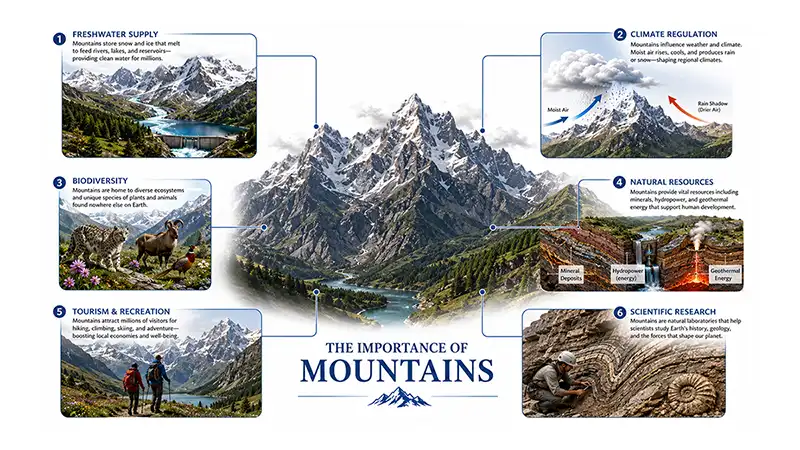
Mountains are far more than towering landforms on Earth's surface. They influence the planet's climate, supply freshwater, support diverse ecosystems, provide valuable natural resources, and shape human civilization. Although they cover only about one-quarter of Earth's land surface, mountains play a critical role in maintaining environmental balance and sustaining millions of people around the world.
From regulating regional weather patterns to preserving biodiversity, mountains are among the most important geological features on our planet.
Source of Freshwater
Mountains are often called the "water towers of the world" because they store and release enormous amounts of freshwater.
Snow, glaciers, and rainfall accumulated in mountain regions feed rivers, lakes, and underground aquifers. Many of the world's largest river systems—including the Ganges, Yangtze, Indus, Mekong, Colorado, and Rhine—originate in mountainous areas.
This freshwater supports:
- Drinking water supplies
- Agriculture
- Hydroelectric power generation
- Industrial activities
- Ecosystems downstream
Without mountains, many regions would experience severe water shortages.
Climate and Weather Regulation
Mountains strongly influence both local and global climate.
As moist air rises along mountain slopes, it cools and condenses to form clouds and precipitation. This process, known as the orographic effect, creates wetter climates on the windward side and drier rain shadow regions on the leeward side.
Mountain ranges also affect:
- Wind patterns
- Temperature distribution
- Snowfall
- Regional rainfall
- Atmospheric circulation
These influences make mountains important regulators of Earth's climate system.
Biodiversity Hotspots
Mountain environments support an extraordinary variety of plants and animals because climate changes rapidly with elevation.
Different altitude zones create distinct habitats, allowing numerous species to thrive within relatively small geographic areas.
Many mountain regions contain:
- Endemic plant species
- Rare mammals
- Alpine forests
- Grasslands
- High-altitude wetlands
Because of this rich biodiversity, mountains are among the world's most important areas for wildlife conservation.
Mineral and Energy Resources
Mountain belts often contain valuable geological resources formed through tectonic activity and magmatic processes.
Important resources include:
- Gold
- Copper
- Iron ore
- Silver
- Rare earth elements
- Building stone
Mountains are also important sources of:
- Hydroelectric energy
- Geothermal energy
- Forest resources
These resources contribute significantly to local and national economies.
Tourism and Recreation
Many mountain regions are famous tourist destinations because of their spectacular scenery and outdoor recreation opportunities.
Popular activities include:
- Hiking
- Mountaineering
- Rock climbing
- Skiing
- Wildlife observation
- Camping
- Photography
Tourism supports local communities by creating employment and encouraging conservation of natural landscapes.
Scientific and Geological Importance
Mountains preserve a remarkable record of Earth's geological history.
By studying mountain rocks and structures, geologists can investigate:
- Plate tectonics
- Continental collisions
- Ancient oceans
- Volcanic activity
- Earthquake history
- Climate change over geological time
Mountain ranges therefore serve as natural laboratories for understanding the evolution of Earth's crust.
Conclusion
Mountains rank among Earth's most remarkable landforms, but they do not appear overnight. Slow geological processes, driven primarily by plate tectonics, create mountains. As Earth's lithospheric plates move, they fold, fault, uplift, and fracture the crust or trigger volcanic activity. Over millions of years, these powerful forces transform relatively flat landscapes into towering mountain ranges. After mountains emerge, weathering, erosion, glaciers, rivers, and earthquakes continue to reshape and modify them.
In this guide, we explored the processes that create mountains, the geological mechanisms behind mountain formation, the major types of mountains, the role of plate tectonics, famous mountain ranges, and the importance of mountains to Earth's environment and human society. Together, these topics show that mountain building continues as an ongoing geological process rather than a single event.
Mountains also play an essential role in sustaining life on Earth. They supply freshwater, regulate climate, support rich biodiversity, provide valuable mineral and energy resources, and preserve a detailed record of Earth's geological history. When we understand how mountains form and change, we gain a deeper appreciation of the dynamic forces that continue to shape our planet.
Whether you study geology, enjoy Earth science, or simply feel curious about the natural world, learning how geological forces create mountains gives you valuable insight into the processes that have shaped Earth's landscapes for hundreds of millions of years.
The geological process of mountain formation is called orogeny. It involves crustal deformation, folding, faulting, uplift, and sometimes volcanic activity over millions of years.
Mountain formation is extremely slow. Most mountain ranges develop over millions to tens of millions of years through continuous tectonic activity and crustal uplift.
Yes. Some mountain ranges, such as the Himalayas, are still rising because the tectonic plates that formed them continue to collide. However, erosion simultaneously wears them down, creating a balance between uplift and erosion.
Tectonic plates are the primary driving force behind mountain formation. Their movement generates the compressional, extensional, and volcanic processes responsible for building most of Earth's mountains.
Yes. Volcanic mountains form when magma rises from Earth's mantle and erupts onto the surface. Repeated eruptions of lava, ash, and volcanic debris gradually build cone-shaped mountains such as Mount Fuji and Mount Kilimanjaro.