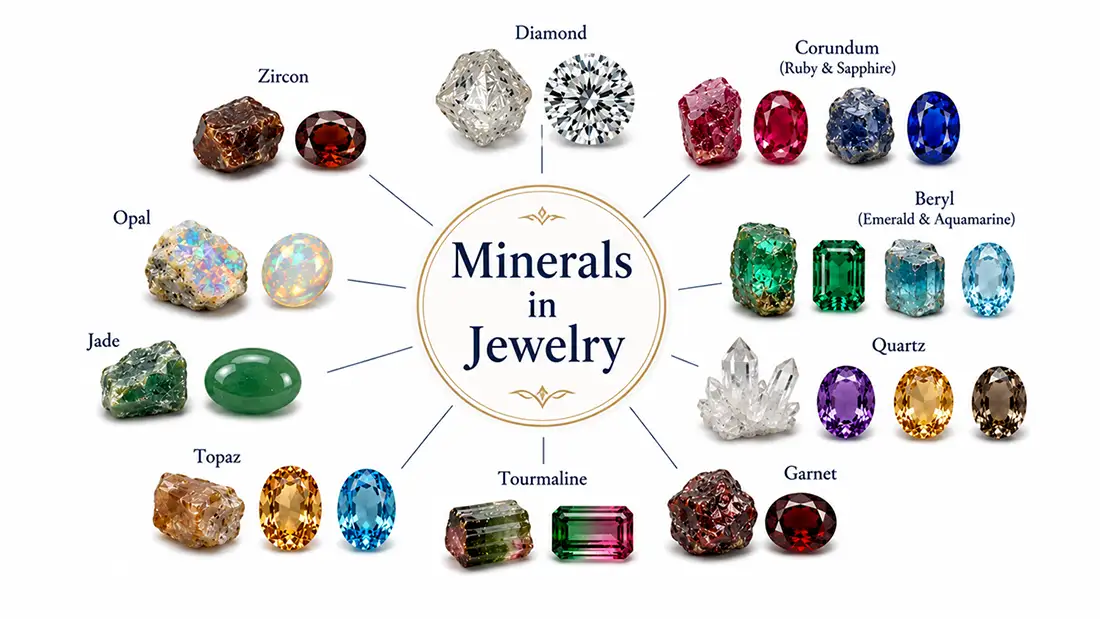
From sparkling diamond engagement rings to colorful sapphire necklaces and emerald pendants, jewelry has fascinated people for thousands of years. Behind every polished gemstone lies an extraordinary geological story that began deep beneath Earth's surface. Long before gemstones are displayed in jewelry stores, they exist as naturally formed minerals that crystallized over millions—or even billions—of years under intense heat, pressure, volcanic activity, and mineral-rich fluids.
The study of minerals in jewelry connects geology, mineralogy, gemology, and materials science. It explains why only a small number of Earth's thousands of minerals possess the beauty, hardness, durability, and rarity required to become gemstones. These exceptional minerals are discovered through geological exploration, extracted by mining, carefully cut and polished, and finally transformed into the jewelry admired around the world.
Understanding jewelry minerals is valuable not only for geologists and gemologists but also for students, collectors, jewelry designers, and anyone curious about how natural crystals become precious gemstones. It provides insight into Earth's geological history while revealing the scientific properties that determine a gemstone's color, brilliance, transparency, and value.
In this comprehensive guide, you'll learn what minerals in jewelry are, how they differ from gemstones, why only certain minerals are suitable for jewelry, how they form in nature, and the physical characteristics that make them some of the most valuable natural resources on Earth.
What Are Minerals in Jewelry?
Minerals in jewelry are naturally occurring crystalline substances that possess the physical and optical properties needed to become gemstones. These minerals are selected because they combine exceptional beauty with sufficient durability, allowing them to withstand everyday wear while maintaining their appearance for decades or even centuries.
From a geological perspective, a mineral must satisfy five scientific requirements:
- It occurs naturally in nature.
- It is inorganic.
- It is solid under normal conditions.
- It has a definite chemical composition.
- It possesses an ordered crystalline structure.
Although scientists have identified more than 5,900 mineral species, only a small percentage have the characteristics required for jewelry.
To qualify as a gemstone, a mineral generally needs:
- Attractive natural color
- High transparency or unique optical effects
- Excellent hardness
- Good toughness
- Resistance to weathering
- Ability to take a brilliant polish
- Relative rarity
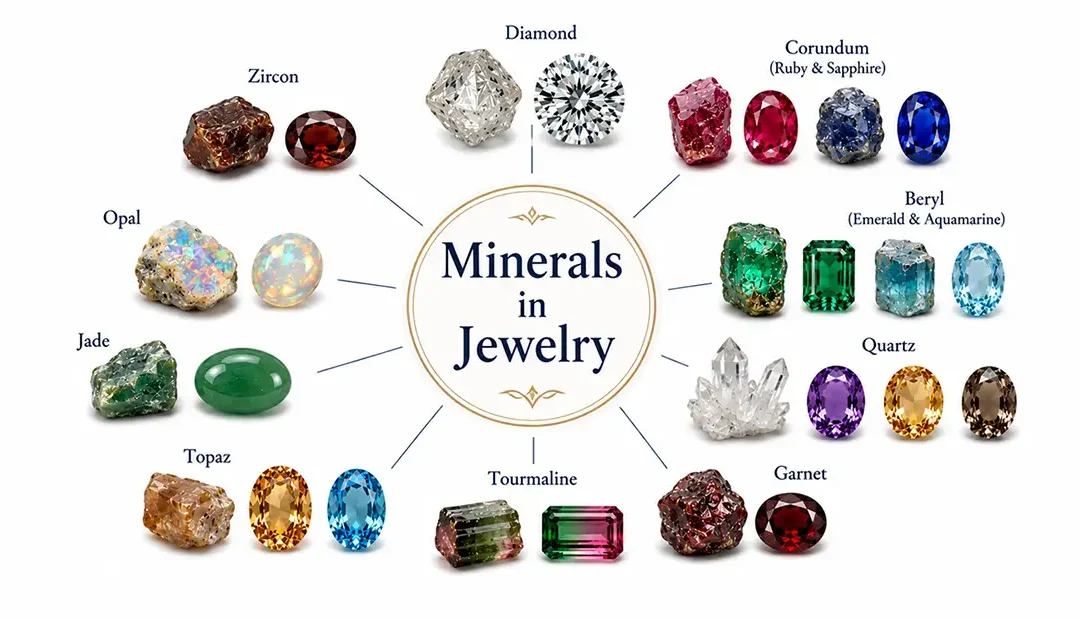
These qualities explain why minerals such as diamond, corundum, beryl, quartz, and garnet have become some of the world's most valuable gemstones.
Minerals vs. Gemstones: What's the Difference?
Many people use the terms mineral and gemstone interchangeably, but they have different meanings.
A mineral is a naturally occurring inorganic substance with a specific chemical composition and crystal structure.
A gemstone is a mineral—or occasionally another natural material—that has been cut, polished, and prepared for decorative use in jewelry.
In simple words: Every gemstone begins as a natural material, but not every mineral becomes a gemstone.
For example:
- Diamond is both a mineral and a gemstone.
- Ruby is the red gemstone variety of the mineral corundum.
- Sapphire is another gemstone variety of corundum.
- Emerald is the green gemstone variety of the mineral beryl.
- Amethyst is the purple gemstone variety of quartz.
There are also important exceptions:
- Opal is classified as a mineraloid because it lacks a crystalline structure.
- Amber is fossilized tree resin rather than a mineral.
- Pearls are produced by living mollusks instead of geological processes.
Understanding this distinction helps explain why mineralogists and gemologists classify jewelry materials differently.
Why Only Certain Minerals Become Gemstones
Earth contains thousands of naturally occurring minerals, but only a few dozen are commonly used in jewelry. The reason lies in their exceptional combination of physical, chemical, and optical properties.
Beauty
Color is usually the first characteristic that attracts attention.
Many gemstone colors are produced by tiny amounts of trace elements within the crystal structure:
- Chromium produces the rich red color of ruby.
- Chromium and vanadium create emerald's deep green color.
- Iron and titanium produce the famous blue color of sapphire.
- Manganese contributes pink tones in several gemstones.
- Iron creates yellow, brown, and green varieties in others.
Even minute chemical differences can dramatically change a gemstone's appearance.
Hardness
Jewelry is exposed to daily wear, making hardness one of the most important properties.
The Mohs Hardness Scale measures a mineral's resistance to scratching.
| Mineral | Mohs Hardness |
|---|---|
| Diamond | 10 |
| Corundum (Ruby & Sapphire) | 9 |
| Topaz | 8 |
| Quartz | 7 |
| Garnet | 6.5–7.5 |
| Opal | 5.5–6.5 |
Harder gemstones generally remain attractive for longer periods and are better suited for rings and bracelets, which experience frequent contact.
Durability
Hardness alone does not determine whether a gemstone is suitable for jewelry.
A gemstone must also resist:
- Breaking
- Chipping
- Cleavage
- Weathering
- Chemical alteration
For example, jade is less hard than diamond but is extremely tough, making it one of the best gemstones for carving and ornamental objects.
Rarity
Scarcity plays a significant role in determining gemstone value.
Although many minerals occur in large quantities, gem-quality crystals are much rarer. Large, transparent, flawless specimens are especially valuable because the geological conditions required to produce them are uncommon.
Optical Beauty
Many jewelry minerals display remarkable optical effects that enhance their appearance.
These include:
- Brilliance
- Fire
- Chatoyancy (cat's-eye effect)
- Asterism (star effect)
- Color change
- Pleochroism
- Opalescence
These natural optical phenomena contribute significantly to a gemstone's beauty and market value.
Geological Formation of Jewelry Minerals
Every gemstone tells a story about Earth's geological evolution. Different geological environments produce different gemstone minerals, and understanding these environments helps geologists locate new gemstone deposits around the world.
Igneous Formation
Some gemstones crystallize directly from cooling magma.
Examples include:
- Diamond (formed deep within Earth's mantle and transported to the surface by kimberlite magma)
- Zircon
- Peridot
Igneous environments often produce well-formed, high-quality crystals.
Metamorphic Formation
Heat and pressure acting on existing rocks create new minerals through metamorphism.
This process forms many famous gemstones, including:
- Ruby
- Sapphire
- Garnet
- Jade
- Spinel
Metamorphic environments are well known for producing large, gem-quality crystals.
Hydrothermal Formation
Hot, mineral-rich fluids moving through fractures within rocks gradually deposit crystals as they cool.
Hydrothermal systems commonly produce:
- Quartz
- Emerald
- Topaz
- Tourmaline
- Aquamarine
Many transparent and highly valued gemstones originate from hydrothermal deposits.
Sedimentary and Secondary Deposits
Weathering gradually breaks down primary rocks, releasing resistant gemstones that accumulate in rivers, beaches, and sedimentary basins.
Examples include:
- Diamond placer deposits
- Sapphire gravels
- Ruby alluvial deposits
- Zircon-rich sands
Many historic gemstone discoveries began in river gravels before geologists identified the original source rocks.
Why Geological Formation Matters
The geological environment in which a gemstone forms influences many of its characteristics, including:
- Color
- Crystal size
- Transparency
- Purity
- Inclusions
- Hardness
- Economic value
Understanding these processes enables geologists to locate new gemstone resources while supporting responsible and sustainable mining practices.
Types of Minerals Used in Jewelry
Gemstones can be grouped according to their mineral families rather than simply listing them alphabetically. This geological classification helps explain why certain gemstones share similar physical properties, crystal structures, and chemical compositions. It also provides a better understanding of their formation and occurrence in nature.
The following mineral groups include many of the world's most valuable and widely used jewelry gemstones.
Diamond
Diamond is the world's hardest naturally occurring mineral and one of the most valuable gemstones ever discovered. Formed approximately 140–200 kilometers beneath Earth's surface under extreme pressure and temperatures exceeding 1,000°C, diamonds are brought to the surface through explosive volcanic eruptions that create kimberlite and lamproite pipes.
Composed entirely of carbon atoms arranged in a cubic crystal structure, diamond exhibits exceptional brilliance, fire, and durability. Its unmatched hardness of 10 on the Mohs scale makes it highly resistant to scratching, making it the preferred gemstone for engagement rings and everyday jewelry.
Chemical Formula
C
Crystal System
Isometric (Cubic)
Mohs Hardness
10
Common Colors
- Colorless
- Yellow
- Brown
- Blue
- Pink
- Green
- Black
Major Producing Countries
- Botswana
- Russia
- Canada
- South Africa
- Australia
Common Jewelry Uses
- Engagement rings
- Wedding bands
- Earrings
- Luxury necklaces
- Bracelets
Ruby
Ruby is the red variety of corundum. Its vivid red color comes from trace amounts of chromium.
Throughout history, ruby has symbolized love, passion, courage, and royalty. Fine-quality rubies often command prices comparable to or even exceeding those of diamonds.
Chemical Formula
Al₂O₃
Mohs Hardness
9
Common Colors
- Deep red
- Crimson
- Pinkish red
Major Producing Countries
- Myanmar
- Mozambique
- Thailand
- Madagascar
- Tanzania
Jewelry Uses
- Engagement rings
- Pendants
- Earrings
- Luxury necklaces
Sapphire
Sapphire includes every color of corundum except red. Blue sapphire is the most famous, although sapphires naturally occur in yellow, green, purple, orange, pink, and even color-changing varieties.
Its outstanding durability makes sapphire one of the best gemstones for rings.
Chemical Formula
Al₂O₃
Mohs Hardness
9
Common Colors
- Blue
- Yellow
- Pink
- Green
- Purple
- White
Major Producing Countries
- Sri Lanka
- Australia
- Madagascar
- Thailand
- Kashmir (India)
Jewelry Uses
- Wedding rings
- Luxury watches
- Earrings
- Bracelets
Emerald
Emerald is the green variety of beryl and is prized for its rich color and rarity. Chromium and vanadium produce its distinctive green appearance.
Unlike diamonds, most natural emeralds contain visible inclusions known as "jardin," which are considered part of their natural beauty.
Chemical Formula
Be₃Al₂Si₆O₁₈
Mohs Hardness
7.5–8
Common Colors
- Deep green
- Bluish green
Major Producing Countries
- Colombia
- Zambia
- Brazil
- Ethiopia
Jewelry Uses
- Luxury rings
- Pendants
- Earrings
- Necklaces
Aquamarine
Aquamarine is another variety of beryl known for its crystal-clear blue to blue-green color.
Its excellent transparency makes it popular in elegant jewelry designs.
Chemical Formula
Be₃Al₂Si₆O₁₈
Mohs Hardness
7.5–8
Common Colors
- Sky blue
- Ocean blue
- Blue-green
Major Producing Countries
- Brazil
- Pakistan
- Nigeria
- Madagascar
Jewelry Uses
- Necklaces
- Earrings
- Engagement rings
Morganite
Morganite is the pink variety of beryl. Its soft pastel colors have made it increasingly popular in modern engagement rings.
Common Colors
- Pink
- Peach
- Salmon
Amethyst
Amethyst is the purple variety of quartz produced by trace amounts of iron and natural radiation.
Mohs Hardness
7
Jewelry Uses
- Rings
- Pendants
- Bracelets
- Earrings
Citrine
Citrine is the yellow to golden-orange variety of quartz.
Natural citrine is relatively rare, although heat-treated amethyst is commonly sold as citrine.
Common Colors
- Yellow
- Golden
- Orange
Topaz
Topaz is admired for its exceptional clarity and wide range of natural colors.
Although naturally colorless, impurities and treatments create blue, yellow, pink, and golden varieties commonly found in jewelry.
Chemical Formula
Al₂SiO₄(F,OH)₂
Mohs Hardness
8
Major Producing Countries
- Brazil
- Pakistan
- Russia
- Sri Lanka
Jewelry Uses
- Earrings
- Rings
- Pendants
- Bracelets
Opal
Unlike most gemstones, opal is a mineraloid because it lacks an ordered crystal structure.
Its spectacular "play-of-color" results from microscopic silica spheres that diffract light into brilliant flashes of multiple colors.
Mohs Hardness
5.5–6.5
Major Producing Countries
- Australia
- Ethiopia
- Mexico
Jewelry Uses
- Pendants
- Earrings
- Decorative rings
Jade
Jade actually refers to two different minerals:
- Jadeite
- Nephrite
Both have been treasured for thousands of years, particularly in East Asian cultures.
Although not exceptionally hard, jade is one of the toughest natural gemstone materials.
Common Colors
- Green
- White
- Lavender
- Yellow
- Black
Jewelry Uses
- Bracelets
- Bangles
- Pendants
- Carvings
Zircon
Natural zircon is one of Earth's oldest known minerals, with some crystals dating back more than 4 billion years.
Its high brilliance often leads people to confuse it with diamonds, although it is an entirely different mineral.
Mohs Hardness
6–7.5
Common Colors
- Colorless
- Blue
- Brown
- Golden
- Green
Jewelry Uses
- Rings
- Earrings
- Luxury jewelry
How Gemologists Identify Jewelry Minerals
Accurate gemstone identification is one of the most important aspects of gemology. Many gemstones look similar to the naked eye, making scientific testing essential for distinguishing natural gemstones from synthetic or imitation materials.
Professional gemologists rely on a combination of physical, optical, and chemical tests.
Mohs Hardness Test
Hardness measures a mineral's resistance to scratching.
For example:
- Diamond – 10
- Corundum (Ruby & Sapphire) – 9
- Topaz – 8
- Quartz – 7
Hardness helps eliminate many look-alike gemstones during identification.
Refractive Index
Every gemstone bends light differently.
Using a refractometer, gemologists measure the refractive index, which is one of the most reliable methods for identifying transparent gemstones.
Specific Gravity
Specific gravity measures a gemstone's density relative to water.
Many gemstones with similar colors can be distinguished using density measurements.
Crystal Structure
Each mineral has a unique crystal structure.
Examples include:
- Cubic (Diamond, Garnet)
- Hexagonal (Emerald, Quartz)
- Trigonal (Ruby, Sapphire)
- Orthorhombic (Topaz)
Crystal structure provides important clues for mineral identification.
Spectroscopy
Spectroscopes analyze how gemstones absorb and transmit light.
Different trace elements produce unique absorption patterns that help identify gemstones and detect treatments.
Microscopic Examination
Gemologists examine gemstones under high magnification to observe:
- Inclusions
- Growth patterns
- Fractures
- Crystal zoning
- Surface features
These characteristics often reveal whether a gemstone is natural, treated, or laboratory-grown.
Advanced Laboratory Techniques
Modern gemological laboratories also use sophisticated analytical instruments such as:
- X-Ray Diffraction (XRD)
- X-Ray Fluorescence (XRF)
- Raman Spectroscopy
- Infrared Spectroscopy (FTIR)
- UV-Visible Spectroscopy
These techniques provide highly accurate mineral identification and detect treatments that may not be visible under a microscope.
Applications of Jewelry Minerals
Although jewelry is their most recognizable use, gemstone minerals also contribute to science, culture, and industry.
Fine Jewelry
- Engagement rings
- Wedding bands
- Necklaces
- Earrings
- Bracelets
- Pendants
Luxury Watches
Diamonds, sapphires, and rubies are frequently incorporated into premium watch designs.
Collecting
Rare mineral specimens are highly valued by museums, universities, and private collectors.
Cultural and Religious Artifacts
Many civilizations have used gemstones in ceremonial objects, royal crowns, and religious ornaments for centuries.
Investment
Exceptional diamonds, rubies, emeralds, and sapphires are considered alternative investment assets because of their rarity and long-term value.
Limitations of Jewelry Minerals
Despite their remarkable properties, jewelry minerals also have several limitations that affect their extraction, use, and long-term sustainability.
Limited Natural Resources
Gem-quality minerals are naturally rare. Only a small percentage of mined crystals meet the quality standards required for fine jewelry, making high-quality gemstones increasingly scarce.
Environmental Impacts
Mining operations can disturb ecosystems, alter landscapes, and affect water resources if not managed responsibly. Sustainable mining practices are essential to minimize these impacts.
High Cost
Rare gemstones such as diamonds, emeralds, and fine rubies can be extremely expensive because of their scarcity, quality, and market demand.
Fragility of Some Gemstones
Not all gemstones are equally durable. Minerals such as opal, emerald, and topaz may contain fractures or cleavage planes that require careful handling during cutting and everyday use.
Synthetic and Imitation Stones
Advances in technology have made synthetic gemstones increasingly similar to natural ones. Without proper testing, consumers may find it difficult to distinguish between natural, laboratory-grown, and imitation stones.
Ethical Challenges
Some gemstone-producing regions have experienced issues related to conflict financing, unsafe working conditions, and illegal mining. Certification and responsible sourcing are becoming increasingly important throughout the jewelry industry.
The most common jewelry minerals include diamond, ruby, sapphire, emerald, quartz, garnet, topaz, tourmaline, jade, zircon, aquamarine, and opal. Each gemstone possesses unique physical and optical properties that make it suitable for decorative use.
No. Although most gemstones are minerals, some are not. Opal is classified as a mineraloid because it lacks a crystalline structure, while amber is fossilized tree resin and pearls are produced by living mollusks.
A mineral is a naturally occurring inorganic substance with a definite chemical composition and crystal structure. A gemstone is a mineral—or occasionally another natural material—that has been cut and polished for use in jewelry because of its beauty, durability, and rarity.
Diamonds are valued because they combine exceptional hardness, brilliance, rarity, durability, and strong cultural significance. Their formation deep within Earth's mantle over billions of years also contributes to their uniqueness.
Diamond is the hardest naturally occurring mineral, ranking 10 on the Mohs Hardness Scale. Its exceptional hardness makes it highly resistant to scratching and ideal for everyday jewelry.
Final Thoughts
Jewelry minerals represent one of the most fascinating intersections between geology, mineralogy, and human craftsmanship. Every gemstone tells a remarkable geological story that began deep within Earth's crust, where immense heat, pressure, and mineral-rich fluids slowly produced beautiful crystalline minerals over millions of years. Through exploration, mining, cutting, polishing, and skilled craftsmanship, these natural treasures are transformed into the jewelry admired across cultures and generations.
Understanding the minerals used in jewelry provides far more than an appreciation of their beauty. It reveals how geological processes shape Earth's mineral resources, why only certain minerals become gemstones, and how scientific techniques help identify and evaluate them. As consumer awareness grows, sustainable mining practices, ethical sourcing, and laboratory-grown gemstones are also becoming increasingly important in the future of the jewelry industry.
Whether you are studying geology, learning gemology, collecting minerals, or simply appreciating fine jewelry, exploring jewelry minerals offers a deeper understanding of both Earth's natural history and one of humanity's oldest forms of artistic expression.
Continue Learning
Expand your knowledge by exploring these related geology and mineralogy topics: