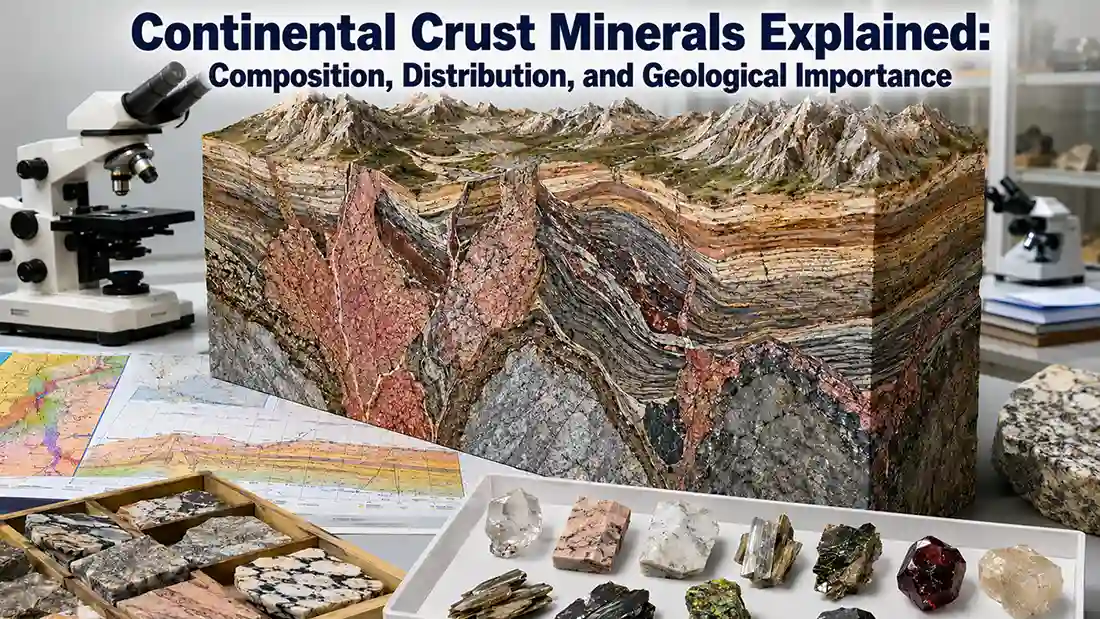
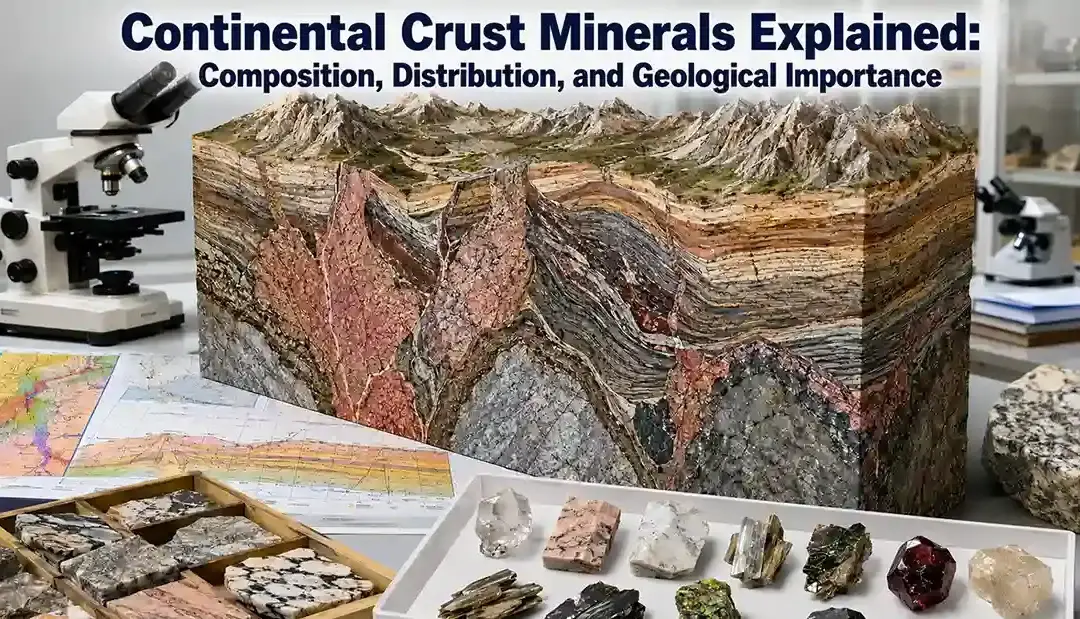
The continental crust is the thick, buoyant outer layer that forms Earth's continents and continental shelves. Unlike the denser oceanic crust, continental crust is composed mainly of silica-rich (felsic to intermediate) rocks, making it less dense and capable of floating higher on the mantle. It is also much older, with some continental rocks exceeding 4 billion years in age.
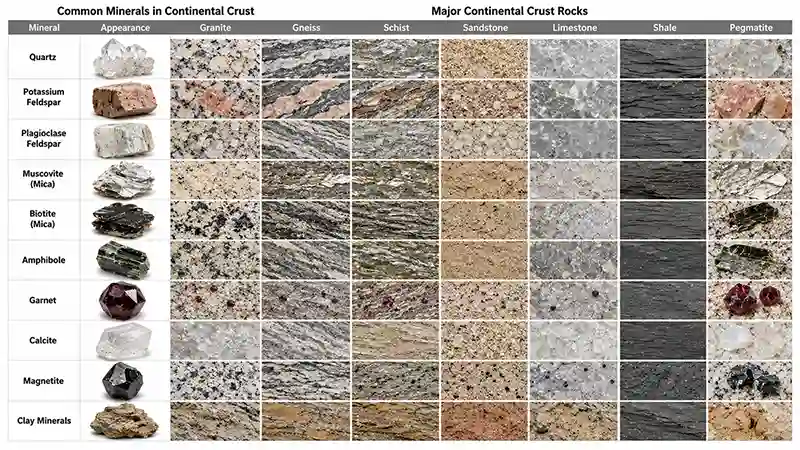
Continental crust is dominated by quartz, potassium feldspar, plagioclase feldspar, mica, amphibole, garnet, and numerous accessory minerals. These minerals occur within igneous, sedimentary, and metamorphic rocks and record billions of years of tectonic activity, mountain building, erosion, metamorphism, and magmatism.
Studying continental crust minerals helps geologists understand continental evolution, plate tectonics, mountain formation, mineral resources, and Earth's geological history.
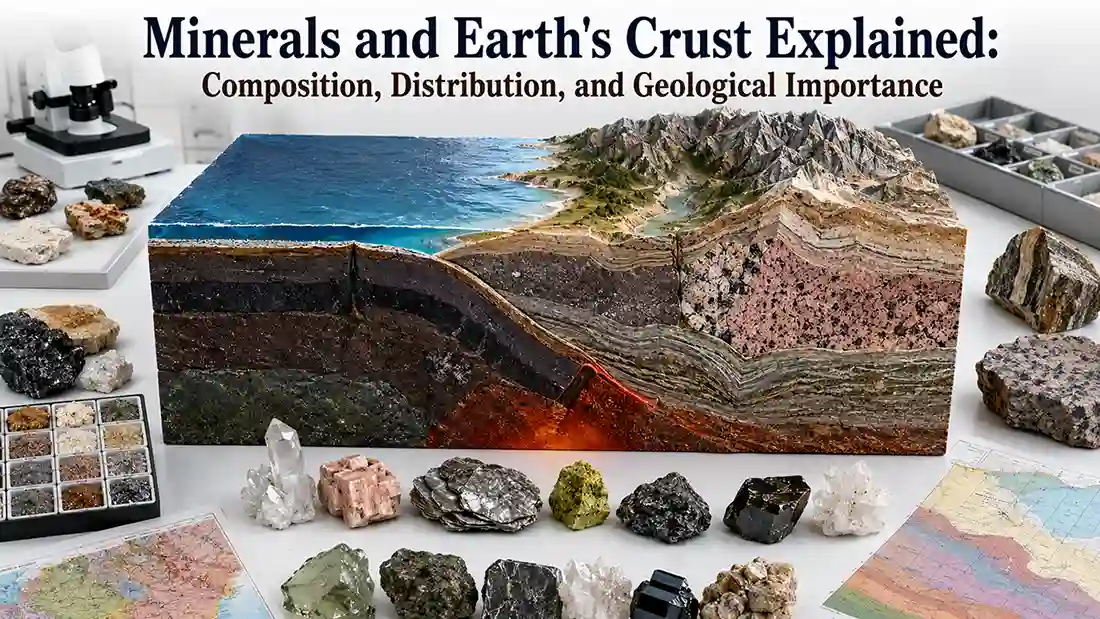
This topic should be studied together with Minerals and Earth's Crust, Oceanic Crust Minerals, and Plate Tectonics and Minerals.
What Is the Continental Crust?
The continental crust is the outer rocky layer beneath Earth's continents.
Key characteristics include:
- Thickness of approximately 30–70 km
- Lower density than oceanic crust
- Rich in silica and aluminum
- Extremely old geological history
- Dominated by granitic rocks
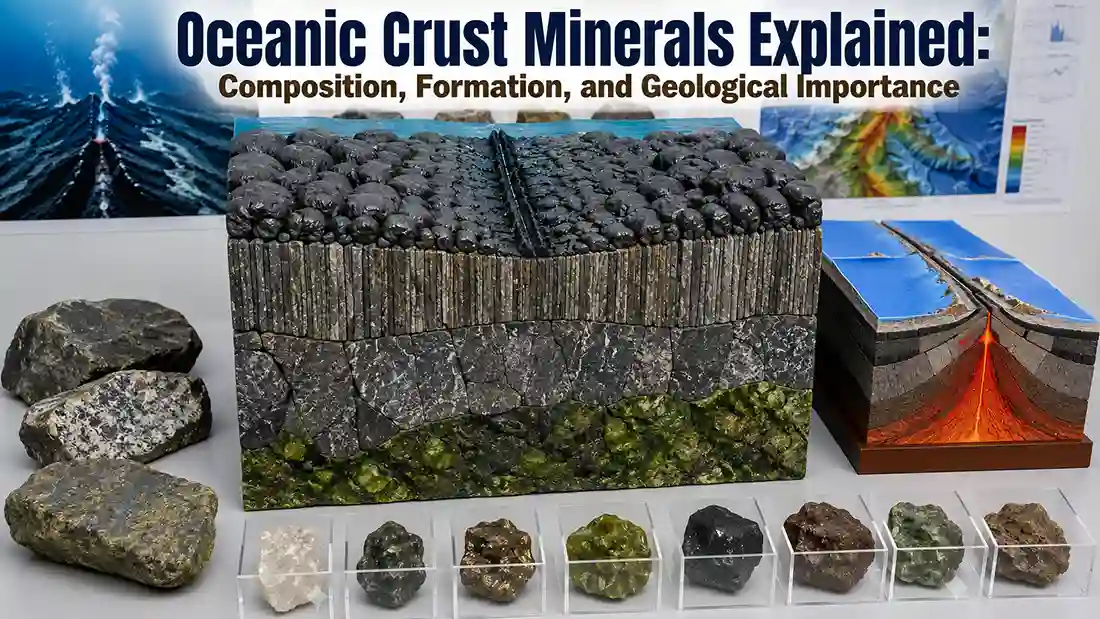
Unlike oceanic crust, continental crust is rarely recycled completely into the mantle.
Structure of the Continental Crust
The continental crust consists of several major components.
Upper Continental Crust
Dominated by:
- Granite
- Sedimentary rocks
- Metamorphic rocks
Contains abundant silica-rich minerals.
Middle Continental Crust
Contains:
- Dioritic rocks
- Gneiss
- Amphibolite
Represents transitional compositions.
Lower Continental Crust
Dominated by:
- Granulite
- Mafic gneiss
- Amphibolite
Contains higher-pressure mineral assemblages.
How Continental Crust Forms
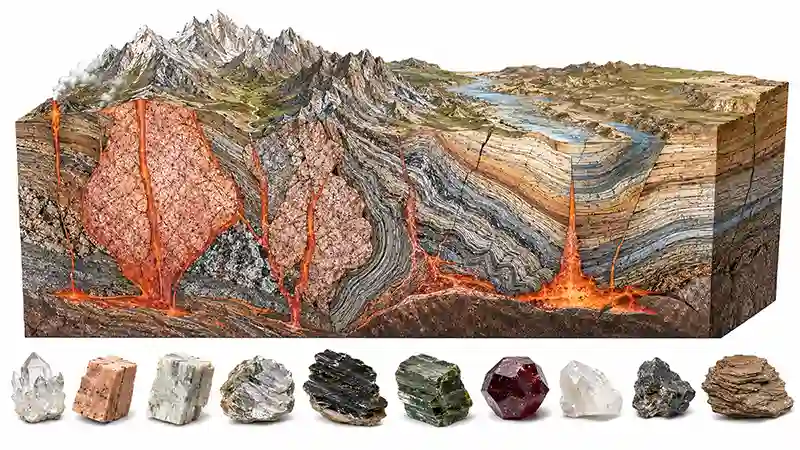
Continental crust develops through multiple geological processes.
These include:
- Partial melting of mantle-derived rocks
- Magma differentiation
- Volcanic arc formation
- Continental collision
- Metamorphism
- Sediment accumulation
- Crustal recycling
These processes gradually build continents over billions of years.
Major Minerals in Continental Crust
Quartz
Quartz is one of the most abundant continental minerals.
Characteristics:
- Hardness 7
- No cleavage
- High chemical stability
- Resistant to weathering
Common rocks:
- Granite
- Quartzite
- Sandstone
Potassium Feldspar
Potassium feldspar dominates felsic continental rocks.
Characteristics:
- Pink, white, or cream
- Two cleavages
- Hardness 6
Common rocks:
- Granite
- Pegmatite
Plagioclase Feldspar
Plagioclase occurs throughout the continental crust.
Characteristics:
- White to gray
- Two cleavages
- Common in both felsic and intermediate rocks
Common rocks:
- Granite
- Diorite
- Gneiss
Muscovite
Muscovite is a light-colored mica.
Characteristics:
- Silvery appearance
- Perfect basal cleavage
- Flexible sheets
Common rocks:
- Granite
- Schist
- Pegmatite
Biotite
Biotite is the most common dark mica.
Characteristics:
- Brown to black
- Perfect cleavage
- Iron and magnesium rich
Common rocks:
- Granite
- Gneiss
- Diorite
Amphibole
Amphibole occurs in intermediate igneous and metamorphic rocks.
Characteristics:
- Dark green to black
- Cleavage at approximately 60° and 120°
Common rocks:
- Diorite
- Amphibolite
Garnet
Garnet commonly forms during regional metamorphism.
Common rocks:
- Schist
- Gneiss
- Amphibolite
It is an important metamorphic index mineral.
Calcite
Calcite dominates carbonate rocks.
Common rocks:
- Limestone
- Marble
Calcite also occurs as a cement in sedimentary rocks.
Magnetite
Magnetite is a widespread accessory mineral.
Characteristics:
- Black
- Magnetic
- Iron oxide
Occurs in many igneous and metamorphic rocks.
Clay Minerals
Clay minerals form through weathering of feldspar-rich rocks.
Examples:
- Kaolinite
- Illite
- Smectite
They dominate soils and shale.
Accessory Minerals
Important accessory minerals include:
- Zircon
- Apatite
- Tourmaline
- Monazite
- Rutile
- Titanite
- Allanite
Although present in small amounts, these minerals provide valuable information about crustal evolution and geologic age.
Common Continental Crust Rocks
| Rock Type | Major Minerals |
|---|---|
| Granite | Quartz, Potassium Feldspar, Plagioclase, Biotite |
| Diorite | Plagioclase, Amphibole, Biotite |
| Gneiss | Quartz, Feldspar, Biotite, Garnet |
| Schist | Mica, Garnet, Quartz |
| Sandstone | Quartz |
| Limestone | Calcite |
| Shale | Clay Minerals |
| Pegmatite | Quartz, Feldspar, Muscovite |
Continental Crust and Plate Tectonics
Plate tectonics continually modifies continental crust.
Major tectonic processes include:
- Continental collision
- Mountain building
- Subduction-related magmatism
- Rift formation
- Metamorphism
These processes create new minerals while recycling older crust.
Economic Importance
Continental crust contains most of Earth's economically valuable mineral deposits.
Examples include:
- Gold
- Copper
- Iron
- Tin
- Tungsten
- Uranium
- Lithium
- Rare Earth Elements
- Gemstones
Most major mining operations are located within continental crust.
Laboratory Identification
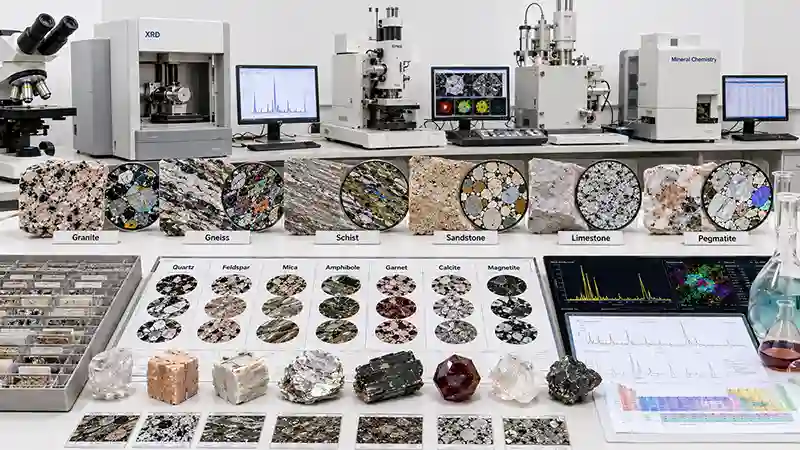
Continental crust minerals are studied using:
- Hand specimen identification
- Petrographic Microscopy
- X-Ray Diffraction (XRD)
- Electron Microprobe Analysis (EPMA)
- Scanning Electron Microscopy (SEM)
- Raman Spectroscopy
- Mineral Chemistry Analysis
These methods determine mineral composition, crystal structure, and geological history.
Importance of Continental Crust Minerals
Studying continental crust minerals helps geologists:
- Understand continental evolution
- Reconstruct tectonic history
- Interpret mountain-building events
- Explore mineral resources
- Investigate weathering processes
- Study ancient geological environments
These minerals preserve the longest geological record on Earth.
Applications
Continental crust mineral studies are important in:
- Mineralogy
- Petrology
- Economic geology
- Structural geology
- Engineering geology
- Environmental geology
- Geochemistry
- Geochronology
Advantages of Studying Continental Crust Minerals
Studying continental minerals allows scientists to:
- Understand Earth's evolution
- Identify economically important mineral deposits
- Interpret crustal deformation
- Improve geological mapping
- Reconstruct ancient continents
- Investigate crustal growth
Limitations
Interpreting continental crust minerals may be challenging because:
- Rocks often record multiple tectonic events.
- Weathering alters primary minerals.
- Metamorphism recrystallizes older minerals.
- Hydrothermal alteration may replace original mineral assemblages.
For comprehensive interpretation, combine continental crust studies with:
- Minerals and Earth's Crust
- Oceanic Crust Minerals
- Mantle Minerals
- Plate Tectonics and Minerals
- Minerals in Igneous Rocks
- Minerals in Metamorphic Rocks
- Petrographic Microscopy
- Mineral Chemistry Analysis
Comparison Table
| Continental Crust Zone | Dominant Rocks | Major Minerals |
| Upper Crust | Granite, Sedimentary Rocks | Quartz, Feldspar, Mica |
| Middle Crust | Diorite, Gneiss | Feldspar, Amphibole, Quartz |
| Lower Crust | Granulite, Amphibolite | Feldspar, Pyroxene, Garnet |
Summary Table
| Feature | Continental Crust Minerals |
| Main Composition | Silica-Rich Rock-Forming Minerals |
| Dominant Minerals | Quartz, Feldspar, Mica |
| Major Rock Types | Granite, Gneiss, Schist, Sandstone |
| Common Study Methods | Petrography, XRD, EPMA, SEM |
| Geological Importance | Continental Evolution and Mineral Resources |
The most abundant minerals include quartz, potassium feldspar, plagioclase feldspar, muscovite, biotite, amphibole, garnet, calcite, magnetite, and clay minerals.
Continental crust contains a higher proportion of silica-rich minerals such as quartz and feldspar, making it less dense than the mafic oceanic crust dominated by pyroxene and olivine.
Granite is the characteristic intrusive igneous rock of the continental crust, although sedimentary and metamorphic rocks are also widespread.
Quartz is highly stable, resistant to weathering, and crystallizes from silica-rich magmas, making it abundant in granitic rocks and many sedimentary deposits.
Geologists study continental crust minerals using field mapping, petrographic microscopy, X-ray diffraction (XRD), electron microprobe analysis (EPMA), scanning electron microscopy (SEM), Raman spectroscopy, and mineral chemistry analysis.
Final Thoughts
Continental crust minerals form the foundation of Earth's continents and preserve an extraordinary record of geological history spanning billions of years. Dominated by quartz, feldspar, mica, amphibole, and garnet, these minerals document the processes of magma generation, mountain building, sedimentation, metamorphism, and plate tectonics that have shaped our planet.
By integrating field observations with petrographic microscopy, X-ray diffraction, mineral chemistry, electron microprobe analysis, and geochronology, geologists can reconstruct continental evolution, locate valuable mineral resources, and better understand Earth's dynamic crust. The study of continental crust minerals remains fundamental to mineralogy, petrology, tectonics, and economic geology.
Continue Learning
Continue exploring Earth's crust and mineralogy with these related guides: