
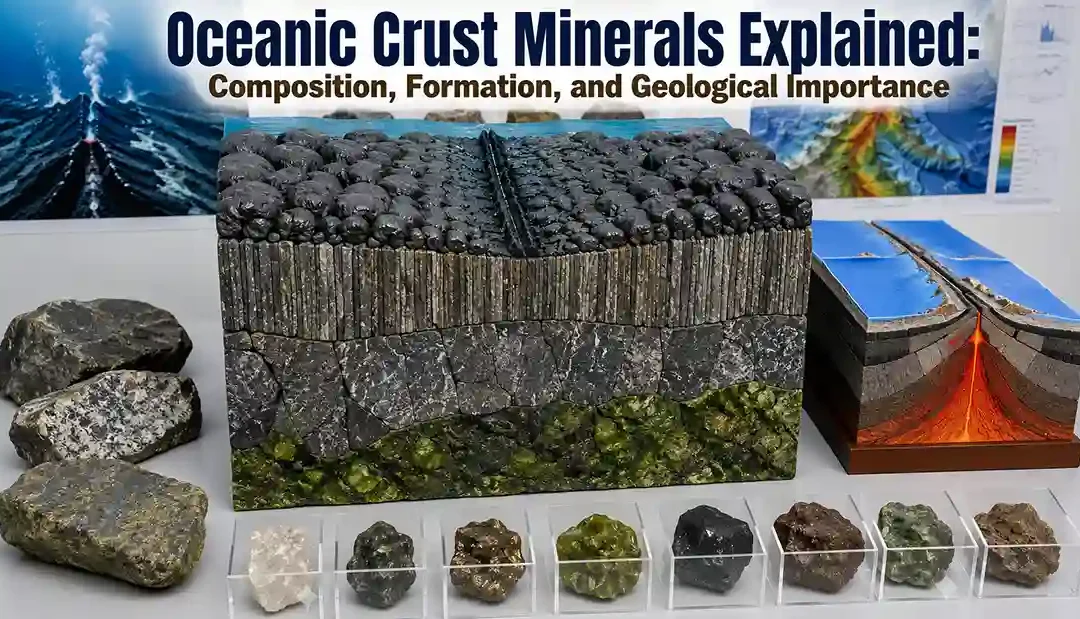
The oceanic crust is the thin, dense outer layer beneath Earth's oceans. It covers nearly 70% of Earth's surface but is only 5–10 kilometers thick, making it much thinner than the continental crust. Oceanic crust forms continuously at mid-ocean ridges, where mantle-derived magma rises, cools, and solidifies into new crust.
Oceanic crust is primarily composed of mafic igneous rocks, especially basalt and gabbro, which are rich in magnesium and iron. Its dominant minerals include plagioclase feldspar, pyroxene, olivine, magnetite, chromite, and hydrothermal alteration minerals such as serpentine and chlorite.
Studying oceanic crust minerals helps geologists understand seafloor spreading, plate tectonics, mantle melting, hydrothermal systems, and the formation of important mineral deposits.
This topic should be studied together with Mantle Minerals, Plate Tectonics and Minerals, and Minerals and Earth's Crust.
What Is the Oceanic Crust?
The oceanic crust is the outer rocky layer beneath the oceans that forms from mantle-derived basaltic magma.
Characteristics include:
- Thickness of about 5–10 km
- High density
- Mafic composition
- Young geological age
- Continuous recycling through subduction
Unlike continental crust, oceanic crust is constantly created and destroyed.
Structure of the Oceanic Crust
Oceanic crust consists of several distinct layers.
Layer 1
- Marine sediments
- Clay
- Limestone
- Siliceous ooze
Layer 2
- Pillow basalt
- Basaltic lava flows
- Sheeted dikes
Layer 3
- Gabbro
- Layered gabbro
- Cumulate rocks
Upper Mantle
Below the crust lies mantle peridotite dominated by olivine and pyroxene.
How Oceanic Crust Forms
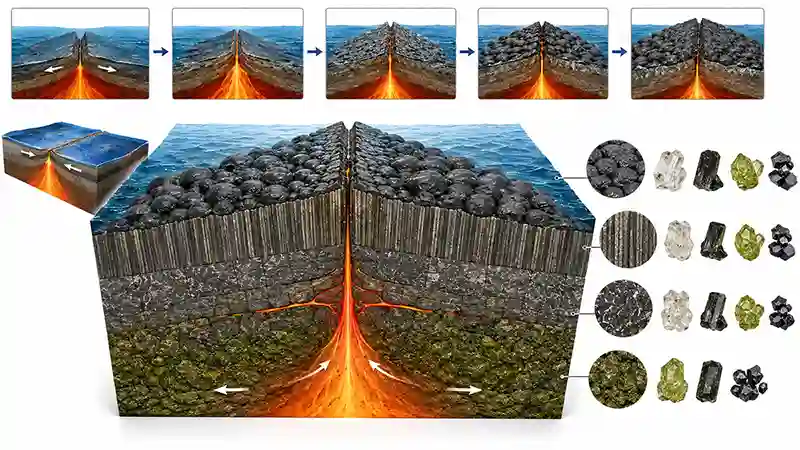
Oceanic crust develops through several stages:
- Partial melting of the upper mantle
- Basaltic magma generation
- Magma rises beneath mid-ocean ridges
- Lava erupts onto the seafloor
- Basalt cools rapidly
- Gabbro crystallizes at depth
- Hydrothermal circulation alters the crust
This process is known as seafloor spreading.
Major Minerals in Oceanic Crust
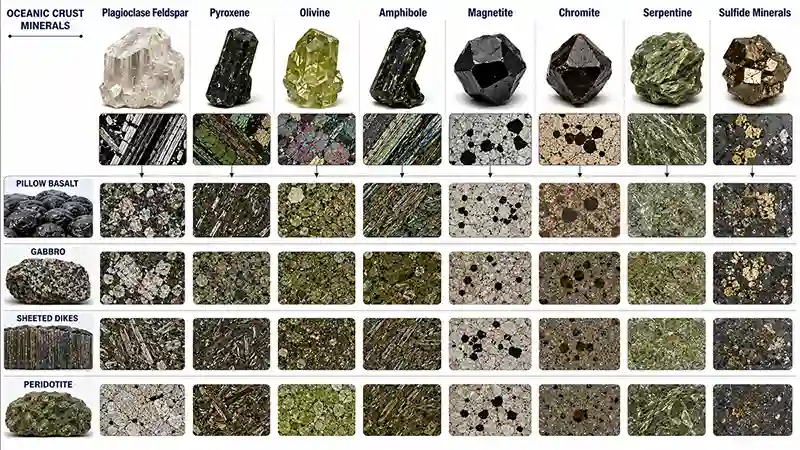
Plagioclase Feldspar
Plagioclase is the most abundant mineral in oceanic crust.
Characteristics:
- Calcium-rich composition
- White to gray color
- Two cleavages
- Hardness 6–6.5
Common rocks:
- Basalt
- Gabbro
Pyroxene
Pyroxene is one of the dominant mafic minerals.
Characteristics:
- Dark green to black
- High iron and magnesium
- Two cleavages near 90°
Common rocks:
- Basalt
- Gabbro
Olivine
Olivine forms from high-temperature mantle-derived magma.
Characteristics:
- Olive green
- Magnesium-rich
- High density
Common rocks:
- Basalt
- Peridotite
Magnetite
Magnetite commonly occurs as an accessory mineral.
Characteristics:
- Black
- Strongly magnetic
- Iron oxide
Magnetite helps record ancient magnetic fields preserved in oceanic crust.
Chromite
Chromite occurs in ultramafic rocks associated with the lower crust and upper mantle.
Characteristics:
- Black
- Chromium-rich
- Dense
It is the principal ore mineral of chromium.
Amphibole
Amphibole develops during hydrothermal alteration.
Common rocks:
- Altered basalt
- Amphibolite
Serpentine
Serpentine forms when olivine reacts with water.
This process, known as serpentinization, is common in the lower oceanic crust and upper mantle.
Sulfide Minerals
Hydrothermal systems commonly produce:
- Pyrite
- Chalcopyrite
- Sphalerite
- Pyrrhotite
These minerals are important components of volcanogenic massive sulfide (VMS) deposits.
Accessory Minerals
Minor minerals include:
- Ilmenite
- Rutile
- Zircon
- Apatite
- Titanite
Although less abundant, they provide valuable geochemical information.
Common Oceanic Crust Rocks
| Rock Type | Major Minerals |
|---|---|
| Basalt | Plagioclase, Pyroxene, Olivine |
| Gabbro | Plagioclase, Pyroxene |
| Peridotite | Olivine, Pyroxene |
| Troctolite | Olivine, Plagioclase |
| Serpentinite | Serpentine |
These rocks form the characteristic structure of the oceanic lithosphere.
Hydrothermal Alteration of Oceanic Crust
Seawater circulates through fractures in newly formed oceanic crust.
This produces alteration minerals such as:
- Chlorite
- Epidote
- Serpentine
- Actinolite
- Zeolite
- Calcite
Hydrothermal alteration changes both mineral composition and rock chemistry.
Oceanic Crust and Plate Tectonics
Oceanic crust plays a major role in plate tectonics.
It is:
- Created at divergent plate boundaries
- Transported across ocean basins
- Recycled at subduction zones
These processes influence global volcanism, earthquakes, and mantle convection.
Economic Importance
Oceanic crust hosts valuable mineral resources.
Examples include:
- Volcanogenic Massive Sulfide (VMS) deposits
- Seafloor massive sulfides
- Manganese nodules
- Cobalt-rich crusts
- Chromite deposits
These resources are increasingly important for modern technology.
Laboratory Identification
Oceanic crust minerals are studied using:
- Petrographic Microscopy
- X-Ray Diffraction (XRD)
- Electron Microprobe Analysis (EPMA)
- Scanning Electron Microscopy (SEM)
- ICP-MS
- Geochemical analysis
These techniques reveal mineral composition, texture, and crystallization history.
Importance of Oceanic Crust Minerals
Studying oceanic crust minerals helps geologists:
- Understand mantle melting
- Explain seafloor spreading
- Reconstruct plate movements
- Investigate hydrothermal systems
- Locate marine mineral resources
- Interpret Earth's magnetic history
These minerals provide critical evidence of Earth's dynamic geological processes.
Applications
Oceanic crust mineral studies are important in:
- Marine geology
- Mineralogy
- Igneous petrology
- Plate tectonics
- Economic geology
- Geophysics
- Oceanography
- Planetary geology
Advantages of Studying Oceanic Crust Minerals
Studying oceanic crust minerals allows scientists to:
- Understand ocean basin evolution
- Reconstruct mantle processes
- Explore marine mineral resources
- Interpret hydrothermal alteration
- Study magnetic reversals
- Improve tectonic models
Limitations
Oceanic crust is difficult to study because:
- Most of it lies beneath deep oceans.
- Direct drilling reaches only limited depths.
- Hydrothermal alteration may modify primary minerals.
- Sampling often relies on ocean drilling, dredging, and ophiolite complexes exposed on land.
For comprehensive interpretation, combine oceanic crust studies with:
- Mantle Minerals
- Minerals and Earth's Crust
- Plate Tectonics and Minerals
- Hydrothermal Minerals
- Volcanic Minerals
- Petrographic Microscopy
- Mineral Chemistry Analysis
Comparison Table
| Oceanic Crust Layer | Dominant Rocks | Major Minerals |
| Sedimentary Cover | Marine Sediments | Clay Minerals, Calcite |
| Upper Crust | Basalt | Plagioclase, Pyroxene, Olivine |
| Lower Crust | Gabbro | Plagioclase, Pyroxene |
| Upper Mantle | Peridotite | Olivine, Pyroxene, Chromite |
Summary Table
| Feature | Oceanic Crust Minerals |
| Main Composition | Mafic Silicate Minerals |
| Dominant Minerals | Plagioclase, Pyroxene, Olivine |
| Major Rock Types | Basalt, Gabbro, Peridotite |
| Common Study Methods | Petrography, XRD, EPMA, SEM |
| Geological Importance | Seafloor Spreading and Plate Tectonics |
The most common minerals are calcium-rich plagioclase feldspar, pyroxene, olivine, magnetite, and smaller amounts of chromite, amphibole, and sulfide minerals.
Oceanic crust is composed mainly of mafic rocks such as basalt and gabbro, which contain dense iron- and magnesium-rich minerals like pyroxene and olivine.
Hot seawater reacts with basalt and peridotite, producing alteration minerals such as serpentine, chlorite, epidote, and actinolite while changing the chemistry of the crust.
Serpentinization is the process in which olivine and pyroxene react with water to form serpentine minerals, commonly occurring in the lower oceanic crust and upper mantle.
Scientists study oceanic crust minerals using ocean drilling, ophiolite complexes, petrographic microscopy, X-ray diffraction (XRD), electron microprobe analysis (EPMA), scanning electron microscopy (SEM), and geochemical analysis.
Final Thoughts
Oceanic crust minerals provide valuable insights into the formation of Earth's ocean basins, mantle melting, hydrothermal activity, and plate tectonics. Dominated by plagioclase feldspar, pyroxene, and olivine, the oceanic crust records the continuous creation and recycling of Earth's lithosphere through seafloor spreading and subduction.
By combining field studies of ophiolites with ocean drilling, petrographic microscopy, mineral chemistry, X-ray diffraction, and geophysical investigations, geologists can better understand the structure and evolution of Earth's interior and locate important marine mineral resources. Oceanic crust minerals remain a key focus of modern geology, marine science, and mineral exploration.
Continue Learning
Continue exploring Earth's interior and tectonic processes with these related guides: