
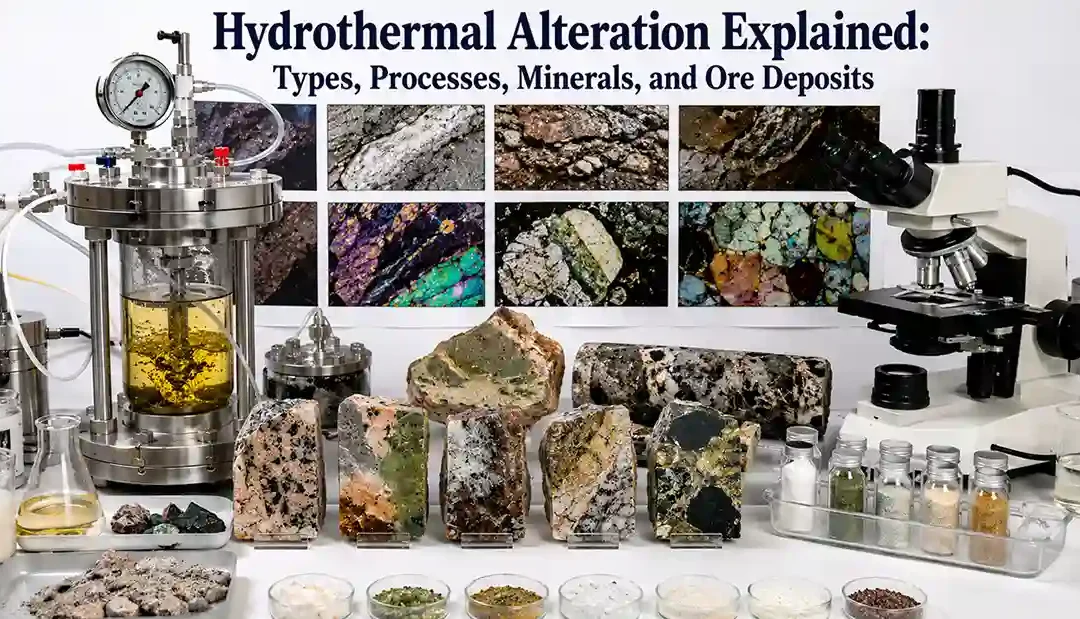
Hydrothermal alteration is the chemical and mineralogical transformation of rocks and minerals caused by hot, chemically active fluids circulating through Earth's crust. These fluids dissolve, transport, and redeposit chemical elements while reacting with existing minerals, producing new alteration minerals that are stable under changing temperature, pressure, and fluid conditions.
Hydrothermal alteration is one of the most important geological processes because it controls the formation of many valuable ore deposits, including copper, gold, molybdenum, silver, lead, zinc, and tin deposits. It also provides evidence of past fluid circulation, volcanic activity, and geothermal systems.
Geologists use hydrothermal alteration minerals and alteration zones to locate mineral deposits, reconstruct geological histories, and understand fluid-rock interactions.
This topic should be studied together with Mineral Alteration Processes, Mineral Chemistry Analysis, and Economic Geology Explained.
What Is Hydrothermal Alteration?
Hydrothermal alteration is the process in which hot, mineral-rich fluids chemically react with rocks and minerals, replacing original minerals with new alteration minerals.
During hydrothermal alteration:
- Hot fluids move through fractures.
- Chemical elements dissolve.
- Minerals become unstable.
- New minerals crystallize.
- Rock chemistry changes.
The original rock may remain recognizable while its mineral composition changes significantly.
What Are Hydrothermal Fluids?
Hydrothermal fluids are hot aqueous solutions that circulate through Earth's crust.
They commonly contain:
- Water (H₂O)
- Dissolved silica
- Sodium
- Potassium
- Calcium
- Iron
- Magnesium
- Sulfur
- Carbon dioxide
- Chlorine
These fluids originate from:
- Cooling magma
- Heated groundwater
- Metamorphic reactions
- Deep crustal fluids
Why Does Hydrothermal Alteration Occur?
Hydrothermal alteration occurs because minerals formed under one set of conditions become unstable when exposed to hot circulating fluids.
The alteration process is controlled by:
- Temperature
- Pressure
- Fluid chemistry
- Rock composition
- Fluid-to-rock ratio
- Duration of fluid circulation
Different conditions produce different alteration minerals.
Major Hydrothermal Alteration Types
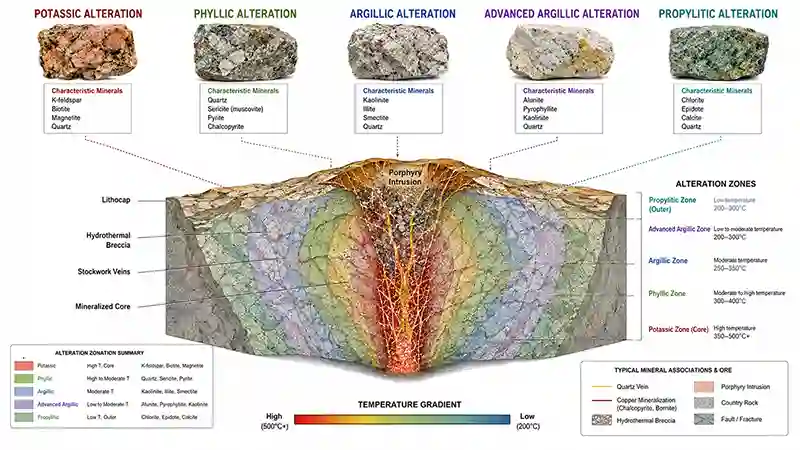
Several alteration styles are recognized in economic geology.
Potassic Alteration
Potassic alteration develops at high temperatures close to intrusive bodies.
Common minerals include:
- Potassium feldspar
- Biotite
- Magnetite
This alteration is typical of porphyry copper systems.
Phyllic Alteration
Phyllic alteration forms at moderate temperatures.
Characteristic minerals include:
- Sericite
- Quartz
- Pyrite
It commonly surrounds potassic alteration zones.
Argillic Alteration
Argillic alteration produces abundant clay minerals.
Common minerals include:
- Kaolinite
- Illite
- Smectite
This alteration is common in weathered and hydrothermal environments.
Advanced Argillic Alteration
Advanced argillic alteration develops in highly acidic hydrothermal systems.
Typical minerals include:
- Alunite
- Pyrophyllite
- Dickite
- Kaolinite
It is often associated with high-sulfidation gold deposits.
Propylitic Alteration
Propylitic alteration occurs in the outer parts of hydrothermal systems.
Common minerals include:
- Chlorite
- Epidote
- Calcite
- Albite
It represents relatively low-temperature fluid-rock interaction.
Common Hydrothermal Alteration Minerals
| Original Mineral | Alteration Mineral |
|---|---|
| Feldspar | Sericite, Kaolinite |
| Olivine | Serpentine |
| Pyroxene | Chlorite |
| Amphibole | Chlorite, Epidote |
| Biotite | Chlorite |
| Volcanic Glass | Clay Minerals |
| Calcite | Silica or Recrystallized Calcite |
These transformations indicate the temperature and chemistry of hydrothermal fluids.
Factors Affecting Hydrothermal Alteration
Several variables influence alteration.
Temperature
Higher temperatures generally produce:
- Potassic alteration
- Biotite
- Potassium feldspar
Lower temperatures favor:
- Chlorite
- Clay minerals
- Calcite
Fluid Chemistry
The acidity and composition of hydrothermal fluids determine which minerals form.
Acidic fluids commonly produce:
- Kaolinite
- Alunite
Neutral fluids commonly produce:
- Chlorite
- Epidote
Rock Composition
Different rocks respond differently.
Examples:
- Granite commonly develops sericite and potassium feldspar.
- Basalt commonly develops chlorite and epidote.
- Limestone commonly develops calc-silicate minerals.
Permeability
Highly fractured rocks allow greater fluid circulation and more extensive alteration.
Hydrothermal Alteration and Ore Deposits
Hydrothermal alteration is closely associated with many economic mineral deposits.
Examples include:
- Porphyry copper deposits
- Epithermal gold deposits
- Skarn deposits
- Greisen deposits
- Volcanogenic massive sulfide (VMS) deposits
- Mississippi Valley-Type (MVT) deposits
Recognizing alteration minerals is a key exploration tool.
Laboratory Methods
Hydrothermal alteration is studied using:
- Petrographic Microscopy
- X-Ray Diffraction (XRD)
- Electron Microprobe Analysis (EPMA)
- Scanning Electron Microscopy (SEM)
- Raman Spectroscopy
- X-Ray Fluorescence (XRF)
- ICP-MS
These methods identify alteration minerals and determine chemical changes.
Applications
Hydrothermal alteration studies are important in:
- Economic geology
- Mineral exploration
- Mining geology
- Petrology
- Geochemistry
- Geothermal exploration
- Environmental geology
- Planetary geology
Advantages of Studying Hydrothermal Alteration
Understanding hydrothermal alteration helps geologists:
- Locate concealed ore deposits
- Interpret hydrothermal systems
- Reconstruct fluid pathways
- Estimate alteration temperatures
- Understand mineral replacement
- Improve exploration efficiency
Limitations
Hydrothermal systems are often complex because multiple alteration events may overlap.
Reliable interpretation requires integrating alteration studies with:
- Mineral Alteration Processes
- Mineral Chemistry Analysis
- Petrographic Microscopy
- X-Ray Diffraction in Mineralogy
- Electron Microprobe Analysis
- Spectroscopy in Mineralogy
- Economic Geology Explained
Comparison Table
| Alteration Type | Typical Minerals | Temperature Range |
| Potassic | K-Feldspar, Biotite | High |
| Phyllic | Sericite, Quartz, Pyrite | Moderate |
| Argillic | Kaolinite, Illite | Low to Moderate |
| Advanced Argillic | Alunite, Pyrophyllite | Acidic Hydrothermal |
| Propylitic | Chlorite, Epidote, Calcite | Low |
Summary Table
| Feature | Hydrothermal Alteration |
| Main Process | Fluid-Rock Chemical Reaction |
| Main Agents | Hot Hydrothermal Fluids |
| Major Products | Sericite, Chlorite, Epidote, Kaolinite |
| Common Study Methods | XRD, EPMA, SEM, Petrography |
| Geological Importance | Ore Deposits and Fluid Evolution |
Hydrothermal alteration is the chemical transformation of rocks and minerals caused by hot, mineral-rich fluids circulating through Earth's crust.
It is caused by hot fluids derived from magma, heated groundwater, or metamorphic processes reacting with existing minerals under elevated temperatures and pressures.
The principal types are potassic, phyllic, argillic, advanced argillic, and propylitic alteration, each characterized by specific mineral assemblages and fluid conditions.
Hydrothermal alteration commonly surrounds valuable ore deposits. Mapping alteration minerals helps geologists locate porphyry copper, epithermal gold, skarn, and other economically important mineral deposits.
Common techniques include petrographic microscopy, X-ray diffraction (XRD), electron microprobe analysis (EPMA), scanning electron microscopy (SEM), Raman spectroscopy, X-ray fluorescence (XRF), and ICP-MS.
Final Thoughts
Hydrothermal alteration is one of the most significant geological processes responsible for modifying rocks and forming many of the world's major mineral deposits. As hot fluids circulate through Earth's crust, they alter existing minerals into new mineral assemblages that preserve valuable information about fluid chemistry, temperature, pressure, and ore-forming environments.
By studying alteration minerals and alteration zones using petrography, XRD, EPMA, spectroscopy, and geochemical analyses, geologists can reconstruct hydrothermal systems, understand fluid-rock interactions, and significantly improve mineral exploration. Hydrothermal alteration remains a cornerstone of economic geology, mineralogy, and modern geological research.
Continue Learning
Expand your knowledge with these related guides: