
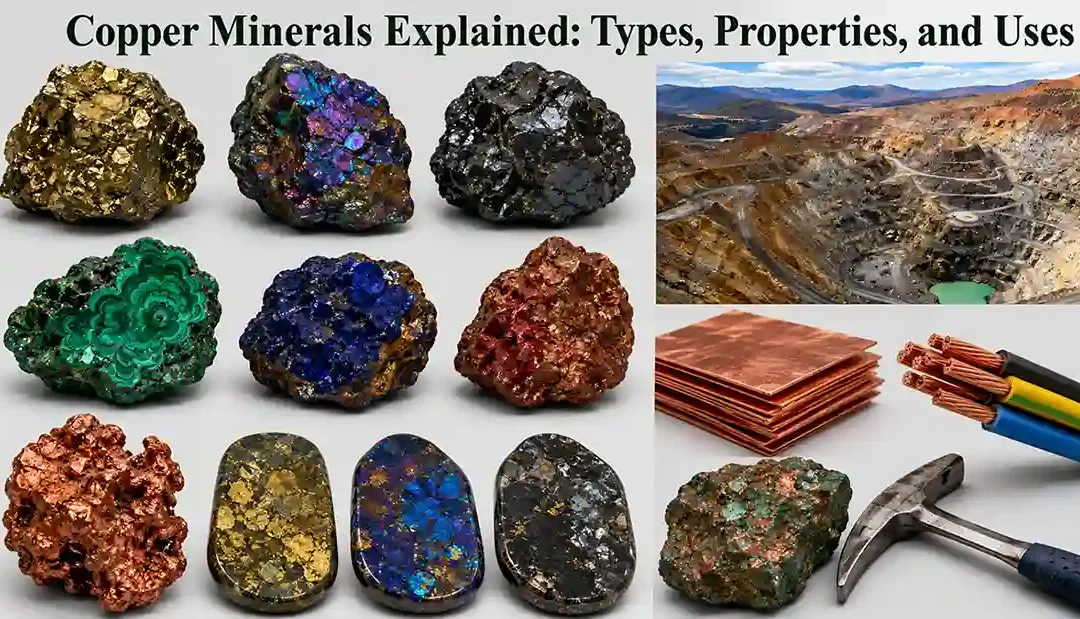
Copper minerals are among the world's most valuable mineral resources because they provide the primary source of copper, one of the most widely used industrial metals. Copper is essential for electrical wiring, renewable energy systems, electronics, plumbing, transportation, and construction.
Although more than 160 minerals contain copper, only a relatively small number occur in concentrations that can be mined economically. The most important copper ore minerals include chalcopyrite, bornite, chalcocite, malachite, azurite, cuprite, and native copper.
What Are Copper Minerals?
Copper minerals are naturally occurring minerals that contain copper in sufficient quantities for economic extraction.
They are used to produce:
- electrical copper
- copper alloys
- industrial machinery
- electronic components
- renewable energy equipment
Copper minerals are among the most important resources in economic geology.
Major Copper Ore Minerals
Chalcopyrite
The world's most important copper ore.
Chemical formula:
Copper content:
Approximately 34.5% Cu
Color:
- brass yellow
- golden yellow
Bornite
Known as "Peacock Ore."
Chemical formula:
Copper content:
Approximately 63% Cu
Color:
- bronze
- iridescent purple
- blue
Chalcocite
One of the richest copper ores.
Chemical formula:
Copper content:
Approximately 79.8% Cu
Color:
- dark gray
- black
Malachite
Secondary copper carbonate mineral.
Chemical formula:
Color:
- bright green
Azurite
Blue copper carbonate mineral.
Chemical formula:
Color:
- deep blue
Cuprite
Copper oxide mineral.
Chemical formula:
Color:
- red
- reddish brown
Native Copper
Occurs as pure metallic copper.
Chemical formula:
Color:
- copper red
- metallic
Copper Mineral Comparison
| Mineral | Formula | Approx. Copper Content | Importance |
|---|---|---|---|
| Chalcopyrite | CuFeS₂ | 34.5% | Excellent |
| Bornite | Cu₅FeS₄ | 63% | High |
| Chalcocite | Cu₂S | 79.8% | Excellent |
| Malachite | Cu₂CO₃(OH)₂ | 57.5% | Moderate |
| Azurite | Cu₃(CO₃)₂(OH)₂ | 55.3% | Moderate |
| Cuprite | Cu₂O | 88.8% | High |
| Native Copper | Cu | 100% | Localized |
Formation of Copper Deposits
Copper deposits form through several geological processes.
Porphyry Copper Deposits
The world's largest source of copper.
Hydrothermal Veins
Copper-rich fluids fill fractures.
Volcanogenic Massive Sulfide (VMS) Deposits
Copper accumulates with zinc and lead sulfides.
Sediment-Hosted Copper Deposits
Copper concentrates within sedimentary rocks.
Supergene Enrichment
Weathering produces rich secondary ores such as chalcocite and malachite.
Porphyry Copper Deposits
Porphyry deposits contain:
- chalcopyrite
- bornite
- molybdenite
- pyrite
Although ore grades are often low, their enormous size makes them economically important.
Physical Properties
| Property | Typical Value |
|---|---|
| Hardness | 2.5–4.5 |
| Luster | Metallic to Vitreous |
| Streak | Black, Green, Red (varies) |
| Specific Gravity | 3.5–6.5 |
| Crystal System | Varies |
Major Copper-Producing Countries
Important copper producers include:
- Chile
- Peru
- China
- Democratic Republic of the Congo
- United States
- Australia
- Russia
- Zambia
Famous Copper Mines
Some of the world's largest copper mines include:
- Escondida Mine
- Chuquicamata Mine
- Grasberg Mine
These operations produce millions of tonnes of copper ore annually.
Copper Mining Methods
Copper is extracted using:
- open-pit mining
- underground mining
- drilling
- blasting
- crushing
- flotation
Large porphyry deposits are generally mined by open-pit methods.
Copper Processing
After mining, copper ore undergoes:
- Crushing
- Grinding
- Froth flotation
- Smelting
- Converting
- Electrorefining
Electrorefining produces copper cathodes with purity greater than 99.99%.
Copper Extraction
The simplified smelting reaction for chalcopyrite concentrates is complex, but the final reduction step commonly produces metallic copper. The oxidation of cuprite can be represented as. Industrial extraction usually involves multiple roasting, smelting, converting, and electrorefining stages.
Uses of Copper
Copper is essential for manufacturing:
- electrical wiring
- power transmission cables
- motors
- generators
- batteries
- electric vehicles
- plumbing
- electronics
- renewable energy systems
- telecommunications equipment
Copper's excellent electrical and thermal conductivity make it indispensable in modern technology.
Copper Minerals vs Copper Ores
Not every copper-bearing mineral is mined as an ore.
A copper mineral becomes an ore when it:
- contains sufficient copper
- occurs in mineable concentrations
- can be processed economically
Economic viability depends on ore grade, deposit size, and mining costs.
Environmental Considerations
Copper mining may affect:
- landforms
- water quality
- acid mine drainage
- biodiversity
Modern operations reduce impacts through:
- tailings management
- water recycling
- mine rehabilitation
- environmental monitoring
Copper Minerals Summary
Copper remains one of the world's most important industrial metals, supporting global electrification, infrastructure, and the transition to renewable energy.
| Feature | Copper Minerals |
|---|---|
| Main Ore Minerals | Chalcopyrite, Bornite, Chalcocite, Malachite, Azurite |
| Main Metal | Copper (Cu) |
| Largest Deposit Type | Porphyry Copper |
| Main Processing Method | Flotation, Smelting & Electrorefining |
| Major Uses | Electrical, Construction, Electronics, Renewable Energy |
The most important copper ore minerals are chalcopyrite, bornite, chalcocite, malachite, azurite, cuprite, and native copper.
Native copper contains 100% copper, while among the major ore minerals, cuprite (88.8% Cu) and chalcocite (79.8% Cu) have very high copper contents.
Chalcopyrite (CuFeS₂) is the world's most important and widely mined copper ore mineral.
Copper is primarily used in electrical wiring, electronics, renewable energy systems, construction, plumbing, telecommunications, and transportation.
Chile is the world's largest producer of copper, followed by Peru, China, the Democratic Republic of the Congo, the United States, and Australia.
Final Thoughts
Copper minerals are essential to modern civilization, supplying the metal that powers electricity, communications, transportation, and renewable energy technologies. From chalcopyrite in giant porphyry deposits to the striking green malachite and deep-blue azurite formed through weathering, copper minerals display remarkable geological diversity.
Understanding their properties, formation, mining, and processing provides valuable insight into one of the world's most important mineral resources and its vital role in economic geology and sustainable technological development.
Continue learning with → /economic-geology-explained/, /mineral-resources/, /smelting-and-refining-minerals/, and /mineral-processing-basics/.