
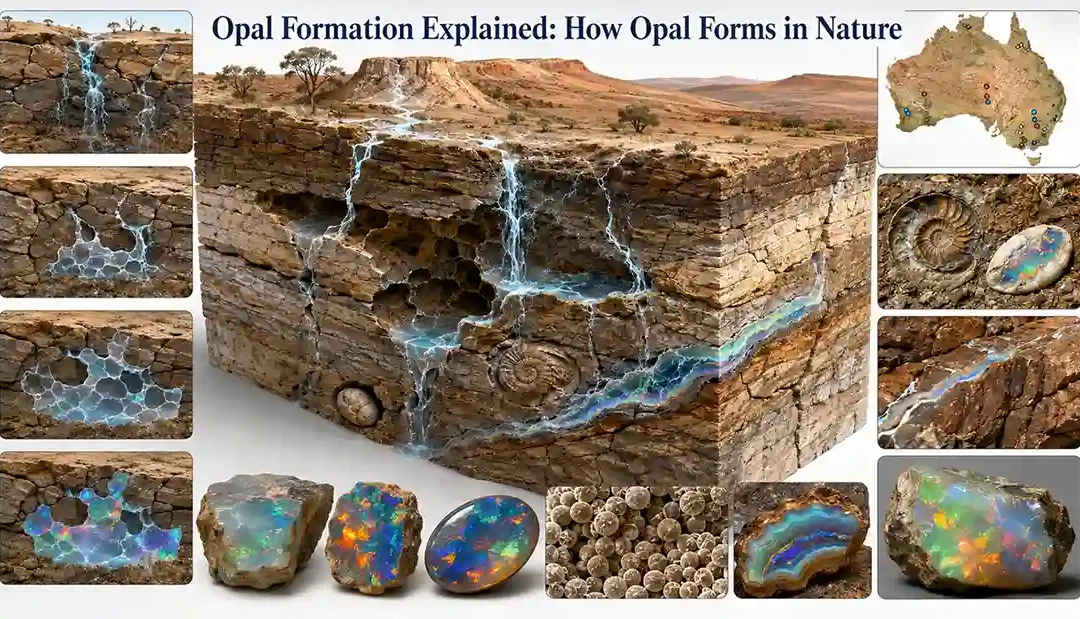
Opal is one of the most fascinating gemstones in the world because it forms differently from most minerals. Unlike crystalline gemstones such as diamond, ruby, or emerald, opal develops when silica-rich water slowly deposits microscopic silica spheres within rock cavities, fractures, and sediments.
The famous rainbow flashes seen in precious opal result from a highly organized internal structure that interacts with light.
Understanding how opal forms helps explain why high-quality precious opal is both rare and valuable.
What Is Opal?
Opal is a hydrated amorphous form of silica. Unlike quartz, opal lacks a regular crystal structure. Opal is technically classified as a mineraloid because it does not possess a true crystalline arrangement.
Chemical Formula of Opal
The approximate formula of opal is: SiO₂·nH₂O
Where:
- SiO₂ = silica
- H₂O = water
Water content commonly ranges from 5–20% by weight.
Opal Mineral Profile
| Property | Value |
|---|---|
| Classification | Mineraloid |
| Formula | SiO₂·nH₂O |
| Color | Various |
| Hardness | 5.5–6.5 |
| Crystal System | Amorphous |
| Luster | Vitreous to Waxy |
| Streak | White |
| Water Content | 5–20% |
The Main Ingredient: Silica
Silica originates from:
- weathering of rocks
- volcanic ash
- quartz-rich sediments
- groundwater interaction
When silica dissolves into water, it can later precipitate and form opal.
Step 1: Silica-Rich Water Forms
Rainwater moves through soil and rocks.
As it travels, the water dissolves small amounts of silica from:
- sandstone
- volcanic rocks
- quartz-rich sediments
This creates silica-rich groundwater, which serves as the raw material for opal formation.
Step 2: Water Enters Cavities and Fractures
Silica-rich groundwater flows into:
- rock fractures
- cavities
- fossil pores
- void spaces
These openings act as natural containers where opal can accumulate.
Step 3: Water Evaporates
As environmental conditions change:
- groundwater levels drop
- evaporation occurs
- pressure changes
The dissolved silica begins to precipitate from the solution.
Step 4: Silica Gel Develops
The precipitated silica form silica gel
This gel gradually accumulates within:
- cracks
- cavities
- sediment pores
Over thousands to millions of years, the gel hardens.
Step 5: Opal Hardens
As water is slowly lost solid opal forms
The result is:
- common opal
- precious opal
- fire opal
- boulder opal
depending on geological conditions.
Opal Formation Sequence
| Stage | Process |
|---|---|
| 1 | Silica Dissolves |
| 2 | Groundwater Transport |
| 3 | Deposition in Cavities |
| 4 | Silica Gel Formation |
| 5 | Hardening into Opal |
Why Precious Opal Shows Color
The famous rainbow flashes in precious opal are caused by silica spheres. Tiny silica spheres become arranged in regular layers. These spheres diffract light in a similar way to a diffraction grating. Different sphere sizes create different colors.
Play-of-Color Mechanism
The color effect results from:
- light diffraction
- sphere size variation
- viewing angle
- internal structure
This phenomenon is known as play-of-color and distinguishes precious opal from common opal.
Precious Opal vs Common Opal
| Feature | Precious Opal | Common Opal |
|---|---|---|
| Play-of-Color | Yes | No |
| Silica Sphere Arrangement | Ordered | Random |
| Value | Higher | Lower |
| Rarity | Rare | Common |
Formation of Boulder Opal
Boulder opal forms when silica-rich solutions fill fractures within ironstone host rocks.
Characteristics:
- thin opal seams
- ironstone backing
- vivid colors
Most famous source: Australia
Formation of Black Opal
Black opal forms in dark host rocks.
The dark background enhances:
- red flashes
- blue flashes
- green flashes
This makes black opal one of the most valuable opal varieties.
Formation of Fire Opal
Fire opal forms under volcanic conditions.
Characteristics:
- orange color
- yellow color
- red color
- transparency
Most famous sources occur in Mexico
Fossil Opal Formation
Silica-rich water can replace organic material.
Examples include:
- wood
- shells
- bones
- dinosaur remains
The original material gradually becomes opal.
Geological Environments of Opal Formation
Common environments include:
Sedimentary Basins
Most precious opal deposits.
Volcanic Regions
Common source of fire opal.
Weathering Zones
Groundwater deposition.
Fossil-Bearing Rocks
Opal replacement deposits.
Major Opal-Producing Countries
Important opal sources include:
- Australia
- Ethiopia
- Mexico
- Brazil
- United States
Australia produces most of the world's precious opal.
Famous Australian Opal Fields
Major opal mining areas include:
- Coober Pedy
- Lightning Ridge
- Andamooka
- Winton
These regions host some of the world's finest opals.
Opal Mining and Formation Examples
Geologists study these deposits to understand:
- groundwater movement
- silica deposition
- gemstone formation
- paleoenvironments
Factors Required for Opal Formation
Successful opal formation requires:
- silica source
- groundwater transport
- cavities or fractures
- long geological time
- suitable temperature and pressure conditions
Because all factors must occur together, gem-quality opal remains relatively rare.
Opal Formation Summary
| Requirement | Role |
|---|---|
| Silica | Building Material |
| Water | Transportation |
| Cavities | Deposition Site |
| Time | Crystal Growth Equivalent |
| Evaporation | Silica Precipitation |
Opal forms when silica-rich groundwater deposits silica within cavities, fractures, and pores in rocks.
The colors are produced by light diffraction from regularly arranged microscopic silica spheres.
No. Opal is classified as a mineraloid because it lacks a crystalline structure.
Most precious opal is produced in Australia.
Yes. Silica-rich water can replace original fossil material and create opalized fossils.
Final Thoughts
Opal formation is one of the most remarkable geological processes in the mineral world. Through the slow movement of silica-rich groundwater and the gradual deposition of silica over millions of years, nature creates gemstones capable of displaying extraordinary flashes of color.
From precious black opals and fire opals to opalized fossils and boulder opals, the diversity of opal deposits reflects the complex interaction of water, silica, and geological time. Understanding opal formation provides valuable insight into both gemstone geology and Earth's dynamic mineral-forming processes.
Continue learning with → /opal-mineral-explained/, and /spinel-minerals-explained/