
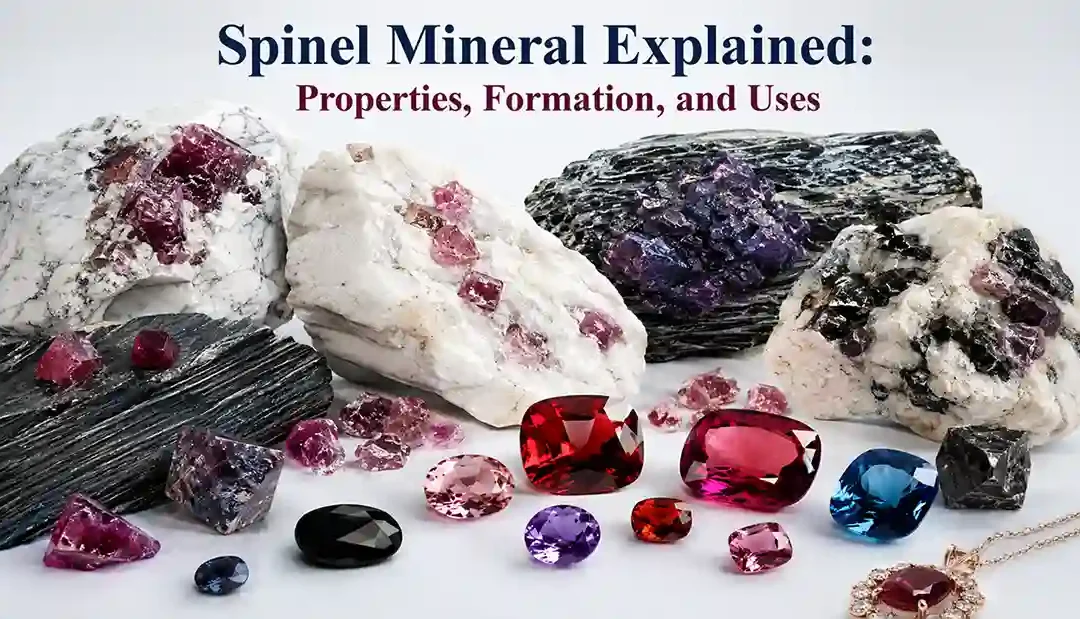
Spinel is one of the world's most underrated gemstones. For centuries, many famous red spinels were mistaken for rubies because of their similar appearance. Today, spinel is recognized as a valuable gemstone in its own right, admired for its brilliant colors, exceptional clarity, and durability.
Spinel occurs naturally in a wide range of colors, including:
- red
- pink
- blue
- violet
- orange
- black
Because of its beauty and rarity, fine spinel is highly sought after by collectors and jewelry enthusiasts.
What Is Spinel?
Spinel is a gemstone and mineral composed primarily of magnesium aluminum oxide.
It is valued for:
- vibrant colors
- high brilliance
- excellent transparency
- durability
- rarity
Unlike many gemstones, spinel's colors are usually natural and rarely require treatment.
Spinel Mineral Profile
| Property | Value |
|---|---|
| Mineral Group | Spinel |
| Chemical Formula | MgAl₂O₄ |
| Color | Red, Pink, Blue, Purple, Black |
| Hardness | 8 |
| Crystal System | Isometric (Cubic) |
| Luster | Vitreous |
| Streak | White |
| Specific Gravity | 3.5–4.1 |
Why Is Spinel Colored?
The color of spinel is caused by trace elements.
Chromium
Produces red and pink colors.
Iron
Creates blue and black varieties.
Cobalt
Produces vivid blue spinel.
Manganese
Can create orange and pink tones.
Different trace elements create the impressive range of spinel colors.
Crystal Structure
Spinel crystallizes in the:
Isometric (Cubic) Crystal System
Characteristics include:
- octahedral crystals
- cubic symmetry
- sharp crystal faces
- excellent crystal development
Learn more → isometric-cubic-crystal-system
Physical Properties
Luster
Vitreous (glass-like).
Transparency
Transparent to opaque.
Cleavage
None.
Fracture
Conchoidal to uneven.
The absence of cleavage contributes to spinel's durability.
Formation of Spinel
Spinel forms in several geological environments.
Metamorphic Rocks
Especially marble deposits.
Igneous Rocks
In mafic and ultramafic rocks.
Alluvial Deposits
Weathered crystals accumulate in river gravels.
Many gem-quality spinels originate from metamorphic marble-hosted deposits.
Major Sources of Spinel
Important spinel-producing regions include:
- Myanmar
- Sri Lanka
- Tanzania
- Vietnam
- Tajikistan
- Madagascar
Myanmar is particularly famous for producing exceptional red spinel.
Spinel vs Ruby
A Historic Confusion for centuries, red spinel was mistaken for ruby. Many famous "rubies" in royal collections were later identified as spinel.
| Property | Spinel | Ruby |
|---|---|---|
| Mineral Group | Spinel | Corundum |
| Formula | MgAl₂O₄ | Al₂O₃ |
| Hardness | 8 | 9 |
| Crystal System | Cubic | Trigonal |
| Cleavage | None | None |
Despite their similarities, spinel and ruby are different minerals.
Famous Historic Spinels
Several famous gemstones once thought to be rubies are actually spinels.
Examples include:
- Black Prince's Ruby
- Timur Ruby
These gemstones are among the most famous spinels in history.
Major Spinel Colors
Red Spinel
Most valuable and ruby-like.
Pink Spinel
Popular in jewelry.
Blue Spinel
Rare and highly prized.
Violet Spinel
Attractive collector gemstone.
Black Spinel
Common in fashion jewelry.
Blue Spinel
Blue spinel is often colored by:
- cobalt
- iron
Fine cobalt-blue spinels are among the most valuable spinels in the world.
Spinel in Jewelry
Spinel is widely used in:
- rings
- earrings
- necklaces
- bracelets
- collector jewelry
Its hardness and durability make it suitable for everyday wear.
Factors Affecting Spinel Value
Color
Most important factor.
Clarity
Eye-clean stones command premium prices.
Size
Large gemstones are rare.
Origin
Certain localities are highly prized.
Saturation
Vivid colors are more valuable.
Why Spinel Is Valuable
Spinel has gained popularity because:
- natural colors
- rarity
- excellent durability
- increasing collector demand
- affordability compared to ruby
Many gem experts believe spinel remains undervalued relative to its rarity.
Spinel Mining and Gemstones
Gem-quality spinels are commonly recovered from:
- marble-hosted deposits
- alluvial gemstone gravels
- metamorphic terrains
Mining often occurs alongside ruby-producing regions.
Spinel as a Birthstone
Spinel is recognized as a modern birthstone for August. It was officially added to the birthstone list in 2016.
Spinel Identification Summary
| Property | Spinel |
|---|---|
| Formula | MgAl₂O₄ |
| Hardness | 8 |
| Crystal System | Isometric |
| Cleavage | None |
| Streak | White |
| Luster | Vitreous |
| Common Colors | Red, Pink, Blue, Violet |
Spinel is a magnesium aluminum oxide mineral with the formula MgAl₂O₄.
Yes. Fine-quality spinel is considered a highly valuable gemstone because of its rarity and beauty.
Red spinel closely resembles ruby in color and appearance, leading to centuries of confusion.
Spinel has a hardness of approximately 8 on the Mohs scale.
Major sources include Myanmar, Sri Lanka, Tanzania, Vietnam, Tajikistan, and Madagascar.
Final Thoughts
Spinel is one of the most beautiful and historically significant gemstones in the mineral kingdom. Its brilliant colors, excellent durability, and fascinating history make it a favorite among collectors and jewelry enthusiasts alike.
From famous royal jewels once mistaken for rubies to modern gemstone collections, spinel continues to gain recognition as one of the world's finest natural gemstones. Its combination of rarity, natural beauty, and outstanding gemological properties ensures its place among the most remarkable mineral treasures on Earth.
Continue learning with → /ruby-mineral-explained/, /corundum-mineral-explained/, and /isometric-cubic-crystal-system/.