
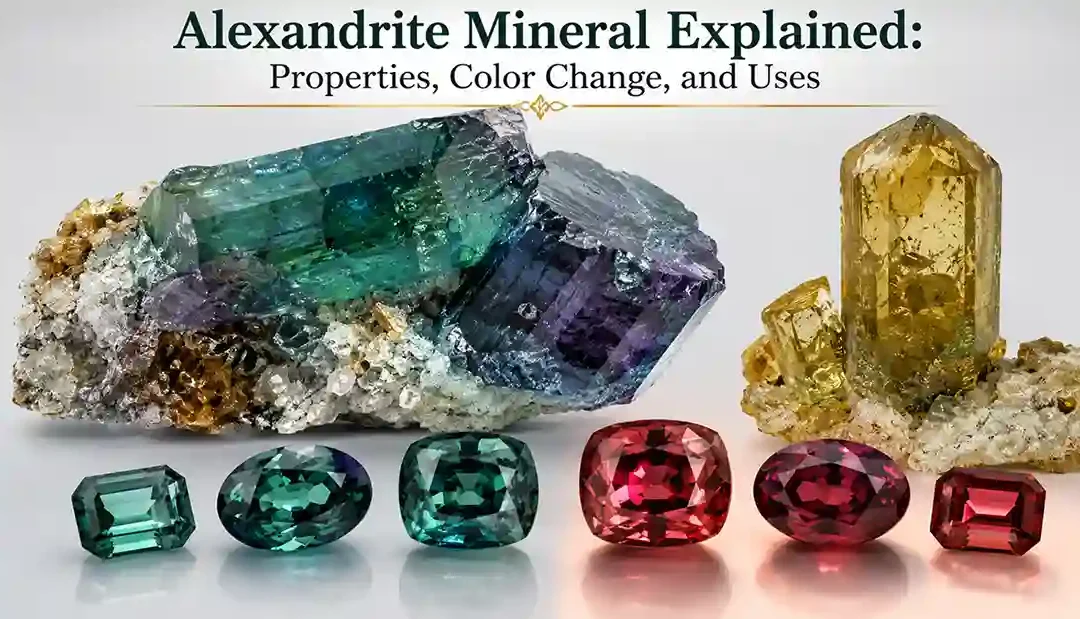
Alexandrite is one of the rarest and most valuable gemstones in the world. It is famous for its remarkable ability to change color depending on the lighting conditions.
In daylight, alexandrite typically appears green to bluish-green, while under incandescent light it changes to red, purplish-red, or raspberry red.
This extraordinary optical phenomenon has earned alexandrite the nickname:
"Emerald by day, Ruby by night."
Because of its rarity, beauty, and unique color-changing properties, alexandrite is considered one of the world's most prized gemstones.
What Is Alexandrite?
Alexandrite is the color-changing variety of the mineral chrysoberyl.
Its distinctive color change results from trace amounts of chromium within the crystal structure.
Alexandrite is prized for:
- dramatic color change
- exceptional rarity
- high durability
- gemstone brilliance
- collector value
Alexandrite Mineral Profile
| Property | Value |
|---|---|
| Mineral Group | Chrysoberyl |
| Chemical Formula | BeAl₂O₄ |
| Color | Green to Red |
| Hardness | 8.5 |
| Crystal System | Orthorhombic |
| Luster | Vitreous |
| Streak | White |
| Specific Gravity | 3.5–3.8 |
Discovery of Alexandrite
Alexandrite was first discovered in the 1830s in the Ural Mountains of Russia. The gemstone was named after Alexander II, who later became the Emperor of Russia.
Because its green and red colors matched the military colors of Imperial Russia, the gemstone quickly gained popularity.
The Famous Color Change Effect
Alexandrite exhibits one of the strongest color-change effects found in nature.
Typical appearance:
Daylight
- green
- bluish green
- emerald green
Incandescent Light
- red
- purplish red
- raspberry red
The stronger the color change, the more valuable the gemstone.
Why Does Alexandrite Change Color?
The color change occurs because chromium ions absorb different wavelengths of light.
The gemstone selectively transmits:
- green wavelengths in daylight
- red wavelengths under warm artificial light
This optical phenomenon makes alexandrite unique among gemstones.
Crystal Structure
Alexandrite crystallizes in the Orthorhombic Crystal System,
Characteristics include:
- tabular crystals
- prismatic forms
- excellent crystal development
Learn more → orthorhombic-crystal-system
Physical Properties
Hardness
Luster
Vitreous.
Cleavage
Poor to indistinct.
Transparency
Transparent to translucent.
Fracture
Conchoidal to uneven.
Its high hardness makes alexandrite suitable for jewelry.
Formation of Alexandrite
Alexandrite forms under rare geological conditions requiring:
Beryllium
Essential component of chrysoberyl.
Chromium
Creates the color-change effect.
Aluminum-Rich Rocks
Source of aluminum.
Because beryllium and chromium rarely occur together, alexandrite is exceptionally rare.
Major Alexandrite Sources
Important sources include:
- Russia
- Brazil
- Sri Lanka
- India
- Tanzania
- Zimbabwe
Modern production comes primarily from Brazil, Sri Lanka, and East Africa.
Alexandrite vs Emerald
| Property | Alexandrite | Emerald |
|---|---|---|
| Mineral Group | Chrysoberyl | Beryl |
| Hardness | 8.5 | 7.5–8 |
| Color Change | Yes | No |
| Main Color | Green to Red | Green |
| Rarity | Extremely Rare | Rare |
Alexandrite is significantly rarer than most emeralds.
Alexandrite vs Sapphire
| Property | Alexandrite | Sapphire |
|---|---|---|
| Color Change | Strong | Rare |
| Hardness | 8.5 | 9 |
| Crystal System | Orthorhombic | Trigonal |
| Mineral Group | Chrysoberyl | Corundum |
Cat's Eye Alexandrite
Some alexandrite specimens display chatoyancy. A bright moving band of light is known as the cat's eye effect.
This occurs when:
- microscopic inclusions
- parallel mineral fibers
reflect light in a concentrated line. Cat's eye alexandrite is extremely rare and valuable.
Alexandrite in Jewelry
Popular jewelry uses include:
- engagement rings
- luxury rings
- pendants
- earrings
- collector pieces
Because of its durability and rarity, alexandrite is highly sought after by gemstone collectors.
Factors Affecting Alexandrite Value
Color Change Strength
Most important factor.
Color Quality
Vivid green and red colors are preferred.
Clarity
Higher transparency increases value.
Size
Large stones are extremely rare.
Origin
Historic Russian stones command premium prices.
Why Alexandrite Is So Rare
Alexandrite requires the simultaneous presence of:
- beryllium
- chromium
- suitable geological conditions
This unusual combination rarely occurs in nature.
As a result, fine alexandrite is often considered one of the rarest colored gemstones.
Alexandrite Mining and Gemstones
Most gem-quality alexandrite is recovered from:
- pegmatite-related deposits
- metamorphic environments
- alluvial gemstone deposits
High-quality stones remain scarce worldwide.
Alexandrite as a Birthstone
Alexandrite is recognized as one of the birthstones for June. It is often considered one of the most prestigious modern birthstones.
Alexandrite Identification Summary
| Property | Alexandrite |
|---|---|
| Mineral Group | Chrysoberyl |
| Formula | BeAl₂O₄ |
| Hardness | 8.5 |
| Crystal System | Orthorhombic |
| Color Change | Green to Red |
| Streak | White |
| Luster | Vitreous |
Alexandrite is the color-changing variety of chrysoberyl.
Chromium within the crystal structure causes selective light absorption, producing different colors under different lighting conditions.
Yes. Fine alexandrite is among the rarest gemstones in the world.
Alexandrite has a Mohs hardness of approximately 8.5.
Important sources include Russia, Brazil, Sri Lanka, India, Tanzania, and Zimbabwe.
Final Thoughts
Alexandrite is one of nature's most extraordinary gemstones. Its dramatic color change, exceptional rarity, and high durability make it one of the most valuable and desirable colored gemstones in the world.
From its historic discovery in Russia to modern deposits in Brazil and East Africa, alexandrite continues to fascinate gemologists, collectors, and jewelry enthusiasts. Its unique ability to transform from green to red under different lighting conditions ensures its place among the world's most remarkable mineral treasures.