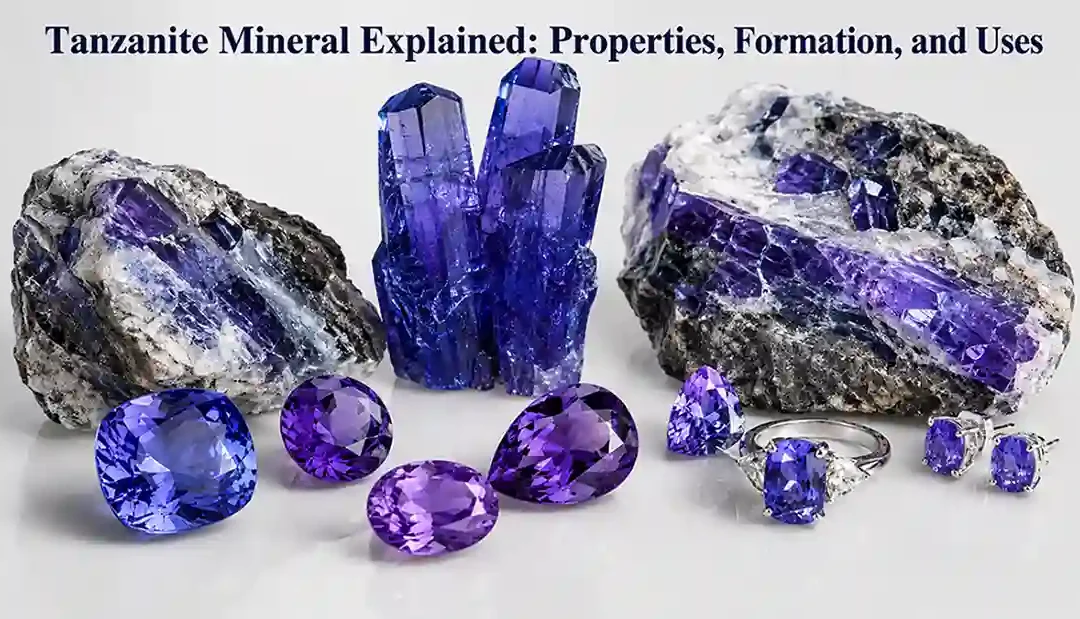
Tanzanite is one of the world's rarest and most valuable gemstones. Known for its striking blue-violet color, tanzanite is found in only one location on Earth—a small mining area in northern Tanzania.
Since its discovery in 1967, tanzanite has become one of the most popular colored gemstones, prized for its beauty, rarity, and unique color-changing properties.
Because of its limited geographic occurrence, many experts consider tanzanite significantly rarer than diamond.
What Is Tanzanite?
Tanzanite is the blue-to-violet gemstone variety of the mineral zoisite.
Its remarkable color results from trace amounts of vanadium within the crystal structure.
Tanzanite is famous for:
- intense blue color
- violet hues
- strong pleochroism
- exceptional rarity
- gemstone quality crystals
Tanzanite Mineral Profile
| Property | Value |
|---|---|
| Mineral Group | Zoisite |
| Chemical Formula | Ca₂Al₃(SiO₄)(Si₂O₇)O(OH) |
| Color | Blue, Violet, Purple |
| Hardness | 6–7 |
| Crystal System | Orthorhombic |
| Luster | Vitreous |
| Streak | White |
| Specific Gravity | 3.1–3.4 |
Discovery of Tanzanite
In 1967, Tanzanite was discovered in Merelani Hills near the city of Arusha. The gemstone was later introduced to the international jewelry market by Tiffany & Co., which named it "Tanzanite" after its country of origin.
The name helped establish the gemstone as a globally recognized luxury gem.
Why Is Tanzanite Blue?
The blue-violet color is caused primarily by:
- vanadium impurities
- crystal structure interactions
- heat treatment effects
Most gem-quality tanzanite is heated to enhance its blue coloration and reduce brownish tones.
Pleochroism in Tanzanite
Tanzanite exhibits strong pleochroism. This means the crystal can display different colors when viewed from different directions.
Common colors include:
- blue
- violet
- purple
- reddish-brown
This optical effect is one reason why tanzanite is highly prized by gem cutters.
Crystal Structure
Tanzanite crystallizes in the Orthorhombic Crystal System.
Characteristics include:
- elongated crystals
- prismatic crystal habit
- well-developed crystal faces
- excellent gemstone transparency
Learn more → orthorhombic-crystal-system
Physical Properties of Tanzanite
Color
Blue to violet.
Hardness
Luster
Vitreous (glass-like).
Transparency
Transparent to translucent.
Cleavage
Perfect cleavage in one direction.
Because of its cleavage, tanzanite must be handled carefully during cutting and jewelry setting.
Formation of Tanzanite
Tanzanite forms through:
Regional Metamorphism
High temperatures and pressures alter existing rocks.
Hydrothermal Activity
Mineral-rich fluids contribute to crystal growth.
Tectonic Processes
East African geological activity created favorable conditions.
The unique combination of these factors is one reason tanzanite occurs in such a limited area.
Where Is Tanzanite Found?
One Location on Earth: Commercial tanzanite is found almost exclusively in the Merelani Hills near Mount Kilimanjaro. This mining district covers only a few square kilometers, making tanzanite one of the most geographically restricted gemstones.
Tanzanite Mining
Most tanzanite is recovered from:
- underground mines
- narrow mineralized zones
- metamorphic host rocks
Mining requires careful extraction to preserve crystal quality.
Tanzanite vs Sapphire
These gemstones are often confused.
| Property | Tanzanite | Sapphire |
|---|---|---|
| Mineral Group | Zoisite | Corundum |
| Hardness | 6–7 | 9 |
| Color | Blue-Violet | Blue |
| Pleochroism | Strong | Moderate |
| Origin | Tanzania Only | Worldwide |
Sapphire is harder, but tanzanite often displays more dramatic color variations.
Tanzanite in Jewelry
Popular jewelry uses include:
- rings
- necklaces
- earrings
- pendants
- luxury gemstone collections
Because tanzanite is softer than sapphire and diamond, protective settings are often recommended.
Factors Affecting Tanzanite Value
Color
Deep vivid blue is most valuable.
Clarity
Fewer inclusions increase value.
Cut
Proper orientation enhances pleochroism.
Carat Weight
Larger stones command premium prices.
Origin
Tanzanian origin is essential.
Why Tanzanite Is Rare
Several factors contribute to its rarity:
- single known commercial source
- limited mining area
- finite reserves
- gemstone-quality material scarcity
Many gemologists consider tanzanite far rarer geographically than diamond.
Tanzanite Identification Summary
| Property | Tanzanite |
|---|---|
| Mineral Name | Zoisite Variety |
| Color | Blue-Violet |
| Hardness | 6–7 |
| Crystal System | Orthorhombic |
| Streak | White |
| Luster | Vitreous |
| Locality | Tanzania |
Tanzanite is the blue-violet gemstone variety of the mineral zoisite.
Tanzanite is found almost exclusively in the Merelani Hills of Tanzania.
Trace amounts of vanadium and heat treatment contribute to its blue-violet coloration.
Geographically, tanzanite is much rarer because it is mined from only one known location.
Tanzanite has a hardness of approximately 6–7 on the Mohs scale.
Final Thoughts
Tanzanite is one of the most remarkable gemstones in the world. Its stunning blue-violet color, strong pleochroism, and exclusive occurrence in Tanzania make it a favorite among collectors, jewelers, and gemstone enthusiasts.
As mining reserves continue to decline and demand remains strong, tanzanite is likely to remain one of the most sought-after colored gemstones in the global jewelry market.