
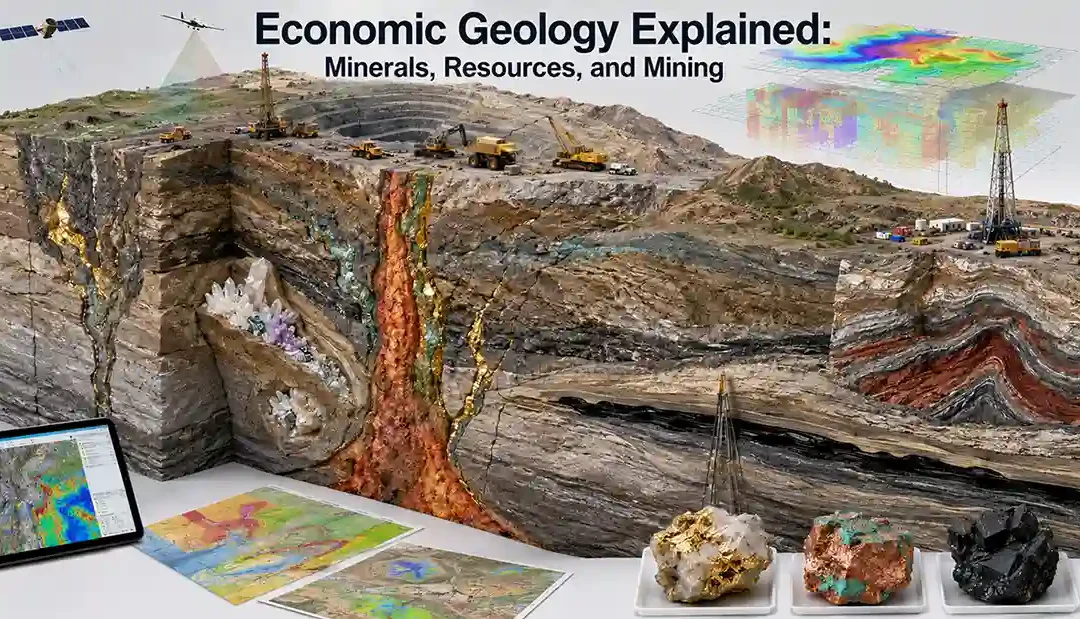
Every smartphone, car, building, solar panel, and power station depends on materials extracted from Earth. Economic geology is the branch of geology that studies how valuable mineral and energy resources form, where they occur, and how they can be discovered and extracted economically.
Economic geology helps answer important questions such as:
- Where are valuable mineral deposits located?
- How did ore deposits form?
- Which resources can be mined profitably?
- How can resources be developed sustainably?
Without economic geology, modern civilization would not have access to the metals, fuels, and industrial minerals needed for daily life.
What Is Economic Geology?
Economic geology is the study of Earth materials that have economic value.
These materials include:
- metallic minerals
- industrial minerals
- fossil fuels
- gemstones
- construction materials
- energy resources
Economic geologists investigate:
- resource formation
- ore deposit geology
- exploration methods
- mining potential
- resource management
What Economic Geology Studies
| Resource Type | Examples |
|---|---|
| Metallic Minerals | Gold, Copper, Iron |
| Industrial Minerals | Gypsum, Halite, Talc |
| Energy Resources | Coal, Oil, Natural Gas |
| Critical Minerals | Lithium, Cobalt, Rare Earths |
| Gemstones | Diamond, Ruby, Emerald |
What Is an Ore Deposit?
An ore deposit is a concentration of valuable minerals that can be mined profitably.
A mineral deposit becomes an ore deposit when:
- valuable minerals are concentrated
- extraction is economically feasible
- market demand exists
- mining technology allows recovery
Not every mineral occurrence qualifies as an ore deposit.
Economic Minerals
Economic minerals are minerals that can be extracted and sold at a profit.
Examples include:
Metallic Minerals
- gold
- copper
- silver
- iron
- nickel
Industrial Minerals
- gypsum
- talc
- fluorite
- phosphate
Critical Minerals
- lithium
- cobalt
- rare earth elements
Learn more → mineral classification system
Major Types of Ore Deposits
Economic geologists classify ore deposits according to how they formed.
Magmatic Deposits
These deposits form directly from cooling magma.
Examples:
- chromite deposits
- platinum group minerals
- nickel sulfides
Common host rocks:
- ultramafic rocks
- mafic intrusions
Hydrothermal Deposits
Hot mineral-rich fluids transport and deposit metals.
Examples:
- gold veins
- copper deposits
- lead-zinc deposits
- silver veins
These are among the world's most important ore deposits.
Sedimentary Deposits
Form through sedimentary processes.
Examples:
- iron formations
- phosphate deposits
- some uranium deposits
Placer Deposits
Heavy minerals accumulate through weathering and erosion.
Examples:
- gold placers
- diamond placers
- cassiterite placers
Metamorphic Deposits
Form during metamorphism.
Examples:
- graphite deposits
- talc deposits
- some gemstone deposits
Major Ore Deposit Types
| Deposit Type | Example Commodity |
|---|---|
| Magmatic | Chromite |
| Hydrothermal | Gold |
| Sedimentary | Iron Ore |
| Placer | Gold |
| Metamorphic | Graphite |
Metallic Mineral Resources
Economic geology focuses heavily on metallic resources.
Important metals include:
Iron
Used in steel production.
Copper
Electrical wiring and electronics.
Gold
Investment and technology.
Aluminum
Transportation and construction.
Nickel
Stainless steel and batteries.
Zinc
Galvanized steel.
Lead
Batteries and shielding.
Critical Minerals
Critical minerals are essential for modern technology and national security.
Examples include:
- lithium
- cobalt
- rare earth elements
- graphite
- nickel
These minerals are crucial for:
- electric vehicles
- wind turbines
- solar energy
- battery storage
Learn more → lithium minerals explained
Energy Resources in Economic Geology
Economic geology also studies:
Coal
Fossil fuel deposits.
Petroleum
Oil reservoirs.
Natural Gas
Hydrocarbon accumulations.
Uranium
Nuclear energy fuel.
Geothermal Resources
Heat from Earth's interior.
Mineral Exploration
Before mining begins, geologists must locate deposits.
Common exploration methods include:
Geological Mapping
Studying rock distributions.
Geochemical Surveys
Analyzing soil and rock chemistry.
Geophysical Surveys
Detecting hidden deposits.
Drilling
Testing underground resources.
Economic Geology and Mining
Economic geology provides the scientific foundation for:
- mineral exploration
- resource evaluation
- mine planning
- extraction methods
Without geological knowledge, mining would be far less efficient and much riskier.
Resource Evaluation
Geologists estimate:
Ore Grade
Amount of valuable material.
Tonnage
Size of the deposit.
Economic Value
Potential profitability.
Mining Feasibility
Whether extraction is practical.
Why Economic Geology Matters
Economic geology supports:
- infrastructure development
- renewable energy
- technological innovation
- national economies
- sustainable resource management
Modern society depends on the resources studied by economic geologists.
Importance of Economic Geology
| Sector | Importance |
|---|---|
| Construction | Metals and aggregates |
| Technology | Electronics minerals |
| Energy | Coal, uranium, lithium |
| Transportation | Steel and aluminum |
| Manufacturing | Industrial minerals |
Economic geology is the study of minerals, rocks, and energy resources that have economic value and can be extracted profitably.
An ore deposit is a concentration of valuable minerals that can be mined economically.
Economic geology provides the resources needed for technology, construction, transportation, and energy production.
Economic geologists study metallic minerals, industrial minerals, fossil fuels, gemstones, and critical minerals.
A mineral deposit is any concentration of minerals, while an ore deposit contains enough valuable material to be mined profitably.
Final Thoughts
Economic geology is one of the most important branches of geology because it connects Earth's natural resources with human needs. From gold and copper to lithium and rare earth elements, economic geologists help discover, evaluate, and manage the resources that power modern civilization.
As demand for critical minerals, renewable energy technologies, and sustainable resource development continues to grow, economic geology will play an increasingly important role in shaping the future of society.